
Daily insights for city builders, delivered every morning at 6 AM ET. I’m Brandon Donnelly — a Toronto-based real estate developer and founder of Globizen. I’ve been writing here since 2013.

Tag: government

  • Building a new city in Colombia

    This month’s issue of Monocle Magazine has a feature on a new masterplanned community to the north of Cartagena called Serena del Mar. Currently under construction, the entire 971 hectare community is slated to be finished by 2030. When complete the developers believe it will house upwards of 200,000 people — effectively an entirely new city.

    It will also be entirely self-governing. There will be no mayor or city council. Revenue to operate the community will be collected through a mandatory monthly fee, though low-income residents will be exempt from paying it. As I understand it, large projects in Colombia have historically been mired in corruption issues, and so this is probably a response to that.

    But the approach has naturally caused a bunch of skepticism. Does this bifurcate the city between public and private? Is this a vote of no confidence on Cartagena’s current governance structures? Building a city from scratch is also exceptionally difficult (there’s a quote in Monocle from Toronto’s own Shawn Micallef on this). Cities usually take time to evolve and settle in.

    I don’t know enough (or anything, really) about Colombia, Cartagena, and this development project to comment specifically. And so I won’t. But these are the questions that are being asked of contemporary masterplans. There’s a reason most (or all) of the tech companies involved in large scale masterplans have banned the word “campus” from their lexicons.
  • A Spanish social media town

    I am a big fan of Twitter.

    I use it more than any other social network and any other app on my phone (according to my battery usage). In fact, I’m such a fan that I recently started buying shares. I don’t own a lot and the Canadian-US exchange is awful right now, but I do plan to continue buying (I like dollar cost averaging).

    Twitter isn’t the darling of Wall Street like Facebook is. And I think the biggest weakness of Twitter is that it’s difficult for new users to really “get it.” Facebook solved this problem early on by recognizing that new users had to connect with X number of friends right away so that they received value immediately and the next time they visited.

    But I digress. That’s not the focus of this post.

    This morning a friend shared a Medium article with me that was written by the Laboratory for Social Machines at MIT. The article is about a small town in Spain called Jun (pronounced “hoon”) that has transitioned to using Twitter as the dominant platform for communication between government and citizens.

    The initiative first launched in 2011 and since then the mayor, José Antonio Rodríguez Salas, has been trying to get every resident onto Twitter. All 3,500 residents are even encouraged to go into the town hall to have their Twitter accounts verified. This way government employees know for sure that they’re dealing with an actual resident of the town.

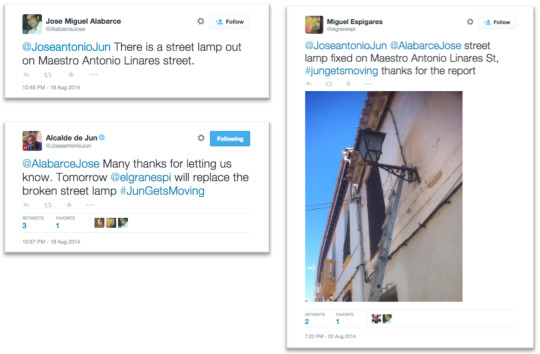
    Here’s a simple example of what this means for government-citizen relations (the folks at MIT translated everything to English):

    image

    In the above example, a citizen tweeted the mayor informing him that a street lamp was out. The mayor then responded, tagged an electrician, and said it would be fixed the following day. Sure enough the electrician went and fixed it the following day, and then tweeted out a photo of the lamp.

    This is great. And Twitter was made for these kinds of interactions. Facebook was not.

    Here in Toronto we have @311Toronto, which I have tweeted many times before with problems and they do respond quickly (far quicker than if you try and call them). But I still think there’s room for us to improve transparency and engagement across the board.

    All of this is a perfect example of how technology and cities are colliding in a big way. In today’s world I really think you need to be able to think across disciplines.

  • Disrupting everything

    Last year when I started working on Dirt—which was really my first startup—I had a number of people say things to me like: “Wow, that’s quite a change, going from real estate into tech.” But that’s not the way I saw and see it.

    I don’t think you can silo industries like that anymore. Technology is touching everything. Some would even go so far as to say that every company in the world is, or will be, a software and technology company.

    The way I looked at it was that I was starting a technology-enabled real estate company. I was hoping to leverage the internet to improve the way things are done in an existing industry. Of course, by improve I really mean disrupt—which is arguably the biggest buzzword in the tech community today:

    “Disruption is not so much a trend as an especially lucrative world philosophy favored by technophilic entrepreneurs. It’s the only path towards progress. If you’re not disrupting something you might as well go collect kindling and roast raccoon meat in the hills of Cupertino.”

    A good example of how disruptive innovation is reaching all sectors of the economy, including government, is the New Haven-based startup called SeeClickFix (which I discovered via This Big City). What it does is allow citizens to report non-emergencies (like potholes) to their local government. Governments can then respond and manage these tasks. (Sorry Rob Ford. Now you don’t need to return all those phone calls.)

    But moreover, I think it shows that technology is not only going to disrupt business and industry, it’s going to disrupt the way cities function and the way we live. I don’t know what that’s ultimately going to look like, but I can already feel it underway.

    Albert Wenger, of venture capital firm Union Square Ventures, recently argued—in a talk at DLD—that we are still in the midst of a transition from the Industrial Age to the Information Age. And I buy that. With every new disruption, we’re one step closer to completely making that transition. But we’re not quite there yet.

    The Industrial Age drove people out of cities. It made cities dirty and undesirable. But in the Information Age, cities are damn important and it’s where people want to be. Look at all the people rushing back to urban centers.

    So if technology has the power to disrupt business, industry, and cities, I suggest we stop just thinking about technology in isolation and remember the powerful words of Marshall McLuhan: “The medium is the message.” Don’t just focus on the obvious or you’ll miss a tidal wave of change happening beneath the surface.