Daily insights for city builders, delivered every morning at 6 AM ET. I’m Brandon Donnelly — a Toronto-based real estate developer and founder of Globizen. I’ve been writing here since 2013.

Tag: globalization

  • The fast-foodification of cities

    Greg Isenberg recently wrote about what he refers to as the fast-foodification of everything — including cities. His arguments are that (1) we have reached peak sameness (Toronto is largely indistinguishable from, say, Sydney) and (2) the best brands and companies going forward will be local, unique, and community-driven.

    I don’t know how to assess whether we have reached peak sameness, but I do know that, whatever we are experiencing right now, is at a minimum 100 years in the making. The International Style (of architecture), which emerged after WWI, is exactly what the name suggests. The intent was to fashion an approach to architecture that worked anywhere in the world. Location, climate, and context were all irrelevant.

    This approach has been widely criticized for the reasons you might expect and for the reasons that Isenberg outlines in his post. But sameness is not exclusively the result of European architects who wanted to eschew ornament and local flourishes. As the world continues to globalize and become “smaller”, there is an inevitability to this growing and continued sameness. Business wants economies of scale.

    But there is no question that, more than ever, people are craving unique and local experiences and places. And if you can create that in our globalized world, you are going to win.
  • How large metro areas are driving the global economy

    “The concentration of economic growth and prosperity in large metro areas defines the modern global economy, creating both opportunities and challenges in an era in which national political, economic, and societal trends are increasingly influenced by subnational dynamics.” -Brookings Institute

    The Metropolitan Policy Program at the Brookings Institute has a new report out for 2018 called the Global Metro Monitor.

    Here are some of the highlights (data is from 2014 to 2016):

    – The 300 largest metro areas in the world accounted for 36% of employment growth and 67% of GDP growth.

    – Metro areas in China and the Asia-Pacific region outperformed, whereas Latin American cities, and in particular the largest Brazilian cities, were weaker performers.

    – The majority of large metro areas had growth rates that exceeded that of their respective regions. So again, cities are the driver.

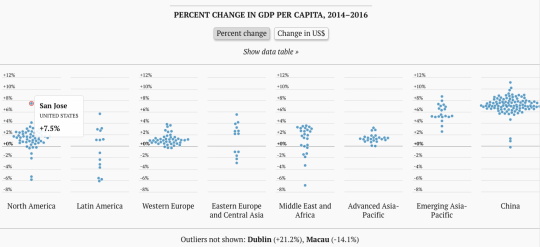
    And here is an interesting interactive chart (better to click through) that shows the % change in GDP per capita. 

    image

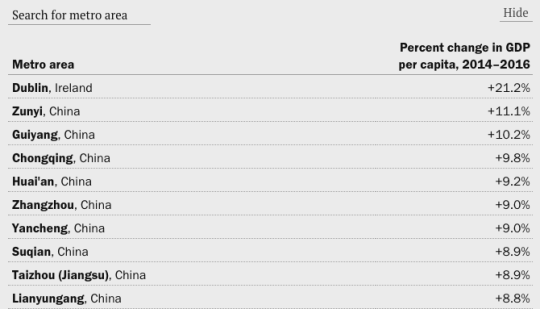
    Look at how much of an outlier San Jose is. Though, check out Dublin in the footnote. And if you look at the actual data table, it is all China, except for Dublin at the top.

    image

    For the rest of the charts, click here. And to download the full Global Metro Monitor report, click here.

  • 3D printing and de-globalization

    This evening I stumbled upon an interesting article by T.X. Hammes talking about “de-globalization” and the impacts that this may have on international security. (He served 30 years in the US Marine Corps.)

    One of his points is that 3D printing (additive manufacturing) is going to transform not only how things are made, but also where things are made. This is perhaps an obvious point, but it’s valuable to think about what all of this will mean when production moves from global to local.

    Here’s an excerpt from the article:

    “Currently we ship raw materials to one country. It puts together the sub-assemblies, packs them, and ships them to another country for assembly. There they complete the assembly and packaging, then ship the packaged product onward to the consuming country. With the emergence of additive manufacturing, we will ship smaller quantities of raw materials to a point near the consumer, produce them, and then ship them short distances for consumption. Thus reducing international trade. The localization of energy production and return of high value agriculture to developed nations will further reduce global trade.”

    Indeed, UPS seems to be predicting that the international shipping market will be significantly impacted by these shifts and has started investing in 3D printing. But going even further, T.X. Hammes believes that declining trade could dramatically alter the international security picture.

    To me, it’s yet another reminder of what Marshall McLuhan was getting at when he argued: “The medium is the message.” Don’t stop at the obvious changes. Look for deeper structural changes. Look for the unanticipated.

  • Prime property appreciation around the world

    Every year for the last decade, Knight Frank has published something called The Wealth Report. I’ve written about it before, but it’s basically a look at “prime property” and global wealth.

    As part of the report, they have something called the PIRI 100. It’s their “Prime International Residential Index”, which looks at luxury residential property prices around the world. They generally define “prime property” as being the top 5% of each market according to value.

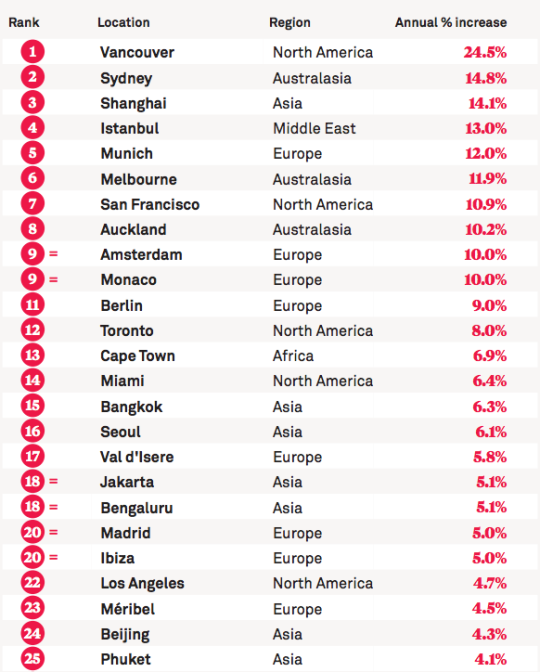
    This year, the top 25 locations in their PIRI 100 are as follows (for the most part, the data is up to December 2015):

    image

    Here in Canada, we like to talk about the insanity of the Vancouver and Toronto real estate markets. This list helps to put that into perspective. Even by global standards, Vancouver is at the top of the pack by quite a significant margin. 

    It’s worth noting that since this is a “prime property” index, it’s pretty safe to assume that the buyer profiles for these sorts of properties would have a significant international bias. So in a way, this list is really about global capital flows.

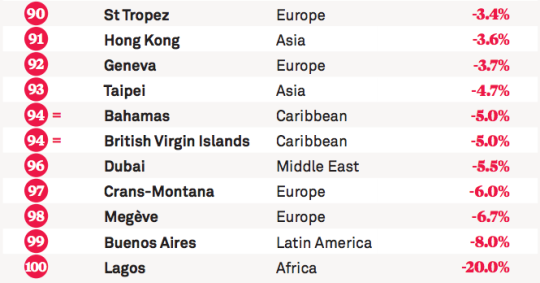
    Here are the bottom 10 locations on this year’s list:

    image

    If you’d like to see the full list, click here.

  • America needs a new map

    image

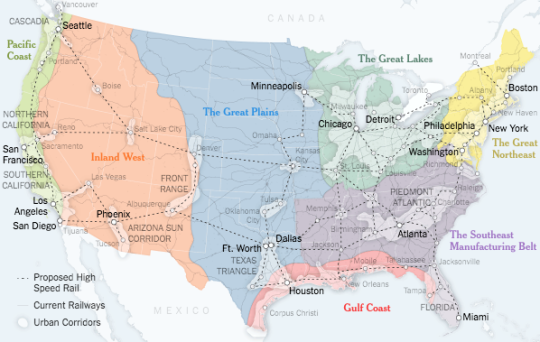
    Parag Khanna recently published an article in the New York Times calling for a new map for America

    Here’s why:

    “The problem is that while the economic reality goes one way, the 50-state model means that federal and state resources are concentrated in a state capital — often a small, isolated city itself — and allocated with little sense of the larger whole. Not only does this keep back our largest cities, but smaller American cities are increasingly cut off from the national agenda, destined to become low-cost immigrant and retirement colonies, or simply to be abandoned.”

    This is something that I’ve been writing about for awhile on this blog. As we continue to transition to an urban-based information economy, it strikes me that, here in North America, we’re going to need to refocus our governance structures around cities. We’re going to need to place our metropolitan regions at the fore if we want to continue competing with rising powers like China – which, by the way, seem to be adopting a megacity model.

    Here’s another snippet from the article:

    “While Detroit’s population has fallen below a million, the Detroit-Windsor region is the largest United States-Canada cross-border area, with nearly six million people (and one of the largest border populations in the world).

    Detroit’s destiny seems almost obvious if we are brave enough to build it: a midpoint of the Chicago-Toronto corridor in an emerging North American Union.”

    I’ve argued for this before and I continue to believe that it makes a lot of sense.

    Image: New York Times

  • Doing new things

    image

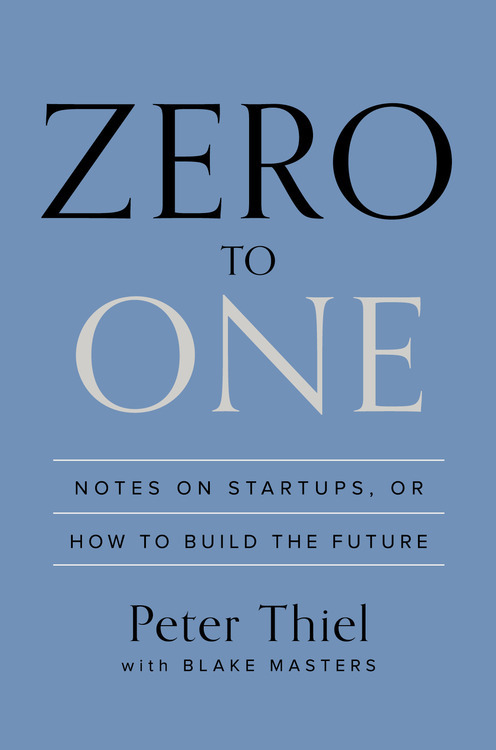
    I just finished reading Peter Thiel’s new book, Zero to One: Notes on Startups, or How to Build the Future. For those of you who may not be well-versed in the world of technology geeks, Peter Thiel is an entrepreneur and investor. He was one of the founders of PayPal back in 1998 and was the first outside investor in Facebook in 2004. He invested $500,000 for a 10.2% stake in the company!

    While the focus of the book is obviously on technology startups, it’s less about “here’s how you build a startup” (there is no formula) and more about “here’s how to think about the world, humanity, and the future of our civilization.” So even if you’re not a founder, or startup and technology enthusiast, I think you’d still find it really interesting.

    As one example, Thiel makes the distinction early on in the book between what he calls “vertical or intensive progress” and “horizontal or extensive progress.” The specific example he gives is of typewriters and word processors. If you take one typewriter and figure out how to make 100 of them, you’ve made horizontal progress. However, if you’ve just replaced typewriters with word processors, you’ve made vertical progress.

    In other words, vertical progress is doing new things and horizontal progress is just copying things that we know already work. In the grand scheme of the world, he argues that globalization is really just a form of horizontal progress. The rise of China is a result of them copying what has already worked in developed countries. But the true way to advance our economy and civilization is to not just copy – that’s easy – it’s to do, new, things.

    That, of course, is a lot harder to do. But to build the future, you need to build things and do things that haven’t been done before.

    Which is why Thiel actually gives $100,000 to a handful of college students every year so that they can drop-out and pursue a startup. In his mind, our education system is just perpetuating the status quo. MBAs move money around without creating anything new. Lawyers just preserve value and mitigate risk, also without creating anything new (Thiel is trained as a lawyer). And so he doesn’t believe that is the best way forward.

    This may not sit right with many of you, but questioning the status quo is a prerequisite if you’re trying to do new things.

  • Capital of the world

    If you had to pick one, which city would you consider to be the “capital of the world?” There are no other instructions. Just select whatever first comes to mind. If for whatever reason you can’t see the poll below, click here.

    If you’re curious about where the above list of cities came from, they’re simply all of the Alpha++, Alpha+ and Alpha cities according to the Globalization and World Cities Research Network (GaWC). The list may be a few years old though.

  • Globalization and new technologies have increased the returns to being smart.

    Ed Glaeser