Daily insights for city builders, delivered every morning at 6 AM ET. I’m Brandon Donnelly — a Toronto-based real estate developer and founder of Globizen. I’ve been writing here since 2013.

Tag: global

  • Visualizing the origins of MIT’s international students

    “Like the United States, and thanks to the United States, MIT gains tremendous strength by being a magnet for talent from around the world. Faculty, students, post-docs and staff from 134 other nations join us here because they love our mission, our values and our community.” -L.Rafael Reif, MIT President

    The MIT Senseable City Lab recently analyzed nearly 20 years of ethnographic student data in order to visualize the origins of its international faculty, students, and researchers from 1999 to the present.
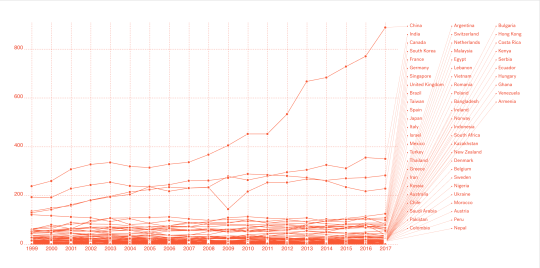
    The above chart may be a bit small (larger version here), but it shows all students (undergraduate, graduate, and visiting/others) by country. The top 5 countries are China, India, Canada, South Korea, and France.

    To give you some sense of the math, there are 3,808 international students at MIT as of 2017. 888 of them alone are from China – mostly at the graduate level (688 out of the 888). So China represents almost ¼ of MIT’s international student population.

    Another thing that stood out for me was the drop off in Canadians in 2009. You can see that “V” roughly in the middle of the chart. Canada went from 233 to 144 students. I wonder if this had something to do with the economic climate at the time. Not sure.

    Click here to see all of the visualizations. 

    Note that you can toggle by region and country, as well as by “Trump’s EO Countries.” That feature, as well as the quote at the beginning of this post, should give you an immediate appreciation for some of the motivations behind this exercise.

    Images: MIT Senseable City Lab
  • Mapping of global migration

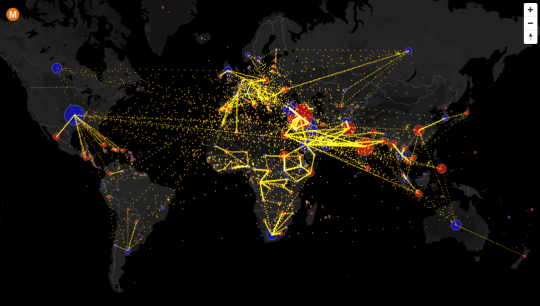
    Max Galka has created an incredible visualization of country-to-country net migration (from 2010 to 2015) on his blog, Metrocosm.

    Here’s a screenshot:

    image

    But you really need to view the full screen interactive version

    In that version, you can hover over a country to see the total net migration number (+/-) and you can click on a country to see where people are moving to and from. A blue circle indicates positive net migration (greater inflows) and a red circle indicates negative net migration (greater outflows).

    All of the data is from the United Nations Population Division. And though the numbers are estimates, it’s a fascinating look at global migration. For instance, look at the outflow from Syria.

    It would also be interesting to see these numbers on a per capita basis because some countries certainly punch above or below their weight in terms of migration. Off the top of my head, I’m thinking of Canada and Australia vis-à-vis the US.

  • The local vs. global city

    Blogger and Senior Fellow at the Manhattan Institute for Policy Research, Aaron M. Renn, recently published an interesting long-form article called, Rethinking America’s Cities’ Success Strategy.

    One of the central themes is the idea that globalization has caused a kind of bifurcation in cities – a disconnect between the local and the global. In an effort to compete with other global cities around the world, we have begun to turn our back on local concerns. At the same time, not every city has the market power of, say, New York or London.

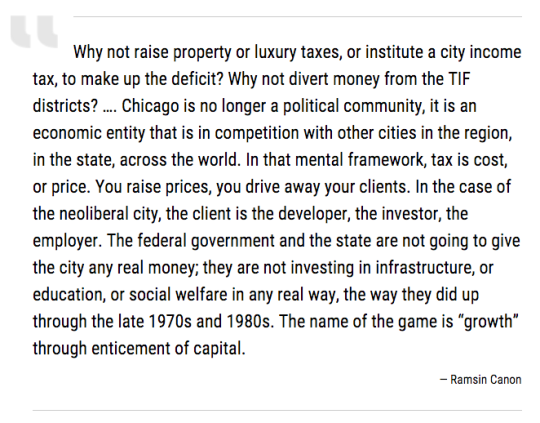
    So what does this mean for cities? Here’s a quote from the article that I think does a good job explaining the mental model:

    At the end of the article, Aaron makes a number of recommendations for how to better think about local entrepreneurship and economic growth. The first one is as follows:

    “Local civic priorities should favor building a successful and inclusive local economy, including entrepreneurship, over global concerns and real estate development.”

    Despite this being seemingly contradictory to do what I do for a living, I think it’s important to note that on a fundamental level, architects and developers simply create space. 

    It might be a beautiful space. A space that improves well-being, creates value, and enables certain activities. But at the end of the day, there needs to be demand for that space. And a robust local economy is paramount to that equation. So I agree that we shouldn’t forget about local and expect that “if we build it, they will come.”

    If you have the time, the full article is worth a read. It’s also part of a broader series on entrepreneurship and cities, so there are a bunch of other related articles on the same page.

  • Fun Friday: ATC subscriber map

    When I was very young I went a Montessori school here in
    Toronto. If you’re not familiar with Montessori education, it’s basically a
    very open ended and independent form of learning. Students choose
    what they want to do.

    Because of this, many have argued that a Montessori
    education is actually great training to be an entrepreneur
    . Instead of being
    told what to do, you as a student need to figure it out on your own. See the
    parallel? Both Google founders went to Montessori school.

    When I was there (< grade 4), my absolute favorite thing
    to do was draw maps. I remember them having these large scale maps of the world where you could
    physically remove each country so that you could then trace it and create your
    own maps. I spent a lot of time doing exactly that.

    To this day, I still really love maps. And I remember many
    of my friends in architecture school being the same way. So perhaps it comes
    with the territory.

    In any case, I recently started playing around with a product
    called cartoDB. And one of the things you can easily do with it is connect it
    to Mailchimp (the service that manages the ATC email newsletter) and anonymously
    map the location of each subscriber. I couldn’t resist giving it a try.

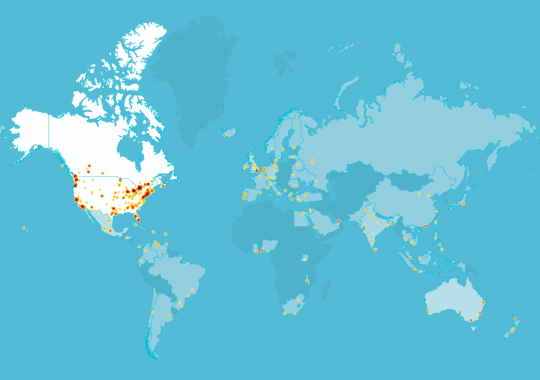
    Below is what that looks like. Not surprisingly, the highest
    concentrations of subscribers to this blog are in Canada and the US.

    image

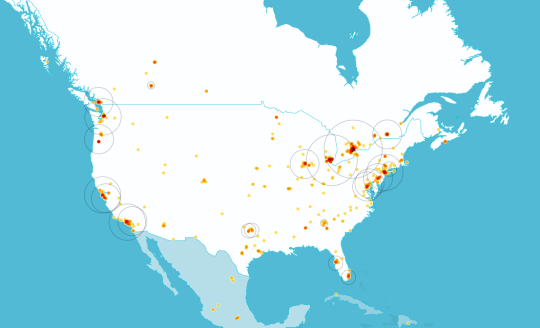
    So here’s a zoomed in version:

    image

    I’ve been trying to branch out from talking about Toronto
    all the time. And that seems to be working somewhat. But I could still do a better
    job of creating more global content. I’ll try harder.