Daily insights for city builders, delivered every morning at 6 AM ET. I’m Brandon Donnelly — a Toronto-based real estate developer and founder of Globizen. I’ve been writing here since 2013.

Tag: global city

  • Hong Kong GDP as a % of mainland China GDP

    I was talking about this with my friend Evgeny Tchebotarev last night:

    The transfer of sovereignty over Hong Kong (also known as the handover) happened at midnight on July 1, 1997. At the time, Hong Kong had a population of about 6.5 million people and China had a population of about 1.23 billion people. But Hong Kong punched well above its weight class and its GDP as a percentage of mainland China’s GDP was about 18.4% (see above). In other words, Hong Kong represented about 0.53% of the population, but almost 1/5 of China’s economic output. Today, well as of 2018, this number has declined to 2.7% (again, see above). Hong Kong still possesses a number of structural benefits compared to mainland China, but its position as a global financial center is not guaranteed.

    Graph: Investopedia

  • Miami in the 21st century

    I started reading a new book this weekend called, The Global Edge: Miami in the Twenty-First Century.

    When many (or perhaps most) people think of Miami/Miami Beach, they think of its beaches and resorts. And that is certainly a mainstay of the region’s offering. But over the past few decades, Miami has also emerged as an important global city (albeit at a more regional scale) and as a center for art and culture. Miami has the second largest concentration of international banks in the United States after New York, which begins to speak to the region’s importance for Latin America.

    New York City is what it is today because it was the port of entry for new immigrants coming to the United States. This same phenomenon is what reshaped the Miami economy, starting first with Cuban exiles. Today, the city remains a refuge for Latin Americans searching for greater political and economic stability. As my friend from Miami likes to tell me, “the best thing about Miami is that it’s so close to the United States.”

    I’m enjoying this book and I bet some of you will as well.

  • Toronto: 2000 vs. 2025

    Last week, Joe Berridge, Partner at Urban Strategies, gave a presentation at the Institute on Municipal Finance & Governance titled, Toronto: The Accidental Metropolis. I’ve seen Joe give similar presentations to this one before, and I always thoroughly enjoy his focus on Toronto’s position as a global city.

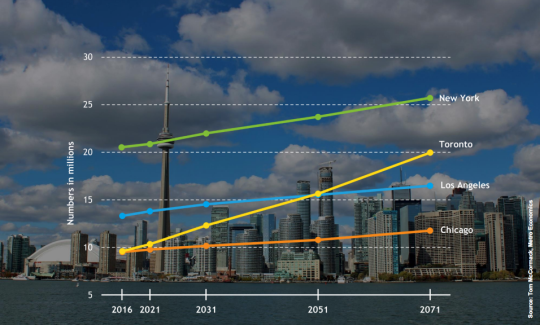
    Here is a slide from the presentation that projects out Toronto’s population to 2071 and compares it to the largest cities in the US.

    image

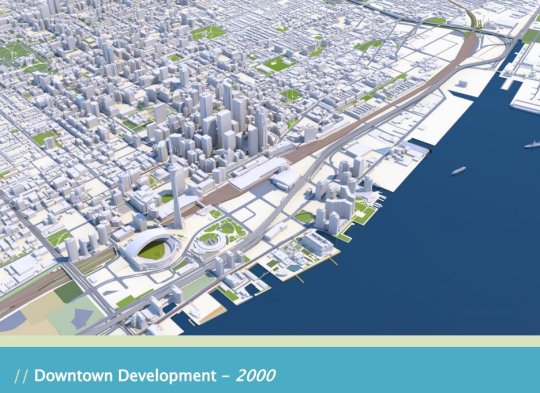
    But the two slides that have been really making the rounds online are the following ones. The first is a rendering of what downtown Toronto looked like in 2000. 

    image

    I remember this time clearly. Queen West seemed to end at Spadina. King West and Ossington weren’t things. And “Richmond and Adelaide” felt like the greatest club district in the world. (If you’re not from Toronto, these references will likely mean nothing to you. Sorry.)

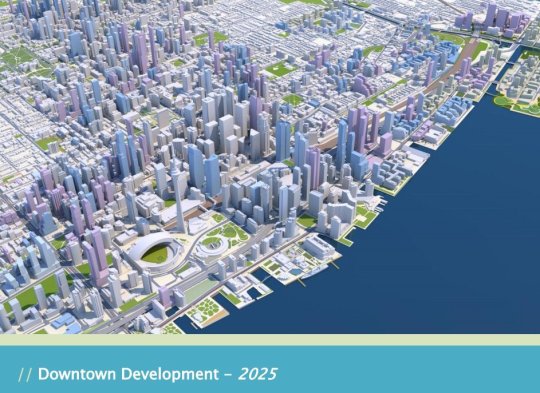
    The second slide is a rendering of what Toronto will look like in 2025. The transformation is just incredible.

    image

    I’ve seen some people comment that the Toronto of 2000 was relatively affordable; the Toronto of 2018 is unaffordable; and the Toronto of 2025 will be even more unaffordable with all of this new development.

    But I don’t understand that logic. Considering the growth rate shown in the first slide, imagine how unaffordable this city would be if we weren’t building new places for people to live and new places for people to work.

    For the full slide deck, go here. And for recent aerial photos of Toronto’s downtown core, check out my Instagram page.

  • Price of 432 square feet in Hong Kong and the future of the region

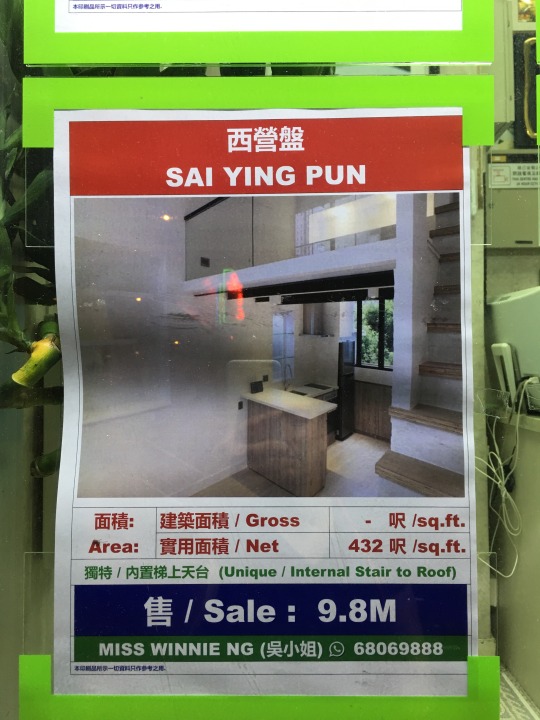
    I came across this Hong Kong apartment listing earlier in the week. Sai Ying Pun is the neighborhood.

    image

    HK$9.8 million = C$1,554,833 based on today’s exchange rate (1 CAD = 6.30293 HKD).

    At 432 square feet (net), that’s C$3,599 psf. But I have also been told that new buildings here could easily fetch C$5,000 psf and probably much more.

    There’s certainly a tremendous amount of wealth in Hong Kong. However, the topic of discussion right now is the new money being generated in mainland China.

    I am curious what all of this could mean for Hong Kong, it’s place within the PRC, and for real estate long-term.

    Hong Kong’s Basic Law stipulates that the region shall maintain a capitalist system and that its current way of life shall be preserved outside of the PRC. 

    But that constitutional document is set to expire in 2047 – fifty years after the handover from the British. And one would assume that China would favor more, rather than less, integration. 

    Already the Cantonese language – the official language of HK along with English – seems to be getting diluted in favor of the “speech of the officials.”

    So what will Hong Kong look like by the middle of the 21st century? Will it simply become a “second city” to Beijing and Shanghai?

    Place your bets in the comments below. Or call Miss Winnie.

  • Houston, the global city

    Houston doesn’t often get a lot of love in urbanist circles.

    Though since Ed Glaeser published Triumph of the City and declared Houston’s unfettered sprawl the secret sauce for housing affordability, it is now frequently held up as the shining example of why housing supply matters.

    But this is a hotly debated topic. 

    Ed Glaeser would argue that increased supply is the key to housing affordability. But Richard Florida would likely be quick to point out that Houston is also one of the most unequal and segregated cities in America. It is not the model we should be following.

    But let’s be positive today on the blog.

    At the bottom of this post is a great talk by Stephen Klineberg called: Houston, The Global City. Klineberg is a Professor of Sociology at Rice University and the founder of the Kinder Institute for Urban Research.

    In this hour long talk, he outlines, among other things, the remarkable transformation of Houston from a one-industry town (oil) comprised predominantly of white people to a mixed economy where every major ethnicity is now a minority.

    He also argues that Houston is at the forefront of the demographic shifts happening all across the country and that, without this inflow of immigrants over the past couple of decades, Houston today would probably look a lot like a decaying rustbelt city.

    It’s a good watch.

    If you can’t see the video below, click here.

    [youtube https://www.youtube.com/watch?v=SJdWYXIr_qE?rel=0&w=560&h=315]

  • Big, bold, and global

    I love the way that urban planner Joe Berridge thinks about Toronto and city building. He is constantly considering our position on the global stage and urging us to fight for a top position by executing on real and meaningful projects. 

    Here is a recent article from the Toronto Star which lists some of those projects. They include everything from a new convention center to creating a fourth university (in addition to the University of Toronto, York, and Ryerson).

    Here’s a snippet:

    We could get “lost in domesticity — very nice, but that’s not enough,” he says, drawing on his experience leading urban renewal projects around the world.

    Toronto’s social cohesion is enough to attract 125,000 new people each year to the region. But they won’t stay if we can’t employ them and provide opportunities. And that requires global thinking.

    Berridge says it is the city’s “moral obligation” to use its taxing power, its wealth, its status as Canada’s only global city and the historical advantages of public education, public health and public services to propel Toronto into super city status.

    Cities will often talk in nebulous terms about being “world class.” That isn’t all that helpful. Let’s be specific and also acknowledge that great things cost money. Are we a top tourist destination? Are we a top convention destination? Are we attracting the smartest people in the world with the best schools? Do we have the best transit and health care systems in the world?

    Toronto is a great city and so it’s perhaps easy to become complacent. But past performance is not an indicator of future outcomes. We need to think in global terms. We need to keep in mind that this is an international competition. And every day all of us step onto that field.

    Thank you Joe for constantly reminding us of that.

  • Journeys by walking

    Arup, the global consulting firm, has an interesting publication out called Cities Alive: Towards a walking world. The report highlights 50 benefits of walking and then 40 actions that city leaders can take today to transform their cities. The entire study was informed by examining 80 international case studies.

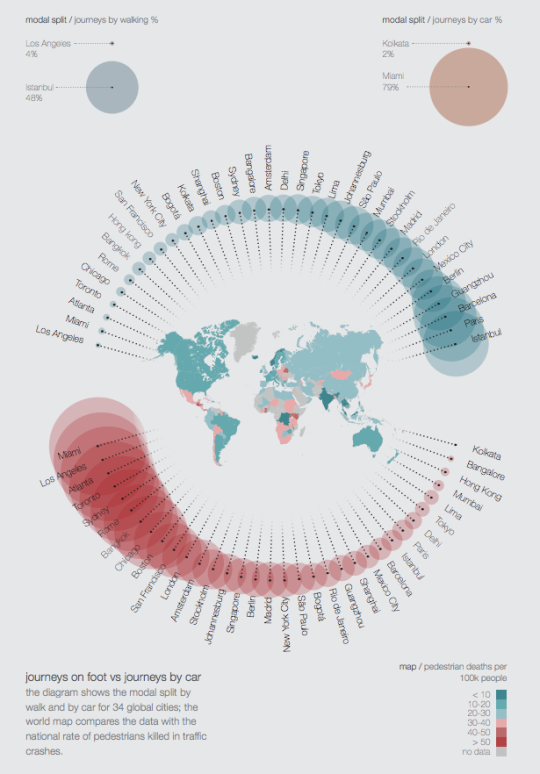
    As I was going through the report, the following diagram caught my attention. It compares journeys on foot vs. journeys by car for a collection of global cities.

    The turquoise circles represent % of journeys by walking. On the left is Los Angeles at 4%. And on the right is Istanbul at 48%.

    The red circles represent % of journeys by car. On the left is Miami at 79% (with Los Angeles right beside it). And on the right is Kolkata at 2%.

    The map in the middle of the circles represents pedestrians killed in traffic crashes per 100,000 people.

    I’m not sure where the data was drawn from, but it’s not all that surprising to see a few North American cities clustered towards the left (less walking; more driving). Still, I wonder how “journey” is defined.

    To view the full report, click here. Arup also produces a lot of other great content that you can download for free, here.

  • Is Toronto a world-class city?

    image

    Earlier this week I was on a panel discussion called Building Toronto Tomorrow. One of the questions was about whether or not Toronto is world-class city. It elicited a good discussion, so I thought I would talk about that today on the blog.

    Shamez Virani, President of CentreCourt Developments, responded by saying that he thinks Toronto is the greatest city in the world and that he wishes more people would just accept how incredible this city is. I agreed with him.

    I also responded by saying that I hate this question. I think it reeks of insecurity and I think it’s a bit of a red herring. It distracts from more direct and meaningful questions – questions such as our livability and our position as a global city.

    Because the reality is that Toronto is one of the most livable cities in the world and, in my view, we are the only true global city in Canada. We are an important node in the global economy for the flow of goods, people (we’re particularly good at this), capital, and now information. There’s a lot to be proud of.

    But that’s not to say that we’re perfect. Everyone knows we need better transit. And to name a few others (non-exhaustive list), I also think we need to:

    • Get a move on road pricing.
    • Loosen up our archaic alcohol laws and start using nightlife as a competitive advantage for attracting talent.
    • Acknowledge through our governance structures that cities are what drive today’s information economy.
    • Stop thinking about the Canadian/Toronto value proposition as being about cost savings. That is, buy this from us because our currency is weaker than yours. This is anti-innovation and there are much better ways to create sustainable value. (Innovation is still a weak spot.)
    • Focus on developing an information economy that leverages the unique talent and knowledge base of Toronto. For example, I think we’re in a great position for real estate + tech innovation.
    • Do everything we can to encourage big tech IPOs in this city. They are critical to developing the ecosystem.

    There’s a saying in Silicon Valley that you “make what you measure.” It means that whatever you decide to focus your attention on, is invariably what you end up making – regardless of whether or not you happen to be focusing on the right metric.

    In the context of Toronto, I think we’d be better served if we focused on and quantified our position in the global economy, as opposed to chasing some idea of “world-class.” The latter will grow as the former grows.

    I also think that this needs to be balanced against our livability. Sometimes there’s a tension. But there are cities – the best example is perhaps Tokyo – who have managed to pair a high quality of life with one of the strongest positions in the global economy.

    Is there anything else you think we should be doing? We can talk about it in the comments below.

    Image: Building T.O Toronto (BuzzBuzzHome Event)

  • The local vs. global city

    Blogger and Senior Fellow at the Manhattan Institute for Policy Research, Aaron M. Renn, recently published an interesting long-form article called, Rethinking America’s Cities’ Success Strategy.

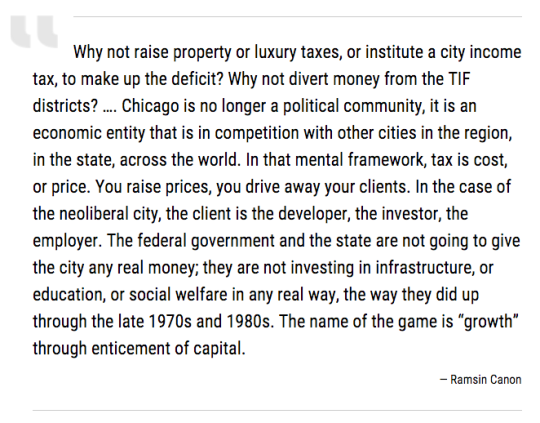
    One of the central themes is the idea that globalization has caused a kind of bifurcation in cities – a disconnect between the local and the global. In an effort to compete with other global cities around the world, we have begun to turn our back on local concerns. At the same time, not every city has the market power of, say, New York or London.

    So what does this mean for cities? Here’s a quote from the article that I think does a good job explaining the mental model:

    At the end of the article, Aaron makes a number of recommendations for how to better think about local entrepreneurship and economic growth. The first one is as follows:

    “Local civic priorities should favor building a successful and inclusive local economy, including entrepreneurship, over global concerns and real estate development.”

    Despite this being seemingly contradictory to do what I do for a living, I think it’s important to note that on a fundamental level, architects and developers simply create space. 

    It might be a beautiful space. A space that improves well-being, creates value, and enables certain activities. But at the end of the day, there needs to be demand for that space. And a robust local economy is paramount to that equation. So I agree that we shouldn’t forget about local and expect that “if we build it, they will come.”

    If you have the time, the full article is worth a read. It’s also part of a broader series on entrepreneurship and cities, so there are a bunch of other related articles on the same page.

  • 10 city building predictions for 2016

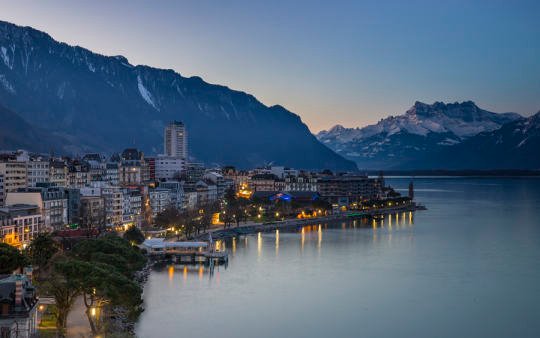
    Dawn by Adrian Popan on 500px.com

    https://500px.com/embed.js

    Few things are better than waking up in the mountains and seeing a notification on your phone that 9″ of fresh snow have fallen overnight, bringing the 48 hour snowfall total to 16″.

    This is what people in mountain towns live for. They ski in the morning and then head to work in the afternoon. I heard a number of people on the mountain today saying that they, “want to be in the office after lunch.” It’s a lifestyle thing.

    On that note, today I’d like to focus on 10 city building predictions for 2016. I’ve been assembling this list over the past few weeks and now that I have had my fill of Utah powder for the day, I’m dedicating the rest of the afternoon to writing.

    These are never easy to put together. But here are my thoughts:

    1. We will see increased migration to secondary cities – outside of the alpha global cities – which offer a higher quality of life, more affordable housing, and the ability to live a particular lifestyle. This includes cities like Austin (creative startup hub) and Denver (outdoor recreation).
    2. As more and more cities wake up to the importance of lifestyle in attracting top talent, I think we will see a lot of cities follow the lead of Amsterdam and create “night mayors” or some other equivalent. These cities will begin to see nightlife as a competitive urban advantage.
    3. Global cities will start experimenting with different land use and property tax reform strategies to try and deal with rising income inequality and eroding housing affordability.
    4. We will see a barbell of residential unit sizes. We’ll see more well-designed small units as a way to try and promote housing affordability and we’ll see larger urban infill units for families and baby boomers who want to live/remain in walkable urban communities.
    5. In line with above, I think we will see a further rethinking of urban spaces. Flexible spaces, unique program mixes, and a continued blurring of public/private spaces. One example of this is the trend towards small private spaces surrounded by generous public/communal spaces.
    6. The Toronto and Vancouver real estate markets will continue to chug along because of low interest rates, a weak Canadian dollar, and increased foreign investment. That said, I think we will see more restraint when it comes to over-the-top luxury product.
    7. We will finally see a disruptive technology product that starts to get people in the real estate industry thinking that change is on the way. This will not be a product that ports an offline experience online; it will a new way of thinking about the industry.
    8. This will be the year that cities stop fighting Uber (and other similar marketplaces). Cities (and lobbyists) will finally accept that this is a new reality and then work to figure out the best way to create policy around it. Edmonton, Alberta has already become the first Canadian city to regulate Uber.
    9. Road pricing will get the attention it deserves in North America. Things will start out slow, but we will finally get ourselves on a path which recognizes that we can’t build our way out of traffic congestion in most major cities.
    10. I will publish a book on becoming a real estate developer.

    Many city building trends and shifts seem to happen in a global way. But I think it’s worth noting that a lot of these predictions were likely written with my North American lens on, and in some cases my Toronto lens on.

    It’s not easy sitting down and thinking about what will happen in the future. But it’s a worthwhile exercise. It forces you to take a stance and then, when the future does come, you can see how well you did. I saw Fred Wilson do this on his blog and I thought it was a great idea.

    Now I would love to hear what you think about my predictions and what yours are for this year. Please let us know in the comment section below.