
Daily insights for city builders, delivered every morning at 6 AM ET. I’m Brandon Donnelly — a Toronto-based real estate developer and founder of Globizen. I’ve been writing here since 2013.

Tag: gil meslin

  • Paris on top of Toronto

    There are about 2.1 million people who live in Paris (2023 figure).

    The metro area is, of course, much larger with over 13 million people. But if you look at Paris proper — that being the 20 arrondissements within the Boulevard Périphérique — it’s the 2.1 million number.

    The footprint of this area is 105 km2, and so that means that Paris has an average population density within its administrative boundaries of just over 20,000 people per km2.

    This is about 4.5x more dense than the City of Toronto as a whole. Which is why if you overlay the outline of Paris on top of Toronto, as Gil Meslin has done over here, you get this:

    To be fair, there are pockets of Toronto that are very dense, even by Paris standards. North St. James Town, for example, was estimated at over 44,000 people per km2 back in 2016. But generally speaking, Toronto is not that.

    And Gil’s maps do an excellent job of demonstrating it.
  • Inaugural meet-up: Planners on bikes getting coffee

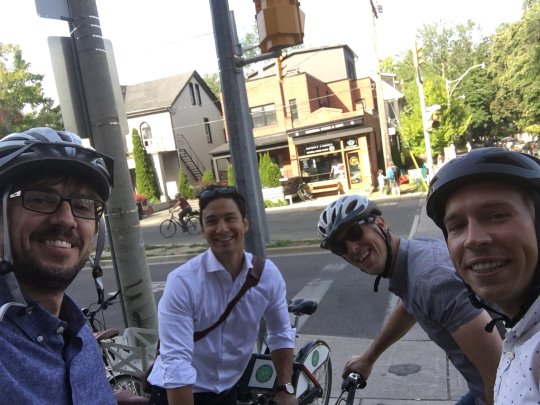
    Remember my post from a few weeks ago about “planners on bikes getting coffee?” Well it happened. That’s the potential of blogging and Twitter. (I sold $TWTR too early.) 

    Here is the selfie to prove it:

    Jason Thorne and I met up with Gil Meslin and Liam Hanebury (Liam needs Twitter) of Artscape and they toured us around a few of their projects, including one of their first artist live/work projects on Queen West.

    I do, however, have to confess that we didn’t have any coffee. I can’t drink coffee in the evening because it keeps me up at night. I already have too many things on my mind.

    Trying to hold a group conversation on a bike is also not as easy as talking in a car, but I would still label the inaugural session a success, even if I was posing as a planner without a bicycle helmet.

    If any of you have any suggestions for the next meet-up or I would like to join, drop me/us a line on the Twitter machine.

  • Hybrid 1-2-3

    For those of you who have been reading this blog since last summer, you’ll know that I’m particularly passionate about the Gardiner Expressway East here in Toronto.

    Last night a public meeting was held to discuss the 3 alternative designs for what has become known as the “hybrid” option. If you’d like a visual summary of the options, click here.

    But essentially as you go from hybrid 1 to hybrid 3, the elevated Gardiner Expressway just gets pushed further north, away from the water. So as you go from 1 to 3, the hybrid option becomes less offensive to the waterfront and its associated public realm, and it opens up more land for development. However, it also becomes more expensive.

    Here’s a graphical summary of the costs, which my friend Gil Meslin tweeted out last night:

    //platform.twitter.com/widgets.js

    Notice that the boulevard (remove) option, which City Council rejected last summer, remains by far the most cost effective option. At a time when the city is searching for cash, I am surprised that nobody is looking here.

    I am also surprised to read that some are commenting on which of the above hybrid options will be the easiest to tear down should we want to remove the Gardiner East in the future. If that’s the lens we are applying, why rebuild it in the first place?

    But enough from me. What do you think? Here’s a Twitter poll I created this morning:

    //platform.twitter.com/widgets.js

  • What’s a bean worth?

    Yesterday I tweeted this picture out from Chicago:

    //platform.twitter.com/widgets.js

    Many of you, I’m sure, have seen this public sculpture before, either in person or somewhere online. It’s called Cloud Gate and it’s by Anish Kapoor – though its nickname has become, quite simply, the bean.

    Given that it’s been a hugely successful piece of public art, I asked what people thought the ROI of it might be. Obviously I wasn’t expecting any sort of number, but I wanted to draw attention to the fact that the right kind of investment in public art can pay huge dividends. Oftentimes we, developers and others, don’t think of it in this context though.

    And it’s probably because it’s so hard to figure out what those dividends might be. What’s the value of a big recognizable bean that everyone around the world associates with your city? But if you think about it, it’s not that different than a corporate logo that everyone knows is yours, which is why I’m interested in the branding of places.

    However, as Gil Meslin rightly pointed out in his tweet storm response to my tweet, it’s hard to consider the bean investment in isolation. I mean, the whole point of the bean is to reflect the surrounding urban landscape. So if it wasn’t for the larger Millennium Park investment and the beautiful historic buildings along Michigan Avenue, maybe that bean wouldn’t be the bean that it is today.

    Ultimately, that just makes coming up with any sort of defensible ROI even more difficult. But that shouldn’t deter us. Because as I’ve said before, just because you can’t measure or prove it (right now), doesn’t mean it isn’t a good idea. In this case, I think it’s pretty clear that this bean has been a hugely successful investment.