Daily insights for city builders, delivered every morning at 6 AM ET. I’m Brandon Donnelly — a Toronto-based real estate developer and founder of Globizen. I’ve been writing here since 2013.

Tag: geneva

  • Facebook announces new cryptocurrency called Libra

    A new Facebook-supported blockchain and cryptocurrency, called Libra, was announced today. The goal: a new global currency. But unlike other cryptocurrencies, this one will be backed by a basket of government-issued securities and other investments.

    A new governing body called the Libra Association has also been formed, with its 28 founding members (see above image) contributing both capital (at least $10 million) and expertise. Going forward, they will help shape the network. It’s important to note that Facebook will have the same status as all other members of the Association.

    Here’s an excerpt from today’s WSJ:

    Facebook said Tuesday the network underpinning the new cryptocurrency would be governed by the Libra Association, an independent, not-for-profit organization based in Geneva. Facebook named more than two-dozen founding partners in that association, including Uber, Visa Inc. and a handful of venture-capital firms and blockchain companies like Coinbase.

    The other thing that differentiates Libra from other cryptocurrencies is that when it launches next year (2020), it will do so inside some of the most widely used consumer apps on the internet, including Facebook Messenger and WhatsApp. That translates into somewhere around 2.4 billion active users.

    Many within in the industry are already speculating that this could be what finally brings the crypto ecosystem into the mainstream, which is, I guess, why companies such as Visa and Mastercard have already signed on to the project. I am also thrilled to see the Creative Destruction Lab listed above. They are a seed-stage program based out of the University of Toronto.

    If you’d like to learn more about Libra, here’s the official website and here’s a good solid overview by TechCrunch.

    Image: Libra
  • Superstar or bubble?

    “The term “bubble” refers to a substantial and sustained mispricing of an asset, the existence of which cannot be proved unless it bursts.” – UBS

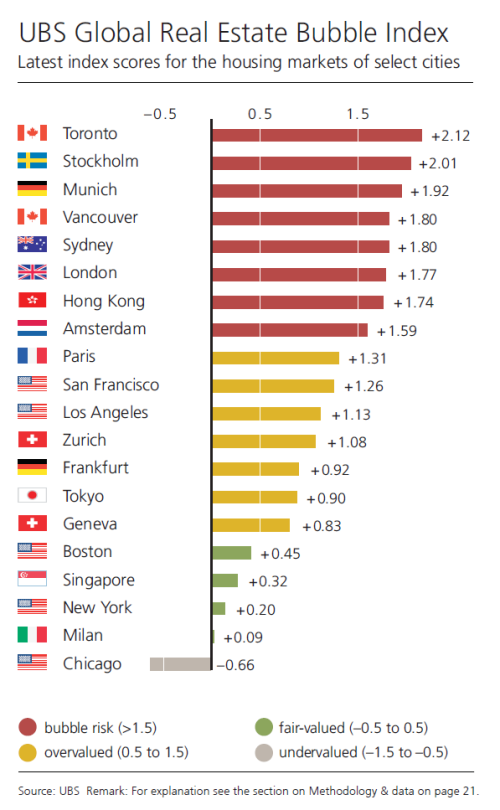
    Last week UBS released its 2017 Global Real Estate Bubble Index. At the top of the list was none other than Toronto, followed by Stockholm, Munich, Vancouver and Sydney. And at the bottom of the list was Chicago – a city that UBS feels is undervalued.

    Here is the full list of index scores:

    image

    The UBS index is a weighted average of the following five sub-indices:

    1. Price-to-income
    2. Price-to-rent (fundamental valuation)
    3. Change in mortgage-to-GDP ratio
    4. Change in construction-to-GDP ratio (economic distortion)
    5. Relative price-city-to-country indicator

    If you look at their price-to-income benchmark in isolation, Toronto drops down to the middle of the pack along with Geneva and San Francisco. Hong Kong, London and Paris sit at the top with the most unaffordable housing. 

    Still, UBS credits “an overly loose monetary policy”, foreign demand, tight zoning, and rental market regulations for the eroding housing affordability in Toronto and Vancouver.

    One of the challenges, of course, is that the capital flowing into real estate is not all local – it’s also global. And many cities around the world are seeing high price-to-income multiples, perhaps because of that. 

    So exactly how much decoupling from local fundamentals should now be considered reasonable in our globalized world? And to what extent is this a result of “superstar economics?”

    Here’s an excerpt from the UBS report:

    The economics of Superstars explains why, in some professions, show business for instance, “small numbers of people earn enormous amounts of money and dominate the activities in which they engage.” By analogous reasoning, prices in the most attractive cities are expected to outperform average cities or rural areas in the long run. Hong Kong, London and San Francisco are exemplars of this theory.

    The intuition is that the national and global growth of high-wealth households creates continued excess demand for the best locations. So, as long as supply cannot increase rapidly, prices in the so-called “Superstar cities” are supposed to decouple from rents, incomes and the respective countrywide price level.

    I guess this is one of the reasons why bubbles are proven after the fact. If you would like to download a copy of the full UBS report, click here.

  • The Green View Index

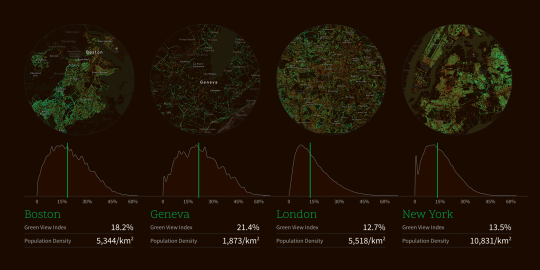
    The MIT Senseable City Lab recently developed something called the Green View Index. It is a measure of a city’s tree canopy. Below are the GVIs for Boston (18.2%), Geneva (21.4%), London (12.7%), and New York (13.5%). You may have to zoom in.

    image

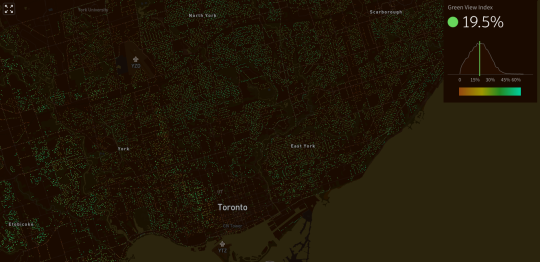
    And here is a screenshot of Toronto. We have a GVI of 19.5%.

    image

    The index was developed by methodically scanning for trees in Google Street View panoramas. The reason street view was used – as opposed to aerial photography – was so that they could capture the human experience at street level.

    All of MIT’s interactive city maps can be found here. It’s also interesting to pan around and see which neighborhoods are the greenest – particularly if you are familiar with the city.

    One thing I noticed is that large green spaces such as Central Park, High Park, and Stanley Park don’t show up as very green. And that’s because the index uses car-based street view data. I feel like these green spaces should count for something though.

  • 10 city building predictions for 2016

    Dawn by Adrian Popan on 500px.com

    https://500px.com/embed.js

    Few things are better than waking up in the mountains and seeing a notification on your phone that 9″ of fresh snow have fallen overnight, bringing the 48 hour snowfall total to 16″.

    This is what people in mountain towns live for. They ski in the morning and then head to work in the afternoon. I heard a number of people on the mountain today saying that they, “want to be in the office after lunch.” It’s a lifestyle thing.

    On that note, today I’d like to focus on 10 city building predictions for 2016. I’ve been assembling this list over the past few weeks and now that I have had my fill of Utah powder for the day, I’m dedicating the rest of the afternoon to writing.

    These are never easy to put together. But here are my thoughts:

    1. We will see increased migration to secondary cities – outside of the alpha global cities – which offer a higher quality of life, more affordable housing, and the ability to live a particular lifestyle. This includes cities like Austin (creative startup hub) and Denver (outdoor recreation).
    2. As more and more cities wake up to the importance of lifestyle in attracting top talent, I think we will see a lot of cities follow the lead of Amsterdam and create “night mayors” or some other equivalent. These cities will begin to see nightlife as a competitive urban advantage.
    3. Global cities will start experimenting with different land use and property tax reform strategies to try and deal with rising income inequality and eroding housing affordability.
    4. We will see a barbell of residential unit sizes. We’ll see more well-designed small units as a way to try and promote housing affordability and we’ll see larger urban infill units for families and baby boomers who want to live/remain in walkable urban communities.
    5. In line with above, I think we will see a further rethinking of urban spaces. Flexible spaces, unique program mixes, and a continued blurring of public/private spaces. One example of this is the trend towards small private spaces surrounded by generous public/communal spaces.
    6. The Toronto and Vancouver real estate markets will continue to chug along because of low interest rates, a weak Canadian dollar, and increased foreign investment. That said, I think we will see more restraint when it comes to over-the-top luxury product.
    7. We will finally see a disruptive technology product that starts to get people in the real estate industry thinking that change is on the way. This will not be a product that ports an offline experience online; it will a new way of thinking about the industry.
    8. This will be the year that cities stop fighting Uber (and other similar marketplaces). Cities (and lobbyists) will finally accept that this is a new reality and then work to figure out the best way to create policy around it. Edmonton, Alberta has already become the first Canadian city to regulate Uber.
    9. Road pricing will get the attention it deserves in North America. Things will start out slow, but we will finally get ourselves on a path which recognizes that we can’t build our way out of traffic congestion in most major cities.
    10. I will publish a book on becoming a real estate developer.

    Many city building trends and shifts seem to happen in a global way. But I think it’s worth noting that a lot of these predictions were likely written with my North American lens on, and in some cases my Toronto lens on.

    It’s not easy sitting down and thinking about what will happen in the future. But it’s a worthwhile exercise. It forces you to take a stance and then, when the future does come, you can see how well you did. I saw Fred Wilson do this on his blog and I thought it was a great idea.

    Now I would love to hear what you think about my predictions and what yours are for this year. Please let us know in the comment section below.

  • The Toronto font

    Susan Kare was the screen graphics and font designer for the original Apple Macintosh computer in the 1980s. Being from Philadelphia’s affluent Main Line, she initially proposed that the various fonts be named after the railroad stops along it.

    However, when Steve Jobs asked where the names had came from, he contested that, if the fonts were to be named after cities, they should be named after “world-class cities”, rather than small ones that nobody had ever heard of.

    image

    And since that’s what Jobs wanted, that’s what Jobs got. The fonts were renamed: Venice, London, Athens, Toronto, Chicago, New York and Geneva. Some of these font names you’ll probably still recognize but some, including Toronto, were eventually abandoned. 

    The Toronto font was removed from System 6 onwards. So from 1988 onwards.