Daily insights for city builders, delivered every morning at 6 AM ET. I’m Brandon Donnelly — a Toronto-based real estate developer and founder of Globizen. I’ve been writing here since 2013.

Tag: general motors

  • Electric vehicles are approaching price parity

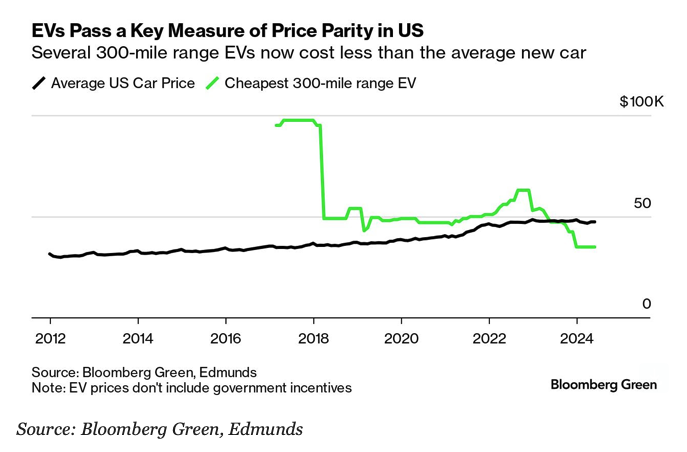
    According to Bloomberg Green, there are now at least three car manufacturers — Tesla, Hyundai-Kia, and GM — with electric vehicles that (1) have a range greater than 300 miles (480 kilometers) and (2) cost less than the average price of a new vehicle in the US (which is currently around $47,000). This means that we are now approaching price parity:

    This is an important adoption milestone, even if it does, at this point, feel totally expected. The International Energy Agency (IEA) is forecasting full price parity by 2030. But in my mind, I’m already done with ICE vehicles. When I bought my current car over 6 years ago, I knew it would be the last internal combustion engine I ever own.

  • Grit and resilience in Detroit

    Earlier this month, the new Hudson’s tower in Detroit “topped out.” Meaning, they laid the last steel beam at the top of building. This, to me, is fantastic news. (Here’s the official project website in case you’re interested.)

    The tower, which was designed by New York-based SHoP Architects, is just over 685 feet tall. This makes it the second tallest building in the state of Michigan, after the Renaissance Center. And when it’s complete, it will house 1.5 million square feet of office, retail, food, residential, hotel, and event space.

    This week it was also announced that General Motors will be moving its headquarters and its 5,000 downtown employees to this new tower. I don’t know who will backfill their old space in the Renaissance Center, but that’s a topic for a different day. Today, I think we should be talking about the grit and resilience of Detroit.

    This is a city that reached a peak population of approximately 1.85 million people in 1950, had its population decline by more than 65%, and then became the largest city in the US to declare bankruptcy (2013). Now they’re building a big ass mixed-use tower in the center of downtown.

    👊

  • San Francisco’s transportation agency doesn’t love autonomous taxis

    Cruise, the autonomous taxi service owned by GM, is working toward offering 24/7 service in San Francisco. I wrote about that here. And so it recently came out with some supportive data suggesting that between September and November of last year, it completed 2,800 rides covering some 27,000 miles, and that it did so without a major collision or injury.

    The San Francisco Municipal Transportation Agency, however, disagrees. They are opposing Cruise’s service expansion plans, and have reported 92 incidents where Cruise’s autonomous taxis have obstructed traffic, caused delays to transit, blocked lanes and, apparently in two cases, driven over firehoses.

    These two things are not all that surprising. Firstly, autonomous vehicles are still in their infancy and they are known to do silly things. Part of this, I’m sure, is because they’re programmed around road and life safety. And so if they don’t know what to do, they’re going to default to what is deemed safe, even if it means blocking a lane or obstructing traffic.

    Secondly, transit agencies are suffering in our post-pandemic world. So this is an obvious and understandable case of self-interest. And it’s not new. But at the same time, we’ve all seen this movie many times before, from Napster to Uber. Progress is disruptive. But does it really make sense to stop?

  • Cruise expands autonomous taxi service in San Francisco

    Cruise, which I wrote about earlier this year, has just announced that its autonomous taxi service will soon be available to the general public 24 hours a day, across all of San Francisco. Initially the service was only available between 11PM and 5AM (when traffic volumes are lower), and in certain parts of the city. It was also free to use. In total, the company now has about 300 AVs operating across San Francisco, Austin, and Phoenix. And it has been charging for rides since June of this year.

    If you’re curious about what it’s like to ride in one of these, check out the above video.

  • End of the automotive era

    Bob Lutz is a former vice chairman and head of product development at General Motors. Recently, he had this to say about the future of the auto industry. 

    Here are a couple of powerful snippets:

    It saddens me to say it, but we are approaching the end of the automotive era.

    The auto industry is on an accelerating change curve. For hundreds of years, the horse was the prime mover of humans and for the past 120 years it has been the automobile.

    Now we are approaching the end of the line for the automobile because travel will be in standardized modules.

    Everyone will have five years to get their car off the road or sell it for scrap or trade it on a module.

    Bob is 85 years old. This is somebody who spent his entire life in the auto industry telling us that the old model is now done. 

    It reinforces something that I wrote about here, where the “end of the automotive era” was pegged at around 2021. 

    And it is part of the mental model that I have started relying on today for decision making.

    Photo by Alessio Lin on Unsplash

  • Thoughts on labor, and the end of summer

    Well, just like that, the unofficial end of summer. Labor Day weekend. But I agree with Shawn Micallef: “Defy the crowd and keep enjoying summer.” There are still weeks of it left.

    But given that it is Labor Day weekend, here are two things to think about. 

    The first is a Financial Times article by Lawrence Summers where he argues that America needs unions more than ever and that, indeed, the central issue of American politics today is the “economic security of the middle class.”

    Here is an excerpt that speaks to declining bargaining power on the part of labor:

    “But I suspect the most important factor explaining what is happening is that the bargaining power of employers has increased and that of workers has decreased. Bargaining power depends on alternative options. Technology has given employers more scope for replacing Americans with foreign workers, or with technology, or by drawing on the gig economy. So their leverage to hold down wages has increased.”

    It’s also worth mentioning that only about 6.4% of private sector workers in the U.S. are in a union today. This is a decline of almost two-thirds since the 1970s and is a good segue into the second thought of this post.

    Two years ago Fred Wilson wrote a post on his blog (which he reblogged today) where he argued that “labor needs a mechanism to obtain market power as a counterbalance to the excesses of markets and capitalism.” 

    But, that this mechanism needs a refresh. He calls it Union 2.0.

    “However, like all bureaucratic institutions, the “Union” mechanism appears anachronistic sitting here in the second decade of the 21st century. We are witnessing the sustained unwinding of 19th and 20th century institutions that were built at a time when transaction and communications costs were high and the overhead of bureaucracy and institutional inertia were costs that were unavoidable.”

    This makes perfect sense to me. 

    At the same time, we can’t forget – and this is how Summers ends his article – that, today, “the most valuable companies are the Apples and the Amazons rather than the General Motors and the General Electrics.”

    That tells me that what may have worked in the past will likely not work in the future.

    Photo by Jonas Viljoen on Unsplash

  • Should you buy a car or just take Uber?

    Urban dawn by Raymond  on 500px.com

    https://500px.com/embed.js

    My friend Evgeny published a great blog post today called, On Car Ownership And The Future Of Transportation

    And in it he made the argument that instead of buying a car and an expensive downtown Toronto parking spot (average price: $40,000 – 60,000), most of us urbanites would be better of just taking a taxi or Uber.

    This got me thinking: At what point does it really make sense to completely forgo owning a car? (Full disclosure: I own both a car and a downtown parking spot.) So I decided to dig into the numbers a bit more and compare 4 mobility options:

    • Owning a car ($25,000 upfront) + downtown parking spot ($40,000 upfront) and driving yourself everywhere
    • Taking a regular taxi exclusively ($3.25 base + $1.75 per km)
    • Taking an UberX exclusively ($2.50 base + $1 per km)
    • Or, taking a futuristic driverless car everywhere (here I assumed $1.50 base + $0.25 per km)

    With the above numbers, I then assumed 15,000 km traveled per year and an average trip length of 15 km (so 1,000 trips per year). The trip length and number of trips per year matter because of the “base fare” that is charged when you take a taxi or Uber.

    I also assumed that the cost of owning a car is $0.60 per km (estimated from this Globe and Mail article) and that there is an opportunity cost to NOT renting out your downtown parking spot ($200/month). That is, every month that you spend driving yourself around and parking your car, you are forfeiting parking revenue.

    Finally, I looked at a 10 year time horizon and then “discounted” all the costs back to today’s dollars so that I could compare each mobility option.

    So what did I find?

    image

    What this says is that if you’re driving 15,000 km per year (average trip length 15km), then you’re better off taking UberX everywhere, as opposed to going out, buying a car and parking spot, and driving yourself around.

    But does this hold true at different travel distances?

    Based on my model, once you hit around 18,000 km per year, then you’re better of with option 1 (owning a car). That’s because the per km savings associated with driving yourself around are enough to offset the upfront costs of the car and parking spot.

    On the flip side, when you drop below 7,500 km traveled per year, even a regular taxi starts to make sense. That’s because you’re simply not traveling enough to reap the benefits of owning a car/parking spot. Again, high upfront costs; lower per km operating costs.

    Of course, there are a number of things I didn’t consider in my model. For one, most people finance their car and parking spot (it is bundled into their home mortgage). So I’m sure there are ways that you could change the above outcomes using leverage.

    At the same time, I didn’t account for the fact that when you’re being driven around (as opposed to driving around) you have the flexibility of doing work, responding to emails, and so on. If you want to attach a value to your time, then the scale would tip back in favor of taxis and Uber.

    But all of this was really just to make one point: look how cheap it could be to ride around in a driverless car. When that becomes the reality in our cities, which it will, it’s going to completely transform our current beliefs around cars, parking, and many other things.

    I guess that’s why General Motors just invested $500 million in the peer-to-peer ridesharing company, Lyft. They know the shit is coming.