Daily insights for city builders, delivered every morning at 6 AM ET. I’m Brandon Donnelly — a Toronto-based real estate developer and founder of Globizen. I’ve been writing here since 2013.

Tag: gdp growth

  • Real estate is a byproduct of economic growth

    I sometimes wonder if I wasn’t born and raised in Toronto if I still would have gone to architecture school and become a real estate developer. I mean, if I grew up in Paris, maybe I would have become a fashion designer. Or if I grew up in Park City, maybe I would have started a snowboard company, slash become a ski bum. I would enjoy doing all of these things. And places certainly do influence us, more than most of us probably appreciate.

    My point with all of this is that Canada likes to somewhat paradoxically over index on housing. I say paradoxically because we never seem to have enough of it for Canadians — certainly the affordable varietal — and yet:

    Canada relies heavily on its real-estate sector to power the economy. Housing investment in Canada as a share of gross domestic product reached 8.9% in 2022, according to the Organization for Economic Cooperation and Development, much higher than the 4.8% on average for the 38 member countries in the OECD.

    If you look at all of the industries that make up the Canadian economy, “real estate and rental and leasing” is at the top with 13.01% of GDP (as of 2020). And if you add “construction” on top of this, the total is about 20.09% (again, as of 2020). This feels suboptimal. And I say this as a developer and builder of real estate.

    Real estate is largely a byproduct of economic growth. When someone starts a business and then needs something like an office or a warehouse, that is a positive thing for the economy. Jobs are being created by the business and further jobs are being created by the people who will deliver the space they need. But if you aren’t creating new jobs in the first place, then just dealing in real estate will only take you so far.

    Immigration helps, but it can also create a mirage of growth and prosperity. If you look at real GDP growth across the G7 from 2019 to today, Canada looks pretty good. We’re second (+4.5%) only to the US (+8.9%). But if you look at GDP per capita over the same time period, we’re dead last (-2%), whereas the US remains on top (+7.2%).

    I’m not an economist; I just build things. But in my opinion, this is a problem. We should be doing everything we can to foster a stronger culture of innovation and entrepreneurship in this country. We have the talent. I mean, Ethereum has roots in this city! We just need more people turning this intellect into wonderful new companies.

  • Protection against risk of expropriation

    Property rights, whether for real world things or for digital things, are the foundation of developed economies. Because if you don’t feel like your property is going to be safe and secure, why would you bother investing and trying to accumulate assets?

    Above is a chart I found, in this great thought piece by Ryan Goldman, showing the direct relationship between “protection against risk of expropriation” and GDP per capita. The more protection, the higher the GDP.

    This is, of course, fundamental to the way we live our lives offline. But it is also becoming increasingly important in the way we live our lives online. Because we now have digital assets that people actually care about owning and protecting. You know, like pictures of apes.

    This market is only going to continue to grow and the above relationship between rights and economic development will certainly hold true. But I think the big question is whether there will be more distributed and equitable access to opportunities in this emerging world.

    I hope that will be the case.

  • How large metro areas are driving the global economy

    “The concentration of economic growth and prosperity in large metro areas defines the modern global economy, creating both opportunities and challenges in an era in which national political, economic, and societal trends are increasingly influenced by subnational dynamics.” -Brookings Institute

    The Metropolitan Policy Program at the Brookings Institute has a new report out for 2018 called the Global Metro Monitor.

    Here are some of the highlights (data is from 2014 to 2016):

    – The 300 largest metro areas in the world accounted for 36% of employment growth and 67% of GDP growth.

    – Metro areas in China and the Asia-Pacific region outperformed, whereas Latin American cities, and in particular the largest Brazilian cities, were weaker performers.

    – The majority of large metro areas had growth rates that exceeded that of their respective regions. So again, cities are the driver.

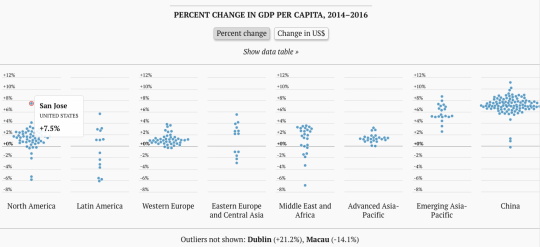
    And here is an interesting interactive chart (better to click through) that shows the % change in GDP per capita. 

    image

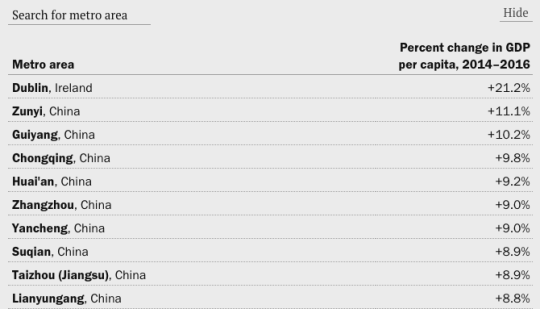
    Look at how much of an outlier San Jose is. Though, check out Dublin in the footnote. And if you look at the actual data table, it is all China, except for Dublin at the top.

    image

    For the rest of the charts, click here. And to download the full Global Metro Monitor report, click here.

  • Winner take all, or most, economy

    The world is increasingly spiky. Inequality is growing and it is increasingly geographic in nature. We know that people tend to make more money in urban areas compared to rural areas – even when they possess the exact same level of education. The returns to being smart and educated are simply greater in cities.

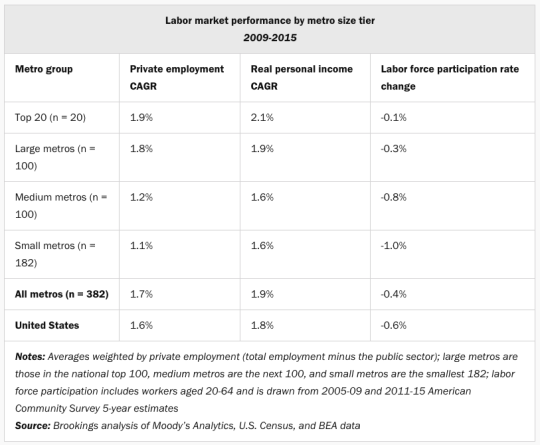
    But they also depend on the size of the city. Mark Muro and Jacob Whiton of Brookings recently published data looking at labor market performance – by metro size – from 2009-2015 (right after the financial crisis). What they found is that larger metropolitan areas simply performed better than smaller ones.

    image

    In summary:

    City size matters because it’s a major influence on city prosperity and adaptability as well as local worker fortunes. Bigger cities are more productive. They are more innovative. They draw better-educated workers by offering higher wages.

    The situation is even more pronounced across the pond. According to the New York Times (quote from Richard Florida), a third of Britain’s gross domestic product comes from London alone.

    What is far less clear is what should be done to address the decline of some of the smaller cities in America – cities that are stagnating and feeling left behind. But perhaps the first step is acknowledging what has happened and what remains feasible in today’s global economy.

    Here is another quote from the above NY Times article:

    Mr. Trump’s promise to relieve the pain by reviving the coal and steel industries, by keeping immigrants out of the country and by raising barriers against manufactured imports is only a rhetorical balm to satisfy an angry base seeking to reclaim a prosperous past that is no longer available.

    That rhetorical balm.