Daily insights for city builders, delivered every morning at 6 AM ET. I’m Brandon Donnelly — a Toronto-based real estate developer and founder of Globizen. I’ve been writing here since 2013.
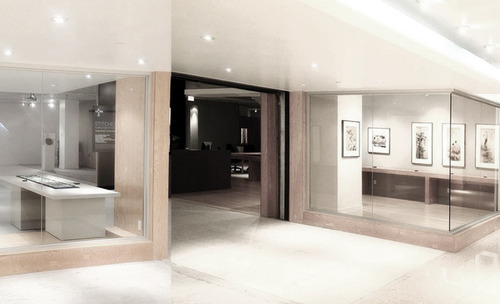
Side Gallery opened up a new 700 square meter exhibition space in Barcelona last month that is worth showcasing. It’s a beautiful space. Designed by Spanish architect Guillermo Santomà, the space sits within an old 19th century factory that used to house an Italian pasta company. It’s minimal and stark white, but the architecture of the former factory still comes through. There’s also a prominent greenhouse featuring flora that is local to South America. Fitting given that the gallery focuses on Latin American design. Have a look.
I also love these images from the architect, which (I think) use light to completely transform the space.
I love this article in Designlines Magazine about how Lawrence Blairs (owner of Atomic Design) has setup his 65 square meter one bedroom condo to serve as both a place to live and an art gallery.
The main living area is equipped with white vinyl screens that pull down to conceal the kitchen and other private areas, and make it feel like a white-walled gallery space. There’s naturally also a projector on the ceiling.
Supposedly it takes him about 30 minutes to prepare the space before an event. Here is a photo by Arash Moallemi via Designlines:
You don’t necessarily need a lot of space to do the things that you may want to do. You just need to be creative. Do you think that developers should offer more creative space solutions as part of their standard offering?
It is the first in the city and I like what they did with the facade of the building. It is decidedly modern and yet there are hints of a local vernacular.
Photographer Jonathan Castellino responded and suggested that I check out the new(ish) Leica store, which is also in Kyoto.
So here is that store (if you can’t see the video below, click here):
I shoot on the Fujifilm X-T3, but Leica certainly makes some exquisite (and expensive) cameras. The Leica Store Kyoto does not deviate from that recipe.
This Tuesday evening at 630pm, WORKSHOP – which is a design studio, gallery, and retail shop located in Yorkville, Toronto – will be hosting a panel discussion titled: What is Smart Now?
On the panel will be a building scientist, a computer scientist, and two architects. The moderator will be Larry Wayne Richards, who is Creative Director of WORKSHOP and the former dean of the Faculty of Architecture, Landscape, and Design at the University of Toronto. He was dean when I was completing my undergraduate degree and is one of my favorite people in the world of Toronto architecture.
Here’s a bit more on the panel:
For more than half a century, visionaries and companies such as Monsanto, Hewlett-Packard, Microsoft, and Samsung have promoted the concept of technologically smart homes with highly integrated, interactive systems. However few of these homes have actually been realized, leaving us to wonder why.
Meanwhile, architects, builders, and home owners have become aware of the advantages of being smart in terms of energy efficiency and sustainability, from using common sense to selectively employing high-tech.
But now, with the digital realm and software advancing rapidly, will sophisticated smart home systems merge with recent advances in high performance materials and energy-efficient construction, making “totally smart” (and affordable) homes commonplace? Will we finally be living in the magical future that was imagined 50 years ago? And what are the implications for architects and architectural education?
And here are the panelists:
PAUL DOWSETT, Architect and Founding Principal, Sustainable TO
SRINIVASAN KESHAV, Professor of Computer Science, University of Waterloo
TED KESIK, Professor of Building Science, University of Toronto
JANNA LEVITT, Founding Partner, LGA Architects, Toronto
LARRY WAYNE RICHARDS (Moderator), Creative Director, WORKSHOP
Given the current “Internet of Things” trend and the fact that software is creeping into so many non-tech fields, such as housing, I think this is a really timely discussion to be having. I also think it’s critical for these kinds of conversations to be cross-disciplinary. There are infinite opportunities in the housing market for people who are able to think in that way.
If you’d like to attend, click here to sign up. It’s free and open to the public. WORKSHOP is located in the lower concourse level of 80 Bloor Street West.
I first heard about Mjölk a few years ago. Located in the Junction, it’s a gorgeous gallery & store dedicated to Scandinavian and Japanese craftsmanship. It has everything from furniture to hand crafts. It’s well worth a visit if you’re into clean lines and the “pure aesthetic of the north.”
Started by a husband and wife duo, the couple also own the building and live above the store. They recently renovated their home and it was just awarded a 2013 Toronto Urban Design Award. You can see all the photos here. I particularly like the third floor inner courtyard:
If you’re curious as to what brought them to the Junction, check out this response from a Dwell interview dated 2011:
“Downtown became so expensive, and that pushed people either east or west. In the past five years, this area has really become a destination. A lot of young, independent businesses have popped up, starting with reclamation stores Smash and Post and Beam. There’s also Crema Coffee Co., Pandemonium Books & Discs, Junction Fromagerie (a Quebecois cheese shop), and Bunner’s gluten-free vegan bakery, to name a few.”
I like to think of residential properties as a leading indicator for gentrification. Sometimes it’s easy to miss the change taking place behind closed doors though.