Daily insights for city builders, delivered every morning at 6 AM ET. I’m Brandon Donnelly — a Toronto-based real estate developer and founder of Globizen. I’ve been writing here since 2013.

Tag: future

  • The next wave of computing innovation

    Venture capital firm Andreessen Horowitz (a16z) has just launched a new site called Future. It is a site for “understanding the future, how tech shapes it, and how we build it.” I just subscribed to it and, if you’d like to do the same, click here. At the same time, the company also just announced their latest crypto fund (a $2.2 billion fund). Here’s an excerpt from the release:

    We believe that the next wave of computing innovation will be driven by crypto. We are radically optimistic about crypto’s potential to restore trust and enable new kinds of governance where communities collectively make important decisions about how networks evolve, what behaviors are permitted, and how economic benefits are distributed. 

    I’ve been reading a lot more about crypto over the last few months (which is something that I mentioned I was doing here.) I am not in this world day-to-day, but I am now fully convinced that we are in the very early innings of a profound shift. So pretty soon this is going to become my day-to-day, whether I like it or not.
  • The birthplace of techno

    Detroit has been called the birthplace of techno. Beginning in the early 1980s – when the city was well in decline – the Detroit techno sound started to emerge, thanks to musicians such as Juan Atkins, Derrick May, and Kevin Saunderson. 

    Chicago had house music. And Detroit had techno music – among, of course, many other musical genres. But what I find fascinating about Detroit techno, in particular, was how it really reflected the ethos of post-industrial Detroit. It was high-tech. It was about machines. And it was obsessed with the future.

    Below is a clip from a 1996 French documentary called Universal Techno. Even if you’re not into electronic music, I think you should at least watch the segment starting at 1:40. I love how Derrick May talks about Detroit, and what should be this balance between the past and the future. It really reflects my own views on city building.

    [youtube https://www.youtube.com/watch?v=RSX_r0u3uzE?rel=0&w=420&h=315]

    If you can’t see the video, click here.

    I’m thinking about Detroit and its music because I’m headed there during Memorial Day weekend for the annual Movement Electronic Music Festival. It has been about 2 years since I was last in Detroit and so I’m excited to see the city in full swing.

  • 10 city building predictions for 2016

    Dawn by Adrian Popan on 500px.com

    https://500px.com/embed.js

    Few things are better than waking up in the mountains and seeing a notification on your phone that 9″ of fresh snow have fallen overnight, bringing the 48 hour snowfall total to 16″.

    This is what people in mountain towns live for. They ski in the morning and then head to work in the afternoon. I heard a number of people on the mountain today saying that they, “want to be in the office after lunch.” It’s a lifestyle thing.

    On that note, today I’d like to focus on 10 city building predictions for 2016. I’ve been assembling this list over the past few weeks and now that I have had my fill of Utah powder for the day, I’m dedicating the rest of the afternoon to writing.

    These are never easy to put together. But here are my thoughts:

    1. We will see increased migration to secondary cities – outside of the alpha global cities – which offer a higher quality of life, more affordable housing, and the ability to live a particular lifestyle. This includes cities like Austin (creative startup hub) and Denver (outdoor recreation).
    2. As more and more cities wake up to the importance of lifestyle in attracting top talent, I think we will see a lot of cities follow the lead of Amsterdam and create “night mayors” or some other equivalent. These cities will begin to see nightlife as a competitive urban advantage.
    3. Global cities will start experimenting with different land use and property tax reform strategies to try and deal with rising income inequality and eroding housing affordability.
    4. We will see a barbell of residential unit sizes. We’ll see more well-designed small units as a way to try and promote housing affordability and we’ll see larger urban infill units for families and baby boomers who want to live/remain in walkable urban communities.
    5. In line with above, I think we will see a further rethinking of urban spaces. Flexible spaces, unique program mixes, and a continued blurring of public/private spaces. One example of this is the trend towards small private spaces surrounded by generous public/communal spaces.
    6. The Toronto and Vancouver real estate markets will continue to chug along because of low interest rates, a weak Canadian dollar, and increased foreign investment. That said, I think we will see more restraint when it comes to over-the-top luxury product.
    7. We will finally see a disruptive technology product that starts to get people in the real estate industry thinking that change is on the way. This will not be a product that ports an offline experience online; it will a new way of thinking about the industry.
    8. This will be the year that cities stop fighting Uber (and other similar marketplaces). Cities (and lobbyists) will finally accept that this is a new reality and then work to figure out the best way to create policy around it. Edmonton, Alberta has already become the first Canadian city to regulate Uber.
    9. Road pricing will get the attention it deserves in North America. Things will start out slow, but we will finally get ourselves on a path which recognizes that we can’t build our way out of traffic congestion in most major cities.
    10. I will publish a book on becoming a real estate developer.

    Many city building trends and shifts seem to happen in a global way. But I think it’s worth noting that a lot of these predictions were likely written with my North American lens on, and in some cases my Toronto lens on.

    It’s not easy sitting down and thinking about what will happen in the future. But it’s a worthwhile exercise. It forces you to take a stance and then, when the future does come, you can see how well you did. I saw Fred Wilson do this on his blog and I thought it was a great idea.

    Now I would love to hear what you think about my predictions and what yours are for this year. Please let us know in the comment section below.

  • Imagining the way things could be

    Photograph Old in new by Andrew Johnston on 500px

    Old in new by Andrew Johnston on 500px

    I was out for lunch with a colleague of mine yesterday afternoon and he said to me: “Brandon, I’m really surprised that you’re so interested in technology. It just seems so different compared to real estate and architecture.”

    And I’ve certainly heard that exact same comment from a number of people before. But I don’t see it that way and here are a few reasons why.

    The common thread for me between architecture, real estate development, and technology is that in all of these cases it is about imagining the way things could be in the future and then creating it. It’s about change. It’s about growth. It’s about creation. And I consider myself a builder in practically every sense of the word.

    At the same time, each of these disciplines is about creating engaging spaces for people. Architects and real estate developers do it in the physical world, but many technology products strive to do exactly the same thing in the online world.

    In fact, a couple of years ago I was fascinated to learn that Facebook has and continues to draw inspiration from many of the same books and philosophies that architects, planners, and developers rely on when it comes to creating engaging communities. The medium might be different, but it’s still about people.

    Finally, as I’ve said many times before here on Architect This City, I think that the distinction between tech and non-tech companies and industries is quickly evaporating. Is Airbnb a tech company or a hospitality company? Is Uber a tech company or a taxi company? Pretty soon we’ll be saying that about many other industries.

    Maybe it’s because I’ve always been interested in wading through the overlaps between disciplines, but this is just the way I see it.

  • The death of driving

    image

    Last night my father and I were walking to dinner and he commented to me that he thinks my generation will be a lot healthier than his–at least on average–given how much more my generation walks. I responded by reaffirming to him how little I drive these days and how much I enjoy that.

    Then today, I was watching this short clip of the The High Road with celebrity chef Mario Batali, where he interviews venture capitalist Fred Wilson. During their tour around New York City, Mario asks Fred what he thinks the future of transportation will be. Fred responds by saying that nobody will drive anymore. He then went on to say that the technology for driverless cars is already ready, but that we as a society just aren’t ready for it, yet.

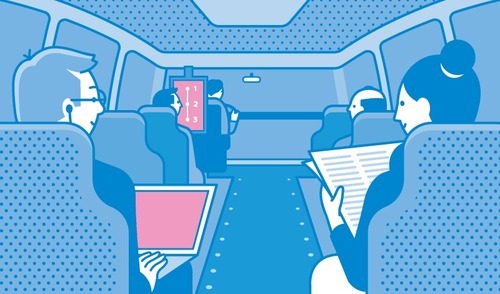
    Finally, on my way home from wakeboarding today, I stumbled upon this Guardian Cities article talking about Helsinki’s ambitious plan to make owning a car pointless. By 2025, the goal is have a “point-to-point mobility on-demand system” that will integrate all forms of mobility into one booking and payment platform. Think everything from public transit to carpools to taxis. 

    As I read on, I then discovered that Helsinki is already offering on-demand public minibuses that allow people to specify their own routes on their smartphone. The system then aggregates all of the requests and establishes the most efficient route based on the immediate demand. Coincidentally enough, it’s quite similar to a use case I wrote about for driverless cars.

    All of this got me thinking that one day we’ll probably look back at that time when people used to drive their own vehicles around as some antiquated and hilarious moment from the past.

    Image: Observatoire