Daily insights for city builders, delivered every morning at 6 AM ET. I’m Brandon Donnelly — a Toronto-based real estate developer and founder of Globizen. I’ve been writing here since 2013.

Tag: funding

  • The rise of proptech

    A friend of mine flipped me this New York Times article today talking about the rapidly growing interest in proptech and about Opendoor – a topic and a company that I have written about many times before on the blog.

    Here’s a snippet about proptech:

    The hauls are part of a race by investors to pour money into technology for real estate, or what Silicon Valley now calls proptech. Having watched tech start-ups upend old-line industries like taxis and hotels, venture capitalists are casting about for the next area to be infused with software and data. Many have homed in on real estate as a big opportunity because parts of the industry — like pricing, mortgages and building management — have been slow to adopt software that could make business more efficient.

    On the Opendoor front, which is the largest/most valuable company in the proptech category, they have now raised over $1 billion. By the end of this year they plan to be in 22 cities across the United States.

    Interestingly enough, they have started experimenting with other business models, beyond just buying and flipping homes. They now circumvent agents and sell some homes directly to customers.

    But Eric Wu, the CEO of Opendoor, believes that you can’t automate proper advice and so that will remain. The role of agents is simply about to shift from “administration” to that of “advisory”.

    I have been arguing for years that the home buying and selling process is ripe for change. And what we are seeing today is really the start of that.

    According to the NY Times, real estate tech startups raised $3.4 billion in funding last year. Some firms, such as Fifth Wall Ventures, are entirely dedicated to the space.

    This is money betting on change.

    Photo by Grant Lemons on Unsplash

  • Last-mile electric scooters — will they work?

    I’ve been hearing a lot about Bird recently. Perhaps it has something to do with the $15 million Series A round they raised last month (February 2018) and the $100 million Series B round they announced earlier today.

    A “Bird” is small electric scooters that look like this and can be rented from your phone for short haul trips. They are currently available in Santa Monica, Venice, UCLA, Westwood, and San Diego, and they are intended to be ridden in existing bike lanes.

    What may be particularly interesting to this blog audience is the fact that Bird is calling itself a “last-mile electric vehicle sharing company.” The pitch: 40% of car trips (in the US?) are less than 2 miles long. Let’s replace those using electric scooters.

    One of the first things that came to my mind is that this feels more accessible than cycling. Cycling to work can be a commitment. You have to think about your attire and the sweat factor, among other things.

    Would you agree?

  • New York, San Francisco, Toronto

    Yesterday it was announced (here, here, and here) that Toronto-based Top Hat has raised $22.5 million (USD) in Series-C funding. The round was led by New York-based Union Square Ventures.

    I am always excited to see Toronto-based startups doing well and I am particularly excited by this remark in USV’s blog announcement:

    “Also worth noting is that Toronto continues to impress us with its quality and diversity of companies. We now have five investments there, placing Toronto third as a location in the USV portfolio after New York and San Francisco.”

    Here is another quote from Fred Wilson’s blog:

    “Toronto is a great place for startups. In addition to five investments of ours that are HQ’d there, I know of at least one other USV portfolio company that has much of their engineering team in Toronto. The talent, mindset, and quality of the people in the Toronto/Waterloo tech/startup community is really top notch and we love investing there.”

    Go Toronto. 

    (Of course, Toronto really means Toronto-Waterloo. That’s the geography of the ecosystem.)

  • Opendoor.com is so risky that it may just work

    image

    I have been writing about the startup Opendoor.com for over 2 years now. And I continue to believe that they are the most promising disruptor in the residential real estate space. 

    Here is the first post that I wrote back in July 2014 after they raised their first round of funding. Here is the second post that I wrote after they launched in Phoenix. And here is another post that I wrote 6 months ago where I argued, once again, that they are doing something worth paying attention to. (This last post explains how the platform works.)

    Well, about a week ago it was announced that they have raised another round of funding: a $210 million Series D. In all likelihood, the company’s valuation is now over $1 billion. Here’s the Techcrunch announcement where the message was: huge ass number; risky business model.

    In response to this, Ben Thompson wrote a terrific and widely shared blog post called, Opendoor: A Startup Worth Emulating. I love his post because he says what I have firmly believed and argued for many years: Zillow and Redfin are not disruptive real estate startups.

    This is what he says about Zillow:

    “And yet, the most successful real estate startup, Zillow (which acquired its largest competitor Trulia a couple of years ago), is little more than a glorified marketing tool: the company makes most of its revenue by getting real estate agents — the ones collecting 6% of fees, split between the buying and selling agents — to pay to advertise their houses on the site. Certainly a free tool that makes it easier to find houses in a more intuitive way is valuable — Zillow has acquired the sort of userbase that allow it to build an advertising business for a reason — but at the end of the day the company is a tax on a system that hasn’t really changed in decades.”

    And though very risky, he argues that Opendoor is far better positioned to shake up the status quo. 

    Here are two of his key points:

    “Sellers are uniquely disadvantaged under the current system, which is another way of saying they are an underserved market with unmet needs.” [Sellers are the side of the market that Opendoor is specifically targeting.]

    “Opendoor has a new business model: taking advantage of a theoretical arbitrage opportunity (earning fees on houses sold at a slight mark-up) by leveraging technology in pursuit of previously impossible scale that should, in theory, ameliorate risk.”

    And here’s what that could ultimately mean for the industry:

    “Opendoor has many more reasons why it might fail than Zillow or Redfin, but its potential upside is far greater as a result. First is the immediate opportunity: sellers who can’t wait. However, as Opendoor grows its seller base, especially geographically, its risk will start to decrease thanks to diversification and sheer size; that will allow it to lower its “market risk” charge which will lead to more sellers. More sellers means both less risk and an increasingly compelling product for buyers to access, first with a real estate agent and eventually directly. More buyers will mean lower marketing costs and faster sell-through, which will lower risk further and thus lower prices, pushing the cycle forward. It’s even possible to envision a future where Opendoor actually does uproot the anachronistic real estate agent system that is a relic of the pre-Internet era, and they will have done so with realtors not only not fighting them but, on the buying side, helping them.”

    I’m with Ben on this.

  • Top 20 cities for venture capital investment

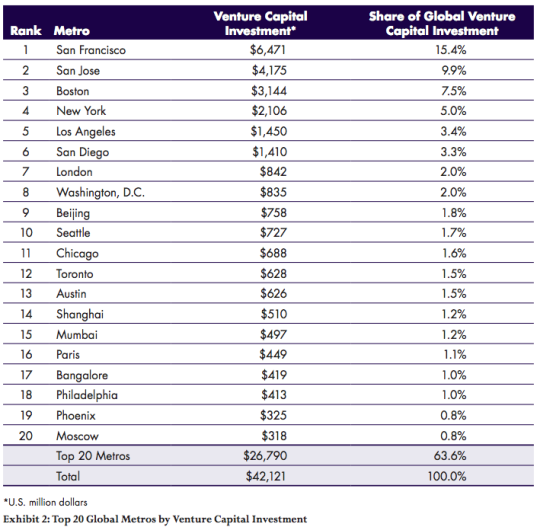
    The Martin Prosperity Institute here in Toronto recently published a new report that looks at worldwide venture capital investment by city. The report is called Rise of the Global Startup City.

    The data is from 2012, because that’s what was available from Thomson Reuters, so keep in mind that there might be some variation in the rankings if we were to look at more recent data. Some of the cities sit fairly close.

    Nonetheless, here are a few of the broader takeaways (from the report page):

    “The United States accounts for nearly 70 percent (68.6 percent) of total global venture capital, followed by Asia (14.4 percent) and Europe (13.5 percent).”

    “Just two broad regions — the San Francisco Bay Area and the Boston-New York-Washington Corridor — account for more than 40 percent of global venture investment.”

    “Global venture investment is highly uneven and spiky — it is concentrated in a small number of large cities and metros around the world.”

    Here are the top 20 cities by total venture capital investment (in USD millions):

    image

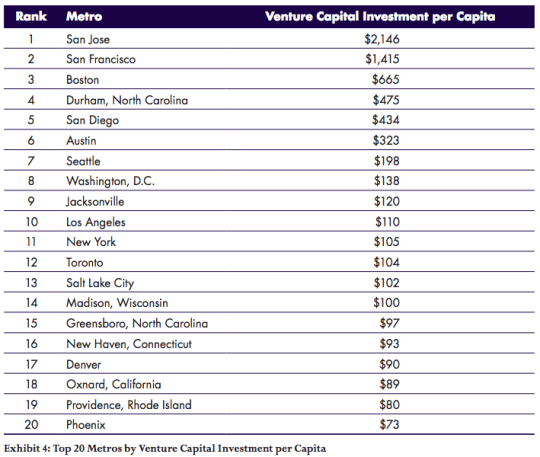
    And here are the top 20 cities according to venture capital investment per capita:

    image

    Given the variation in these two lists, you realize that some cities are largely benefitting from sheer size. London, for example, drops off the list when you look at venture capital investment per capita. 

    In fact, in this second list, 19 of the 20 cities are in the United States. The only non-American city that remains is Toronto.

  • The democratization of real estate

    In 1960, real estate investment trusts were created in the U.S. with the goal of democratizing real estate ownership. Here’s how Yale professor Robert Schiller described it:

    “REITs were created by law in 1960 to democratize the real estate market and make it possible for a broad base of investors to participate in this huge asset class. That was absolutely the right thing to do, because portfolio theory tells us people should diversify across major asset classes, and real estate is one of them.”

    But a lot of things have changed since 1960. We now have the internet. 

    And one of the things that the internet is very good at is creating peer-to-peer networks that connect supply and demand without the same kind of intermediaries. This could be people who have MP3s with people who want MP3s or it could be people who have real estate with people who are looking to invest in real estate.

    So with the advent of crowdfunding in both the U.S. and Canada, I think we are at the dawn of another era of real estate democratization. Already we have seen the first crowdfunded real estate development project and it happened at a much smaller and local scale than is usually the case with REITs.

    Similarly, we are also seeing companies emerge – such as HomeUnion in the U.S. – that allow people to build their own rental portfolios by directly investing, either fully or partially, in real estate. Again, there are differences here compared to how REITs typically operate.

    When I was in grad school at Penn and Sam Zell used to come in and talk to the students, he used always mention how when he started out in real estate (1960s) the industry was disproportionately controlled by a small number of players. That’s been changing ever since and it looks like that trend will only continue.

  • A guide to digital marketplaces

    Version One Ventures – which is an early-stage venture capital fund based in Vancouver – recently published a free handbook called, A Guide to Marketplaces.

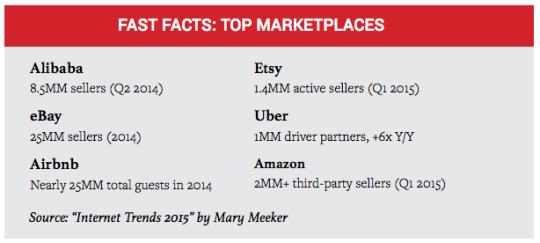
    Online marketplaces are really fascinating because they are perhaps broader in scope than you might initially think. For example, Uber is a marketplace. There’s a supply-side (drivers with cars) and a demand-side (people needing rides). Uber connects these two groups together and acts as a kind of digital middle person. Uber does not own any of the cars.

    This is an incredibly power business model and it can and is being applied in many different ways. Here are the top internet marketplaces (via the handbook):

    I have been interested in this space for years because I have been very curious as to why we haven’t seen more innovation when it comes to online real estate marketplaces. Yes, there are platforms like Zillow.com. But Zillow has not done to real estate what Uber is doing to urban mobility.

    My thinking is that it comes down to supply-side aggregation. Online marketplaces in general are hard to get started, which is why investors love them. They have defensibility. But real estate, in particular, is even harder to jumpstart compared to the incumbent models because of what I see as constraints on the supply-side.

    That’s why I am so excited about what BuzzBuzzHome.com is doing on the new construction side of the business. They are aggregating supply.

    If you’d like to download the guide to marketplaces in PDF, click here. It’s a great read and I’m glad that Boris and Angela took the time to assemble. Thank you 🙂

  • Made in Toronto: 500px

    https://500px.com/embed.js

    If you’re a regular reader of Architect This City, you’ll know that I generally like to include at least one photo with every post. Sometimes I run out of time and I don’t always do that, but that is at least the intent.

    You might have also noticed that my go-to for stock photography is 500px. That is the case for a few reasons. 

    I find the photos to be of higher quality than any other service. I can easily “embed” them into my posts while giving appropriate credit to the author and linking back to 500px. The company was founded by a good friend of mine and snowboarding compadre. And the company is made in Toronto.

    That’s why it’s exciting to report that yesterday the company announced an additional $13M in funding (Series B). To date the company has raised $23M of outside funding, from some big names like Andreessen Horowitz. This is great for the everyone in the company, and I believe it’s great for this city.

    Why is that?

    Well, here’s a video from the New York Times’ Cities For Tomorrow conference, where Andrew Ross Sorkin and Fred Wilson talk about creating startup hubs. It’s about 20 minutes long and well worth a watch.

  • Enabling innovation by lowering the barriers to entry

    Yesterday afternoon Sam Altman of Y Combinator published a blog post talking about a new YC Fellowship program for even earlier stage companies. 

    For those of you who aren’t familiar with Y Combinator, they are a super successful funding platform for early stage startups. They are located in Mountain View, California.

    What’s unique about their approach is that they invest a relatively small amount of money ($120,000 for 7% of your company) in a relatively large number of companies. Their most recent cohort was around 85 companies and they do that twice a year.

    The rationale behind this approach is that it can be incredibly hard to predict which people and ideas will produce the next great company. Oftentimes the best ideas appear really shitty at first. (Here’s a post by one of the cofounders of Airbnb talking about the company’s early rejections.)

    So instead of putting all of their eggs in one basket, YC invests smaller amounts in more companies.

    But beyond this being beneficial to them, it’s also a model that I think helps to reduce the barriers to people starting a company. It gives more people the chance to prove that their company has the potential to be something great. 

    And that’s precisely what makes this new YC Fellow program/experiment so interesting to me.

    Instead of $120,000, YC fellows will receive $12,000 and they won’t have to move to the Bay Area (although it’ll be encouraged). They’ll still get mentorship and advice like the regular YC program, but it’ll be a kind of light version. 

    Though this is almost certainly just the beginning. Here’s how Sam ended his announcement post:

    “Someday if it works, we’d love to fund 1,000 companies per year like this.”

    Now all of a sudden that’s some scale.

    What’s exciting about this is that I believe our cities have the potential to be far more innovative than they are today. Every city is trying to be the next Silicon Valley, but every city is not the next Silicon Valley.

    I saw a great tweet the other day that went something like this (I wish I could remember who the author was):

    “Entrepreneurs aren’t risk takers. They’re just rich kids with big safety nets.”

    It’s a bit of a tongue-in-cheek generalization. But to unlock the full potential of our cities, we should be figuring out how to get everyone participating and building their ideas, not just those with a head start. 

    I think there are a lot of people around the world who could be doing great things, but they just haven’t been able to take that first step for one reason or another.

    Hopefully organizations like Y Combinator will be able to help them take it.

  • Revisiting electronic road pricing as a way to fight traffic congestion

    https://500px.com/embed.js

    As disappointing as this week’s vote on Toronto’s Gardiner Expressway East was, there is one good thing that has come to the forefront and that is the will to explore road pricing. At this point, I have almost no confidence that this City Council would ever vote it in, but at least we’re talking about it. That’s better than not talking about it.

    If you’ve been reading Architect This City since the beginning, you might know that I’ve been a vocal supporter of road pricing. I wrote two posts on the topic: The case for electronic road pricing (which was based on an HBS case I did as part of my MBA) and More on electronic road pricing (which was a Lunch & Learn I did while I was at TAS).

    I continue to believe that road pricing is a highly sensible solution to big city traffic congestion. But I do think that an electronic/variable pricing model is preferable to and more equitable than a flat toll model. A variable model means that the price of using the road adjusts based on congestion levels and/or the time of day. I also think that we should use as much of the revenues as possible to fund continuous transit improvements.

    If you’re interested in learning more about this topic, check out the two posts mentioned above. I’d also love to hear your thoughts on road pricing in the comment section below. Would you welcome it in your city?