Daily insights for city builders, delivered every morning at 6 AM ET. I’m Brandon Donnelly — a Toronto-based real estate developer and founder of Globizen. I’ve been writing here since 2013.
Search for the most iconic chair designs in the world and you’ll likely come across a list that includes:
Wassily Chair by Marcel Breuer (1928)
Barcelona Chair by Mies van der Rohe (1929)
Grand Consort by Charlotte Perriand, Le Corbusier, and Pierre Jeanneret (1928)
The various Eames Chairs (starting in 1945)
Wishbone Chair by Hans Wegner (1949)
Wiggles Side Chair by Frank Gehry (1972)
And the list goes on.
Most of these chairs also look as if they were just designed yesterday. Meaning, they’re timeless and have stood the test of time. But they are mostly older designs. Which raises an interesting question: How much does the passage of time play in a role in determining whether or not something is “iconic”?
There are some more recent designs that you could call iconic. The Roly-Poly Chair by Faye Toogood (2014) and the Louis Ghost Chair by Philippe Stark (2002) come to mind. This suggests that really great designs can become immediate classics. (Though, this latter example is a reinterpretation of a classic French chair that in and of itself is an icon.)
What I think is the mostly right answer is that, yeah, sometimes you can catch lighting in a bottle. The Louis Ghost Chair, for instance, is one of the top selling chairs of the 21st century. It’s a clever and modern take that used new technologies (as is often the case) to revisit an old classic. Starck nailed it.
But more often than not, you probably need time. Time is what allows the object to form cultural associations in our mind and to prove that it is, in fact, timeless. However, if this is truly the case, then it makes it difficult to determine if we’re still producing as many design icons today as we did in the past. We won’t really know until they become old.
La Foundation Louis Vuitton (which is housed in a building designed by Frank Gehry) has an exhibition on right now that displays the art collection of two brothers: Mikhaïl Abramovitch Morozov (1870-1903) et Ivan Abramovitch Morozov (1871-1921). The collection contains mostly early modernist work from the late 19th century and includes pieces by Cézanne, Van Gogh, Renoir, Monet, Matisse, Picasso, as well as others, including some Russian avant-garde work. We went through the exhibition last week when we were in Paris. Partially to see the collection and partially to see the architecture, which is, you know, very Frank Gehry. See above photo.
As I was going through the exhibition I was reminded of how much I like the Impressionist movement. I like the work, but I also really love the story. The Impressionist movement started in Paris in the late 1800s and many consider it to mark the beginning of modern art. It broke free of tradition and violated the rules of what was considered to be proper art work at the time in France.
Because of this, the Impressionists were heavily criticized at the outset. So much so that they were routinely rejected from exhibiting in the traditionally accepted art venues in Paris. The annual Salon de Paris was the big and most prestigious one as I understand it. This forced the group to organize their own exhibitions and circumvent the incumbents in order to get their work out into the world, which is pretty much what any “startup” has to do. Obviously the rest is history and now people to go to museums like La Foundation Louis Vuitton to look at Impressionist art work and talk amongst their friends about how we don’t make art like they used to back in the late 19th century.
I mention all of this because of what is happening today in the world of NFTs. Non-fungible tokens and their application to digital art feels to me like history is repeating itself. We are at the dawn of something new and a lot of people seem to think that what’s happening today is pretty stupid: Why pay thousands or even millions for a JPEG? I can just download a copy to my computer for free. This is not art. How do you even display it? I don’t get it.
I am sure that most of the NFTs that people are buying today will go to $0 in value; just like a lot of the paint that has gone onto canvasses over the years hasn’t created much value. Art is a funny thing. But that doesn’t mean that cultural value will not be created over time. When people are talking and they think what you’re doing is dumb, you may actually be on to something. The Impressionists taught us this important lesson well over a century ago.
“Every unemployed American is a failure of entrepreneurial imagination.” -Edward Glaeser
At the end of September, economist Edward Glaeser returned to the Manhattan Institute to deliver the 2017 James Q. Wilson Lecture. If you’re a regular reader of this blog, you may remember that he was there in 2016 and delivered a presentation called “The End of Work.”
This year’s talk continues that theme, but focuses on joblessness and economic stagnation in the US Heartland.
The solutions he puts forward are based on a very simple economic model for growth that he refers to as “rules and schools.” Simply put: The rules of a place need to support business and entrepreneurship and the people need to be educated.
One example he gives is of a woman in Detroit who was trying to start a food truck business but had to wait 18 months for a permit. There’s no reason that should happen. He blames the insider restaurant lobby for working to keep competition at bay. The rules are bad. We have similar problems here in Toronto with our food trucks. I think it’s wrong.
He also pokes fun at the Bilbao effect. Yes, Frank Gehry created a beautiful piece of architecture. But did it lower the unemployment rate?
The last thing I’ll mention are his comments regarding Amazon HQ2 because I like how he frames it.
Firstly, Amazon is going select a city that doesn’t need Amazon. It’s going to go where there’s already abundant human capital.
Secondly, “smokestack chasing” is not the right economic development strategy. The key questions should be: How will this benefit our human capital and how many new firms could it create?
If you have an hour, check out Ed Glaeser’s talk. If you can’t see it below, click here.
Some of the best architecture in the city is being built on this campus.
One thing you’ll notice about this summary of architects is the emphasis on age. Architecture is a slow process. This is true for buildings in general. So historically it has been the case that architects usually don’t hit their stride until later in their career.
The youngest architect on the list is Bjarke Ingels at 42. An outlier for sure. He saw tremendous success in his 30s, and even in his 20s with the firm PLOT. I think great storytelling had a lot to do with this.
Tehrani is 53. And the author rightly points out that Frank Gehry didn’t become Frank Gehry until he renovated his own house at the age of 48.
Next weekend a good friend of mine from architecture school will be visiting Toronto from Philadelphia. And I’m really excited to show him the city. (Next month it’s my turn to go to Philadelphia.)
He’s a fellow city geek. He hasn’t been to Toronto in a number of years. And I haven’t seen him since our trip to Detroit 2 years ago.
For those of us living and working in Toronto, there’s a lot to celebrate. Sure the Gardiner Expressway East decision didn’t go as I – as well as many other urbanists, including our Chief City Planner – had hoped. But there’s no shortage of other things to brag about.
So here are 10 reasons to visit Toronto right now:
1. We’ve created an entirely new business district south of Union Station called South Core. Now the region’s primary mobility hub is in the middle of the country’s most important business district, as opposed to on the edge of it. It’s a better use of infrastructure.
2. We now have a dedicated train (the Union Pearson Express) that takes you from the country’s busiest airport directly to downtown in 25 minutes. You’ll find local retailers at the stations and a brand created by the brain behind Monocle Magazine. You can even use a smart card to ride it and our local transit system.
3. We didn’t shut down Uber. Instead our mayor wants to create new policy that will allow these services to coexist with conventional taxi services. We don’t yet know how this will turn out, but I believe it’s a step in the right direction. It’s Toronto taking a leadership approach to innovation as opposed to trying to stomp it out.
4. We are about to host the largest sporting event in Canadian history. The 17th Pan American Games will have double the number of athletes competing as the 2010 Winter Olympics in Vancouver.
5. We created an entire neighborhood from scratch in order to house all of these athletes (Canary District). And I think it’s destined to become one of Toronto’s great neighborhoods. I’m saving my first visit for next weekend, so expect a follow-up post on this.
6. We are dramatically rethinking this city’s public realm. From the plaza out front of Union Station to the new Queens Quay Boulevard along the waterfront, we are prioritizing people and creating more complete streets. It has given Toronto an entirely new urban feel.
7. We are slowly starting to embrace our forgotten laneways and alleys through the help of organizations like The Laneway Project. And this is going to eventually lead to a further rethink of our pubic spaces and urban fabric.
10. The ATC community is in the process of identifying a new, quintessentially Toronto food dish. But since we have every type of imaginable cuisine here, we’re struggling to pick just one. When you visit, you can help us identify the best and most Toronto dish.
So there’s a lot to be excited about. I for one can’t wait for us to host the Pan Am Games, starting tomorrow. It’s a chance to show off this great city.
So if you’re also in town next weekend and want to geek out about cities, drop me a line.
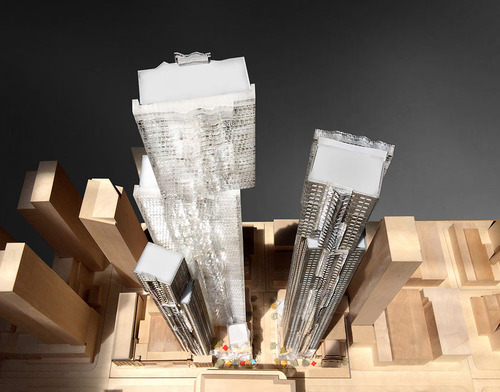
The developers behind the much talked about Mirvish+Gehry project in Toronto (Projectcore) recently released a video showcasing the architectural model. It’s a great way to see the project from every angle. Click here if you can’t see it below.
I’ve written about this project a number of times before and my view has always been that I’m excited by the project, but that I don’t think we should be demolishing all of the heritage buildings on-site. This latest scheme – with two towers ranging from 82 and 92 storeys – is the result of that compromise.
What are your thoughts on Mirvish+Gehry? And what do you think the condos will ultimately go to market at? My guess would be somewhere around $1,000 per square foot.
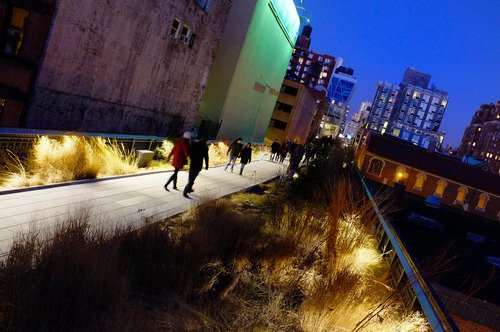
In 1980, the last train ran on an elevated corridor on the west side of Manhattan known as the High Line. Originally built in the 1930s, the trucking industry had made these trains obsolete and service was halted.
At this point, neighboring property owners began to lobby for the demolition of the High Line, as they no doubt saw it as an opportunity to increase the value of their land holdings. But thanks to local residents – most notably a man by the name of Peter Obletz – the 1.45 mile-long elevated rail corridor was saved from demolition.
In 1999, Joshua David and Robert Hammond then decided to form a non-profit with the goal of both preserving and reusing this unused rail corridor. The group was called Friends of the High Line.
By the early 2000s, Friends of the High Line had successfully made an economic case for transforming the rail line into a public open space and things started moving forward. Initially, it was thought that a public park of this sorts would attract about 400,000 people annually and generate upwards of $286 million in new tax revenues over the following 2 decades (Globe and Mail).
With these expectations in mind, construction on the new High Line Park began in 2006. The first section opened in 2009 – a decade after Friends of the High Line was formed. And the third, and last section, opened just two weekends ago at the end of September.
Today the High Line Park attracts 5 million visitors a year and is believed to be directly responsible for about $2.2 billion in new economic activity. The increased tax revenues over the next 2 decades are expected to reach about $980 million. Without a doubt, the High Line has been a huge success. It has become the 2nd most visited cultural attraction in New York (Globe and Mail).
Which is why every city now wants their own High Line. Philadelphia wants one. Chicago wants one. Mexico City wants one. Seoul wants one. And the list goes on. Here in Toronto, we’ve recently proposed one called the King High Line, which will connect the Liberty Village and West Queen West neighborhoods across a rail corridor.
While I do believe that this is an important connectivity problem to be solved, I worry about how explicit the references are to the actual High Line. Even the street furniture is the same in their promotional video.
I worry not only because it means we’re clearly taking on the role of follower, as opposed to leader, but because an elevated park isn’t going to work in all urban contexts the same way that the High Line worked in Chelsea. This is similar to how Frank Gehry can’t magically turn your city into the next Bilbao.
So while I have shown my support by becoming a “Friend of the King High Line” (and I would encourage you to do so as well), it’s important to keep in mind that the problems we’re trying to solve here aren’t necessarily the same ones that New York had to deal with.
The High Line – from the start – was designed to have an intimate relationship with its surrounding buildings. The tracks rain directly through them so that the trains could easily load and unload their cargo – that was the whole point. So when the High Line was redone, all of a sudden these buildings were able to reconnect themselves to the park in a way that they were already accustomed to doing.
But in Toronto’s situation, and perhaps in your city, that’s not the case. We’re talking about stitching together two completely disconnected neighborhoods. It’s a noble goal and certainly one that I wholeheartedly believe we should pursue. But I don’t think we should assume that it’s a problem that has already been completely solved for us.
Last week Toronto City Council voted to support planning staff’s recommendation to approve the landmark Mirvish + Gehry development on King Street West in the Theatre District.
The revised design now includes 2 towers (as opposed to 3) at 82 and 92 storeys tall. As a result of this change, 3 of the 5 existing buildings on the site will now be retained. I think this represents a good balance between (historic) preservation and progress.
If you’re interested in a bit more of the backstory, Toronto Life published an article today called David Mirvish on the Edge. It talks about his father (Ed Mirvish), his upbringing, and how he got into the real estate development business.
I am a real estate developer and I believe in progress. But I also fundamentally believe in balancing progress and preservation. I’ve said this before.
Now, I’ve said before that I like this project. I don’t mind the height and I don’t buy the argument that there aren’t enough public spaces in the area. There’s David Pecaut Square directly to the south that could use a few more warm bodies in it.
But as I also said before, I think the key concern here is one of heritage. There are 4 heritage designated buildings on the site dating back to as early as 1901. Here’s where they sit:
The Anderson Building (1915) is particularly unique. Here’s a larger photo (via blogTO):
So while I’m excited by the prospect of a real Gehry project in Toronto, I think we need to figure out a way to find a balance. Preserve the facades, build on top, or relocate them. Do something besides wipe the slate clean.
As Bozikovic rightly points out in his article, “Toronto has a sophisticated culture of working with heritage buildings.” There are lots of great examples of how we managed to move forward as a city, without erasing our past.
And in many ways, I see this ability to work with and build upon heritage buildings as an emerging Toronto vernacular. I mean, what could be more appropriate for the most diverse city on the planet than an architectural style—of our own—that blends and layers history with disparate design ideologies.
I sense an opportunity.
We could have Gehry’s white sinuous curves drape over the heritage buildings. Make them become a literal unveiling of Toronto’s past and a metaphor for the sophisticated way in which we build upon legacy.
It’s too easy to just demolish everything. We’re better than that.
I was reading Novae Res Urbis this morning and they had a piece on the 3 tower Mirvish + Gehry proposal in Toronto’s Entertainment District. It was talking about David Mirvish’s “sales pitch” to the Empire Club of Canada this week, an attempt to help overcome the criticism around the design, height and overall density of the project. The article ended by saying that the developer will be appealing to the OMB this January.
I know that I’m probably biased in this matter, but I fail to understand the concern around height and density – particularly since the site is 2 blocks from a subway station. Why are we – citizens and policy makers – so obsessed with building height? Good architecture and urban design involves a lot more than the number of floors. Can we not have more sophisticated conversations about built form rather than fixating ourselves on building height?
Secondly, whenever a building gets proposed in Toronto that attempts to, literally, step outside of the box it gets pegged as controversial. Take, for example, the Royal Ontario Museum by Daniel Libeskind. When people used to ask me what I thought of the crystal addition, I used to say that I was a fan simply because it was pissing off so many people. Love it or hate it, it’s architecture. The same can’t be said for a lot of the other stuff going up in this city. Why doesn’t mediocrity invoke the same response? It should.
So my issue is that we seem to be far more comfortable accepting banality than we are with accepting bold new changes like the Mirvish + Gehry proposal. And frankly, if we could actually pull off three 80+ storey towers, it would be down right impressive in this market. How many cities in the world have a real estate market robust enough to support this scale of development?
But this is not a post of unconditional support. I do have concerns.
I’m concerned that 4 heritage designated properties will need to be destroyed in order for this project to move forward. This makes me wonder: What’s the point of a designation if the building can still be demolished? I’m actually surprised that this topic hasn’t been getting its fair share of attention. Again, we’ve been more interested in talking about building height.
Further west along King Street, I have similar concerns with a development proposal that would demolish “restaurant row.” This a spectacularly successful – albeit touristy – restaurant strip and I would hate to see it go. It’s difficult to create this kind of fine grain retail experience from scratch.
Now don’t get me wrong, I believe in development. I am a developer, after all. But I don’t believe we should be so quick to erase our history.