Daily insights for city builders, delivered every morning at 6 AM ET. I’m Brandon Donnelly — a Toronto-based real estate developer and founder of Globizen. I’ve been writing here since 2013.

Tag: foreign buyers

  • Most new condominiums are not owner-occupied — is that actually a bad thing?

    Here’s some data (via Jeremy Withers) explaining that a large portion — about 61% — of new condominiums built in Ontario between 2016 and 2021 were not owner-occupied. In the case of low-rise houses, the figure is lower — about 24%.

    Now, the premise of Jeremy’s tweet storm is that non-owner-occupied housing is bad and that the government should be doing more to discourage this. Simply taxing and restricting foreign buyers is not enough (and I agree that this is mostly symbolic).

    But is non-owner occupied really such a bad thing?

    First of all, non-owner occupied implies that somebody else is renting the place. I don’t think that a significant chunk of these homes are being left vacant. So isn’t the fact that somewhere around 61% of all new condominium apartments are becoming rental housing something that is potentially positive?

    One counter argument would be that these investors are bidding up new home prices and squeezing out end users. But that brings me to my second point: small-scale individual investors are a critical ingredient in the delivery of new condominium housing in Ontario.

    This point cannot be overstated.

    The lender requirement to pre-sell suites in order to obtain construction financing means that developers rely heavily on buyers who are willing to purchase many many years before occupancy. And this is generally a lot more challenging for end users, as we have talked about many times before.

    So if it weren’t for investors, I am certain that we would see a lot less new housing getting built. And in turn, that would mean a lot less new rental housing getting built.

  • Singapore increases property stamp duty for foreigners to 60%

    Singapore isn’t exactly saying that foreigners can’t buy homes there, but it did just increase the stamp duty on purchases by foreigners to 60%. So it is saying that maybe you shouldn’t do it, unless you want to pay a lot of tax.

    On the other hand, if you’re a foreigner with permanent residency in Singapore, the stamp duty is only 5%. But if you then want to buy a second property, the rate jumps to 30% (up from the previous rate of 25%). Companies or trusts that buy any sort of residential property also now need to pay a stamp duty of 65% (up from 35%).

    The official message is that these are “pre-emptive measures” to cool demand, which I guess is mostly aimed at mainland Chinese buyers. This is the largest group. Last year, they accounted for about 25% of foreign condo purchases in Singapore. However, the total number of homes purchased by foreigners remains pretty low at just 4.7% (2022). Though first quarter data from this year does suggest the number has increased to about 7%.

    Even still, how many homes is this?

    Based on this information, there were 20,909 private home sales in Singapore in 2020. So let’s assume this has since increased and the number is, oh I don’t know, somewhere around 25,000 homes per year. At 7%, that’s 1,750 homes being sold to foreigners each year. Going forward, I don’t know how many people are going to be willing to pay the 60% stamp duty, but presumably some will still do it.

    If we pick a random number and assume that this higher tax wipes out 80% of the foreign demand, then that’s an additional 1,400 homes for locals and only 350 homes going to foreigners each year. Maybe this is something?

  • Non-Canadians can’t buy a lot of real estate

    The Prohibition on the Purchase of Residential Property by Non-Canadians Act — which came into effect in January of this year and bans foreigners from buying residential real estate in the country for two years — is weird.

    We can debate whether banning foreigners from buying residential real estate is really helpful for housing affordability and if it’s the most impactful place to focus our attention (and we have talked about this many times before), but the part that is particularly odd is this feature here:

    …the law’s definition of residential property includes land that is zoned for residential use or mixed use, which covers huge swaths of commercial land across the country. As well, an entity is deemed foreign if a non-Canadian owns a minimum of 3 per cent of the entity.

    What this means is that the following scenario is now technically a problem (not actual legal advice!):

    • You own a commercial property with zero homes
    • You have long-term commercial leases in place that also generally preclude you from building new homes in the foreseeable future
    • The zoning of your property allows for residential uses (which you like having in your back pocket)
    • And your cousin from Italy owns 3% of the entity that owns the real estate

    This is a scenario where residential homes do not exist and they are unlikely to exist any time soon. It seems clear cut, but I suppose one could argue that it’s exceedingly onerous to try and figure out which sites are soft sites and could actually be developed with new residential. And so if you have the potential to build and then own residential, you should be regulated as if you might ultimately own some of it one day.

    But even here, I don’t know why we would want to restrict the supply side of the housing equation. If you’re a developer in Canada where housing is known to be kind of expensive and you want to build more of it for Canadians, isn’t that a good thing? And isn’t it also a good thing if we can get some non-Canadians to help pay for these new homes?

  • Hong Kong to Singapore, quietly

    Here is an interesting article from the Financial Times talking about the quiet move of people and companies from Hong Kong to Singapore. I say quiet, because apparently Hong Kong-based companies are reluctant to overtly signal that they are setting up offices and moving some of their executives out of the city, in case that starts to upset people over in Beijing.

    But the real estate market in Singapore seems to be benefitting from some of these macro trends, as well from the city-state’s handling of the coronavirus. This is despite there being a 25% stamp duty tax on foreign property purchases (US nationals and a few others are exempt) and despite the fact that the economy shrank in the second quarter of this year by the largest percentage (13.2%) since independence in 1965.

    According to FT, there were 2,362 residential property transactions in the core central region of Singapore in the first 9 month of this year. This compares to 1,962 transactions for the same period last year. Of these total sales, 260 residential homes were sold to foreign nationals this year (~11%), compared to 316 last year (~16%). While this is obviously a decline, including a decline in the percentage sold to foreign nationals, it still feels pretty significant given that the borders were presumably closed, or largely closed, earlier this year.

    Apparently 75% of the above 260 homes were sold to buyers from either mainland China or Hong Kong. I don’t know how this percentage compares to last year. But the narrative out there right now is that it is up (along with office leasing by foreign companies) and that Singapore is a pretty safe place to put your money right now.

    Photo by Kirill Petropavlov on Unsplash

  • #donthave1million

    Tiny Park by David Brookfield on 500px.com

    https://500px.com/embed.js

    After I wrote this week’s post about Chinese homebuyers in Vancouver, I was surprised to learn about the racism debate that flared up in the city / on Twitter. I guess this really is a touchy subject. (See: #donthave1million)

    My reaction to the research was: Great to see someone (Andy Yan) putting in the time to try and better understand a market phenomenon. It’s painful how opaque real estate markets can be. Let’s get even more data so that we can make even better policy decisions. I didn’t read it as: let’s deliberately single out a race.

    Because the reality is that we all knew this was happening.

    Bloomberg recently published an interesting and related article that talks about China’s money exodus and how the Chinese logistically get their money out of the country. There are restrictions in place. 

    But first, here are two snippets from Bloomberg that describe the order of magnitude we’re talking about:

    This flood of cash is being felt around the world, driving up real estate prices in Sydney, New York, Hong Kong and Vancouver. The Chinese spent almost $30 billion on U.S. homes in the year ending last March, making them the biggest foreign buyers of real estate. Their average purchase price: about $832,000.

    In total, UBS Group estimated that $324 billion moved out last year. While this year’s numbers aren’t yet in, during the three weeks in August after China devalued its currency, Goldman Sachs calculated that another $200 billion may have left.

    Now here’s how it is being done:

    It works like this: Chinese come to Hong Kong and open a bank account. Then they go to a money-change shop, which provides a mainland bank account number for the customer to make a domestic transfer from his or her account inside China. As soon as that transaction is confirmed, typically in just two hours, the Hong Kong money changer then transfers the equivalent in Hong Kong or U.S. dollars or any other foreign currency into the client’s Hong Kong account. Technically, no money crosses the border – both transactions are completed by domestic transfers.

    And here’s a snippet that stood out for me because it shows how easy this has become:

    While the first exchange has to be set up face-to-face, customers can place future orders via instant-messaging services such as WhatsApp or WeChat, and money changers set no limit on how much money they can move.

    Given the scale and complexity of this issue – housing affordability – I have to believe that cities and policy makers would be far better off with more, rather than less, information. I hope we can work towards that.

  • The impact of Chinese buyers on Vancouver’s single family home market

    I have a new favorite blog that I think you might all enjoy as well. It’s called BT | A | Works and it is the “architectural and urban research and development division” of Bing Thom Architects in Vancouver. 

    I think it’s it’s important to have people in a firm who are researching and experimenting with ideas beyond the day-to-day tasks of a job. So I was excited to discover their work this morning.

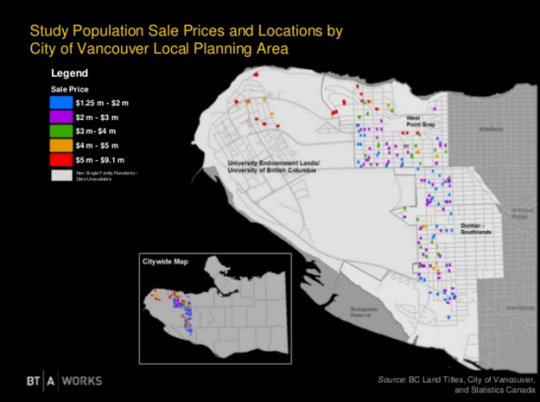
    Their most recent post is a look at ownership patterns of single family homes sold in 3 west end neighborhoods in Vancouver from September 2014 to February 2015 (a 6 month period). These are some of the most expensive areas in the city and, collectively, they found 172 properties sold with an aggregate value of around $520 million.

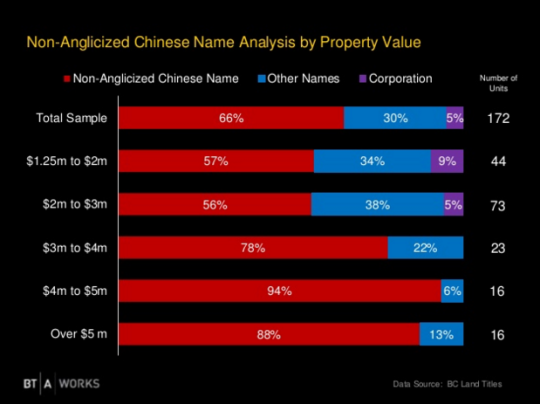
    Given the presence of foreign buyers in Vancouver’s real estate market, one of the things they then did was identify “non-anglicized Chinese names” on the title records. This means names like “Li Xian”, but not names like “Andrew Shui-Him Yan”, because the anglicized first name suggests that they are probably not a new immigrant or probably not living abroad.

    Here’s what they found:

    In total, 66% of the properties in the sample (172 properties) were associated with a non-anglicized Chinese name. And for properties over $5 million, the percentage jumps to 88%. The other interesting thing worth noting is that 23% of the registered owners declared their occupation as “homemaker/housewife.”

    I thought this would serve as an interesting follow-up to the post I wrote about a month ago called, Is Hongcouver better off than Vancouver? If you’d like to see the full BT | A | Works presentation, click here.

  • Why Vancouver’s housing market hinges on China’s economy

    Last week a friend of mine sent me a really fascinating article from The Economist talking about the role of foreign investors in Vancouver’s housing market. If you subscribe to The Economist, you can click here to read the article. If you don’t subscribe, you’ll have to rely solely on what I’m about to say.

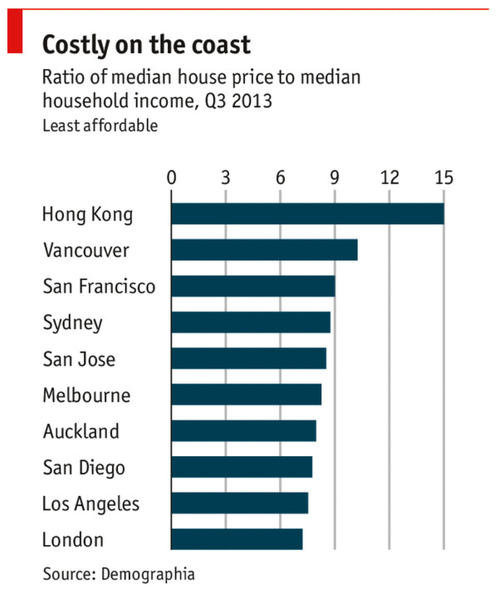
    In case you weren’t aware, Vancouver is an incredibly expensive city when it comes to real estate. The average price for a single-family detached house is now around C$1 million. By some measures, that makes it the most expensive housing market in North America. Here’s a chart that looks at house prices as they relate to household income:

    image

    According to The Economist, the median household income in Vancouver is $68,970. This places them 23rd out of 28 in terms of Canada’s major cities. So how is it that homes are, on average, selling for $1 million? The locals don’t seem to be able to afford them.

    Well, it’s a well known fact that Chinese buyers continue to be an integral part of Vancouver’s housing market. In fact, up until this year, Canada offered a fast track option for citizenship applications if you brought at least $800,000 into the country.

    So we know that foreign buyers are having an impact. It’s a phenomenon we’re seeing in many other cities around the world, such as London. But to what extent is hard to measure–which has forced analysts to get creative.

    To try and figure out what percentage of homes are going to foreign buyers, analysts have been looking at macro data, filing through sales records, and even monitoring utility bills to see which homes might be sitting empty.

    What they found is that there’s a fairly significant correlation between economic activity in China, and Vancouver’s housing market. When the Chinese economy does well, so do Vancouver homes. Interesting. Still, that doesn’t quantify impact.

    When analysts looked for utility bills that would suggest an empty home, they found that only about 8% of high end downtown condos were likely sitting empty. That’s a relatively small amount. It could be vacancy rate.

    But when they looked for “mainland Chinese-sounding names” on sales records, they found that for homes priced $3M and up, almost ¾ of the buyers could be from mainland China. Now that’s a significant number!

    I found this all rather fascinating and I thought you all might as well. It yet again reminds me of how much opacity there is in real estate markets. We’re all craving better data. Why else would people be scouring utility bills?