Daily insights for city builders, delivered every morning at 6 AM ET. I’m Brandon Donnelly — a Toronto-based real estate developer and founder of Globizen. I’ve been writing here since 2013.

Tag: fitness

  • The geography of gyms

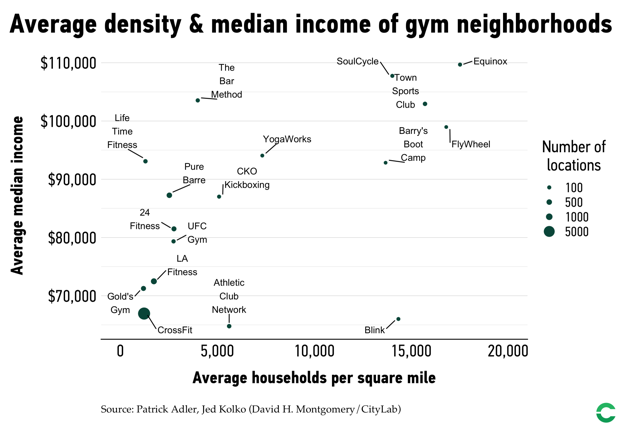
    Richard Florida and Patrick Adler recently looked at the geography of gyms across the United States. They analyzed 17 different fitness chains, over 10,000 gyms, and nearly 5,000 zip codes. Full article over here at CityLab.

    image

    The findings probably won’t surprise you, but it’s still interesting to see some of the data. Gyms and fitness studios tend to concentrate themselves in affluent neighborhoods with a high number of college graduates.

    The median household income of the average zip code with a gym or fitness studio is $72,720. This is compared to $56,694 for all zip codes. And when it comes to zip codes with an Equinox, SoulCycle, The Bar Method, or Town Sports Clubs, the median income jumps to over $100,000.

    Above is from the second post in the two part series they are doing on “the geography of fitness.” For the first one, click here.

  • Blue Zones

    Over the weekend I learned about Dan Buettner’s Blue Zones. These are cities and parts of the world where, according to Dan, people have a much longer life expectancy. The five regions he identifies as Blue Zones are: Okinawa (Japan); Sardinia (Italy); Nicoya (Costa Rica); Icaria (Greece); and Loma Linda (California).

    Many of you have probably heard of this finding from Malcolm Gladwell. I think he writes about it in Outliers. I had. But I didn’t know about Dan Buettner and his efforts to teach these “secrets” to other regions around the world. 

    I can’t speak for the efficacy of his consulting practice, but I think it’s interesting that some of the characteristics of these Blue Zones include a strong sense of family and community, as well as constant moderate physical activity. In other words, activity that is integral to normal life, such as lots of hills in a mountain town.

    The links between urban form, walking and biking (instead of driving), and health outcomes are something that get a lot of air time. It is, of course, one of the reasons why denser cities are thought to be healthier cities. They encourage more active forms of mobility.

    But what else could we be doing to make physical activity an inseparable part of urban life? In Rio de Janeiro, they often incorporate fitness facilities into their public spaces, whether it’s a parklet or the beach. That probably doesn’t qualify as inseparable, but it’s certainly a start.

  • Real estate company? No, a lifestyle brand.

    This past weekend a rooftop restaurant, pool, and entertainment venue called LAVELLE opened upon atop 629 King Street West here in Toronto. It’s on the rooftop of a condo by Freed Developments, that for some reason is no longer called the Thompson Residences.

    Here’s a sampling of their Instagram to paint you a picture:

    imageimageimageimage

    I mention this not because I went, but because I think it’s interesting to see how Peter Freed is evolving his company and brand. He is best known as a real estate developer. But what he wants to do and what he is doing is turning Freed Developments into a “vertically and horizontally integrated progressive lifestyle company.”

    According to this recent press release, LAVELLE is the first venture of Trademark Hospitality Inc., which itself is “a branch of Freed Hospitality.” This is him selling not just selling a place to live, but selling a particular lifestyle and a certain community – and then taking an active and ongoing role in the programming of it.

    The other example that comes to mind is that of Equinox Fitness. I’m sure you all know this company, but what you may not know is that it’s owned by a real estate development firm called Related. The New York-based company acquired them in 2005 (closed in 2006) for about half a billion dollars. 

    Here’s why they did it (excerpt from this press release):

    Related and Equinox have historically shared similar visions. Both companies are known for their commitment to lifestyle, service, innovation and design, and have a passionate following amongst dedicated upscale consumers. The companies’ respective customers have similar demographic and psychographic profiles and both foster fiercely loyal clientele who are passionate about their brands.

    Related has redefined the residential marketplace, created the benchmark for sophisticated urban living and has been committed to quality fitness facilities in its buildings since the mid-eighties. Since its inception 15 years ago, Equinox has been widely recognized for being an industry innovator and for delivering an unparalleled fitness experience.

    Both companies will enjoy a number of key strategic opportunities from the partnership. Related will secure a well known brand as a quality anchor tenant for key current and future developments. This will also help Related to enhance the quality of its amenities and facilities available to residents.

    So this is not a new thing. In both of these cases, the goal is to create a brand and identity centered around a precise lifestyle. I mean, Related even mentions “psychographic profiles” in their news release. They know who their audience is, just as Freed does.

    Another way of looking at this is how it ties into what I see as a broader shift away from just development to more city building. It’s not just about throwing up a building and then moving on. It’s about trying to foster a certain kind of community and lifestyle. We may not all agree on what that community should be, but overall I think it’s an exciting direction for cities.

    If you’re taking a similar approach in your business (or even if you’re not), I would love to hear from you in the comments below.

  • The definition of a habit

    I recently heard someone define a habit as something that you need to do in order to feel normal. In other words, until you do it, you don’t feel yourself. 

    This, of course, could refer to both good habits and bad habits. And most of us probably have habits from both camps. But I like it as a clear and simple definition. 

    I’ve written about disciplines and habits a few times before, because I think of myself as having a few. The most public of my habits is this blog and, at this point, I certainly don’t feel normal if I don’t write everyday. I’ve missed a few days since I started writing in 2013 and each time I felt bad.

    My other big habit is going to the gym and lifting weights. And since my snowboarding injury back in February, I haven’t been able to do this properly (though I still tried). It’s easily the longest break I’ve taken from it since I started this particular habit when I was 16.

    Because of this, I really haven’t felt myself for about 2 months. My energy levels aren’t the same and I just don’t feel as mentally sharp. Those are some of the main reasons why I love this habit. And I still haven’t adjusted.

    Thankfully (with some help from Totum Life Science), my back and shoulder are finally starting to feel better. And so today, instead of writing about cities, I’m going to go to the gym and try and do one of my regular workout routines.

    I’m not quite at 100% yet, but I should be soon. And then I’ll finally feel normal again.

  • The hard things about retail

    image

    Retail is one of the hardest – if not the hardest – real estate category to get right. If you don’t have the right setup, the right location, and the right tenant mix, you can fail pretty easily. It’s a bit of an art. And that obviously applies to both landlords and tenants. I mean, we all know what recently happened with Target Canada.

    This past weekend I had the opportunity to visit the Aura Condos in Toronto, which is supposedly the tallest and largest residential condominium in Canada. There’s about 1.1 million square feet of residential space across 79 floors and somewhere around 150,000 to 180,000 square feet of retail space (the estimates I found online varied). The main anchors include Bed Bath & Beyond, Marshalls, and Hard Candy Fitness (which also serves as the gym for the residences above).

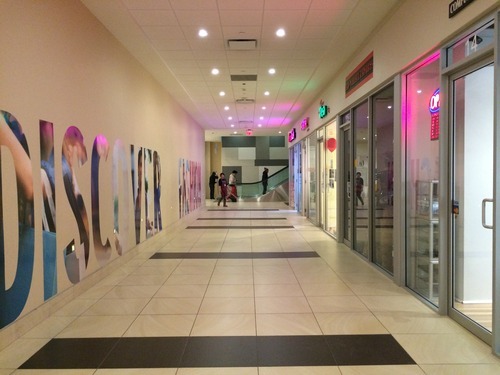
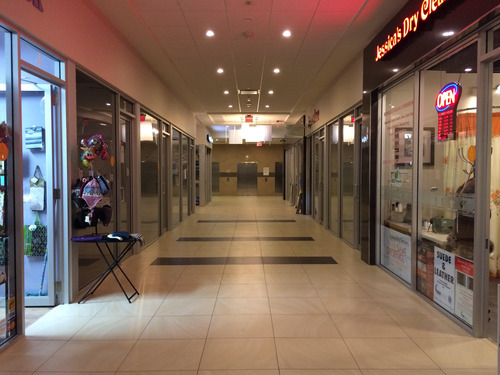
    But what’s probably most unique about the retail component of this building is the P1 level (the first underground level). It’s made up of small retail condos, some of which looked to be about 90 square feet. That means that each retail unit is individually owned, just like a residential condominium, and there’s no singular landlord focused on curating the tenant mix and ensuring the entire retail center does well.

    Now, I’m told that this approach works perfectly well in other parts of the world and I know that we’re trying it in other parts of the Greater Toronto Area, but I worry about the long term viability of this (P1) space in particular. When I was there on Saturday there was almost no foot traffic and probably half of the retail units were vacant.

    Maybe it’s because there isn’t enough employment density in the area. Maybe it’s because it’s not well connected to other P1 level retail. Or maybe it’s because the anchors all sit above this space, as opposed to around it (as they do in traditional malls). Whatever it is, I wasn’t feeling product/market fit.

    I hope I’m wrong.

    Images: P1 Retail at Aura Condos

  • Do you know where you spend your time?

    Yesterday my friend Sachin Monga published a really great article on Medium called, 2014: My Year in Review. It was broken down into a few sections that included everything from his favorite blog posts of the year to all of the images he posted on Instagram. He called it “a stream of personal observations, data, and highlights for the year.”

    And it put my end of the year blog post to shame.

    One section that really stood out for me though was Places & Transit. Using a mobile app called Moves, Sachin extracted an incredible data set for where he physically spent his time and how he got around in 2014. I can’t believe I haven’t heard of this app yet – it’s totally in my wheelhouse. But I’m clearly late to the party. Facebook bought them in the first half of last year.

    The data set included how many hours he spent at home and at work. His top 3 most visited coffee shops. His top 5 most visited friends. How many nights he stayed in a hotel. His average daily commute time. And his total distance walked and cycled, among many other things. It was fascinating. I love data – especially when it was previously impossible or difficult to collect it.

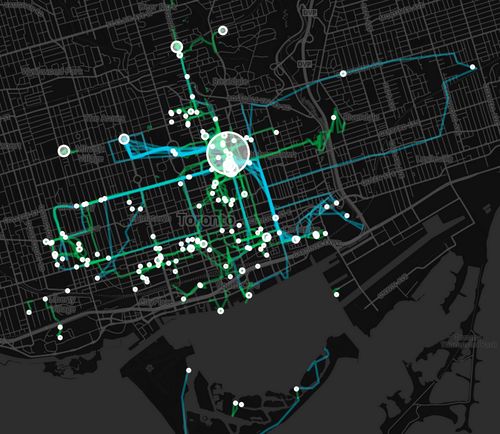
    He was also able to translate his data into a set of beautiful maps, showing where he spent his time and how he got around. Here is his personal map for Toronto. The larger the circle, the more often he was there. Blue lines are cycling. And green lines are walking.

    image

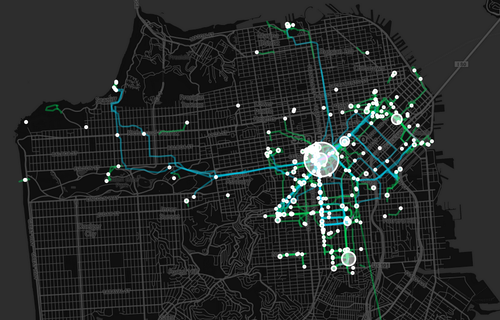
    And here’s San Francisco (where he now lives):

    image

    After reading his post, I immediately downloaded Moves. And I can’t wait to see how my personal map of Toronto will look like in a few weeks and months. Once I have enough data points, I’ll be sure to share it with you all here.

    In the interim, do you have any ideas for what this kind of data might be used for? I can certainly think of many. Let us know in the comment section below.