Daily insights for city builders, delivered every morning at 6 AM ET. I’m Brandon Donnelly — a Toronto-based real estate developer and founder of Globizen. I’ve been writing here since 2013.

Tag: financial services

  • The Apple Card fine print

    Apple announced a number of new products and services this week, including Apple TV+ and a new Apple credit card, which will initially only be available in the US.

    It all aligns nicely with their goal of growing their service/subscription businesses and weaning themselves off of an over-dependence on iPhone revenue.

    Below is a video summary of the new Apple Card. In typical Apple fashion, it sounds and looks like an elegant solution and I already want to one.

    I thought this topic would make an interesting follow-up to my recent post about whether cities should be banning cashless businesses so as to not discriminate against the “unbanked.”

    Because embedded in the above credit card is the following cashback reward structure:

    • 3% back on Apple purchases
    • 2% back on purchases made with Apple Pay (iPhone)
    • 1% back on purchases made with the (optional) physical card

    And so what this “card” will do is pay you to always use your phone. The cashback reward system is also instantaneous and you’ll be able to spend that Daily Cash (that’s the name) just like you would actual cash.

    Do you think this would change how you pay for things? I think for most people it will.
  • The City as a Place for People

    The City of London Corporation recently published a report called “The City as a Place for People”, which talks primarily about itself and how great London is as a magnet for talent. 

    But as self-serving as it may be – the report is timed to be ahead of this year’s MIPIM – there appears to be some data and interviews backing up the claims.

    58% of “institutional investors” said that London is the best European city for business. Dublin was next at 22%. 

    A separate survey of 2,568 “corporate decision makers” in Europe revealed that 21% of respondents felt that London was the best European city for business, followed by Paris (13%) and Frankfurt (7%). When asked which city had the best talent pool, the responses were fairly similar.

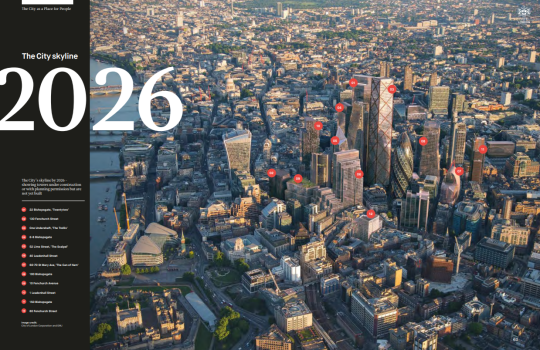
    Also included in the report is a rendering of the City’s skyline by 2026. These are always fun to see. Here is a screen grab:

    image

    It is showing all towers under construction and all towers with their planning permissions in place. If you’d like to download the full report, you can do that here.

  • Could a decentralized sales model work?

    image

    Since I started blogging last year, I’ve been getting regular emails from both people I know and from readers I don’t know (but hope to one day meet) asking for advice on buying real estate. Usually somebody sends me the link to a place they’re thinking about buying, and they want to know what I think about the property and the neighborhood.

    I’m more than happy to help when I can and I try to be brutally honest in terms of what I think. What’s interesting about this dynamic though, is that I don’t have a vested interest in any of the outcomes. Whether I tell that person I love the place or that it’s shit, I don’t stand to gain anything. And that means I can be brutally honest. It’s for this same reason that customer reviews on websites can work so well. 

    Because on the flip side, if I make money when you buy, then guess what, I’m going to want you to buy. That’s how it works for any industry–from financial services to real estate to retail. That’s why some stores will promote the fact that their sales people are not on commission. Although you could argue that those sales people are then less motivated to help you.

    In any event, all of this got me wondering if there isn’t some way to take customer reviews to the next level. Could a decentralized sales model work?

    Last year I had a conference call with one of the chief officers of one of the top 3 real estate websites in the US and I was told that they had actually tested a “social buying model.” It ultimately failed, but it strikes me as an interesting concept. Reviews are starting to feel a bit dated now on the social web, but I think the idea of crowdsourced input is here to stay.

    Image: Flickr

  • Tech is now the second largest job sector in New York City

    According to a recent report called Building a Digital City, which I found via Fred Wilson’s blog, tech is now the second largest job sector in New York City behind financial services (which includes real estate). There are an estimated 262,000 tech workers in the city earning wages in excess of $30 billion.

    This is a really interesting stat that speaks to the diversity of New York’s economy and the ability for it to continually reinvent itself. But what I found particularly interesting, was the following comment by Fred Wilson:

    “And the reason tech is growing so fast in NYC is that it is embedding itself in all of these other industries. It’s not entirely clear to me whether Gilt is a tech company or a fashion/retail company, it is not clear to me whether ZocDoc is a tech company or a health care company, it is not clear to me whether Codecademy is a tech company or an education company.”

    This is very much the way I think about so called tech companies today. I recently had a Rotman colleague say to me that he felt the startup world was becoming saturated. Everyone is now seemingly working on some new app.

    But I like to think of it slightly differently. As Fred’s comment above suggests, a lot of startups today aren’t purely tech companies. They’re just out to solve a problem and it just so happens that technology and the internet are creating all sorts of opportunities for new solutions.

    I also read a blog called Platform Connected and the author put it like this:

    “In the future, every company will be a tech company. We already see this change around us as companies move to restructure their business models in a way that uses data to create value. We are moving from linear to networked business models, from dumb pipes to intelligent platforms. All businesses will need to move to this new model at some point, or risk being disrupted by platforms that do.”

    So there you have it. Software really is eating the world.