Daily insights for city builders, delivered every morning at 6 AM ET. I’m Brandon Donnelly — a Toronto-based real estate developer and founder of Globizen. I’ve been writing here since 2013.

Tag: financial crisis

  • What is it that I believe?

    Back in 2008, I was living in the United States. And at that time, during the financial crisis, I remember people positing that the US wouldn’t be able to build another commercial office building for at least the next twenty years. That’s how bad things felt. People were panicking. But of course, that never happened. Yes, it took some time for real estate values to recover and for people to deleverage, but ultimately things did recover. New buildings were built and new ideas flourished.

    In fact, I’ll never forget what a close friend of mine said to me a few years after that moment in 2008. He said to me, “you know what Brandon, the crisis was probably one of the best things to happen to me. It meant that I couldn’t find a job and I was forced to start my own company. I probably wouldn’t have done that otherwise.”

    Today, we’re living through a different kind of crisis with its own set of uncertainties. Some, or perhaps many, seem to think it could lead to the demise of cities, similar to how our last crisis was supposed to lead to the demise of new office buildings (at least for a period of time). It’s easy to get caught up in narratives and headlines at times like this. And there are always ways to convince ourselves that this time might be different. Sure, we’ve had pandemics before, but previous generations didn’t have the tech that we have, right? Perhaps.

    The challenge is that we’re all trying to decode how much of what’s happening today is related to (1) short-term dislocation, (2) trends that were already happening and just got accelerated, or (3) durable and long-term structural changes. My own view is that the post-mortems will reveal more of (1) and (2), as opposed to (3). And that will mean that some of us have maybe been making long-term decisions (flee the city) based on short-term dislocation (a 1-2 year health crisis).

    Of course, I could be wrong. But it’s what I believe and what I have conviction around.

    Headlines are designed to target what Seth Godin and others refer to as our “lizard brain.” That being the primitive part of our brain that tells us when we’re, among other things, scared, hungry, fearful, and horny. What excites the lizard brain is not a headline saying that everything will probably be just fine. What excites the lizard brain is a headline saying that everything is utterly broken and a new paradigm is now upon us — pay attention or perish.

    It’s for this reason that I think it can be helpful to pause and ask yourself: “What is it that I truly believe?”
  • Focusing on fundamentals

    When the financial crisis hit in 2008, I was living in the United States. At that time I remember developers and other people saying that it was going to take at least 20 years before the country would build another commercial office building. It felt that bad.

    Job opportunities had certainly dried up — especially for Canadians like me who were focused on real estate development. But of course, things eventually got better. New office buildings got built well inside of two decades, and the US went on to see its longest ever economic expansion.

    This past Monday we saw the financial markets suffer one of, if not the, biggest selloffs since the financial crisis. If you haven’t yet checked your portfolio and/or retirement savings, I suggest you hold off until the Fed “prints” some more money. The time to sell is not right now. (Not actual financial advice.)

    Now is, of course, the time to remain rational and disciplined, and focus on the relationship between price and value. Fred Wilson’s recent blog post on “market meltdowns” is a good reminder of this. So here are a couple of excerpts that I really liked:

    I’ve seen this movie before. I had just started working in the venture capital business in 1987 when the stock market crashed 23% on “black monday.” There was the Internet stock meltdown in 2000 when the internet sector went down something like 80% over that bear market. And then there was the financial crisis in 2008.

    Capital markets sometimes put out the for sale sign and if you are patient and wait for bargains to emerge, they will do that.

    But I do know that good companies with resilient businesses and strong balance sheets will survive these occasional crises and that they can be bought with confidence at the right time.

    👊

  • Urban vs. suburban home prices

    Aaron Terrazas, who is a Senior Economist at Zillow, recently gave this presentation about the US and Virginia Beach housing markets. (I discovered it through City Observatory.)

    There are a bunch of interesting graphs/stats in the presentation. Home values in Virginia Beach, for example, have yet to fully recover from the 2007-2008 financial crisis. They are still 8% below their pre-crisis peak, which was in July 2007. (I presume the presentation is dealing in nominal dollars.)

    I’ll give two more examples. 

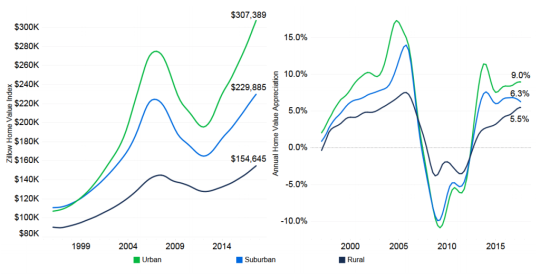
    Below is a chart comparing average home prices for rural (dark blue/purple), suburban (blue), and urban (green) homes. In the late 90′s, suburban and urban homes were roughly equal in terms of average prices. But since then, urban homes have shown greater appreciation. The spread also appears to be widening.

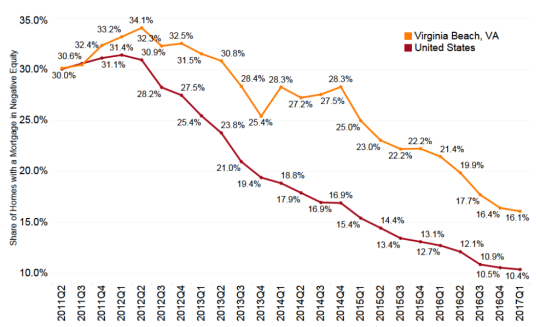
    And here is a graph showing the share of mortgage borrowers in a negative equity position. That is, the value of the home is less than the outstanding balance of the mortgage.

    Now this is only covers people who have a mortgage. According to this Washington Post article, about 34% of all US homeowners don’t have one. Either they have paid it off or they never had one.

    Still, the above numbers stood out to me. They speak to the severity of the financial crisis. At the end of 2011 and the beginning of 2012, over 30% of borrowers were in a negativity equity position. And in Virginia Beach it was more than 1/3 of all borrowers at the peak.

    For the full presentation, click here.

  • Depression babies

    Recently I’ve been seeing a number of posts/articles talking about the dot-com bubble. It seems to be driven by talk of a pending crypto bubble. 

    Whatever the case may be, the recounts are interesting. In this one by venture capitalist Fred Wilson, he talks about how 90% of his net worth went to zero following the crash. And the only reason it wasn’t all of his net worth was because he was fortunate enough to sell some tech stocks in advance of the crash to buy “two significant pieces of real estate.” The two properties were 10% of his net worth before the crash and 100% of his net worth after the crash.

    Fred goes on to talk about how he had to learn about diversification the hard way. And this reminded me of a theory that many of you are probably familiar with called “depression babies”. This is the belief that large macroeconomic shocks – such as the Great Depression and the dot-com boom – create a lasting impact on people’s propensity to take financial risks.

    And indeed, there’s evidence to suggest that this is in fact the case. In this 2010 paper by Ulrike Malmendier and Stefan Nagel, they came to the following conclusion: “Our results show that risky asset returns experienced over the course of an individual’s life have a significant effect on the willingness to take financial risks.”

    I often think about this with respect to my own career. I started working in real estate before the 2008 financial crisis. I also happened to be living in the U.S. at the time – where it was far worse than in Canada. We got off easy. I remember seasoned real estate professionals telling me that it was going to take at least 20 years before the U.S. would build another commercial office building. It was that bad. And that was the sentiment at the time.

    Of course, that wasn’t the case. It didn’t take two decades to resume building. But I like to think that 2008 will remain permanently etched in my mind. It’s my reminder that crashes can and will happen. Don’t forget that. Stay disciplined. At the same time, it’s my reminder that these periodic crashes create opportunities. Because fear invariably makes us overshoot the mark.

  • When rent control goes too far

    I was catching up with a friend of mine over coffee this morning and he was telling me about his recent trip to Porto, Portugal. I’ve never been, but it’s fairly high up on my list of places to visit.

    He was telling me about how beautiful the center of the city is and how it’s a UNESCO World Heritage Site. But he was also telling me how eerie it was to see so many abandoned and decaying buildings.

    And part of the reason for this – I learned – is that up until fairly recently, Portugal had some incredibly onerous pro-tenant rent controls in place that dated back to the beginning of the 1900s.

    In fact, they were so onerous that, by some estimates, roughly 150,000 households in Portugal were paying less than €50 per month in rent before the laws were changed!

    Because of this, landlords in many cases could not, and cannot, actually afford to maintain their properties. Buildings were left to decay, and in some cases they were completely abandoned. That was their only option. And it led to a virtually non-existent rental housing market (according to the IMF).

    Clearly, this is a problem. If you have a market distortion as serious as this one – where there’s virtually no incentive to invest – you’re on a highly unsustainable economic trajectory.

    Which is why when Portugal received its bailout package from the International Monetary Fund and European Union following the 2008 financial crisis, it was asked to reform its rent control laws – which it agreed to do.

    The hope was that the reforms would allow Portuguese landlords to charge more reasonable and market-oriented rents, as well as do other crazy things like evict tenants that don’t actually pay their rent. Not surprisingly, many fought the changes.

    I don’t know precisely how these reforms have ultimately played out in the market over the past few years (if you do, I’d love to hear from you in the comments below), but I do believe that liberalization of the market was, and probably still is, needed.

    While paying €5 a month for a 4 bedroom apartment in a desirable central neighborhood might be great for that one individual family, it’s not so great for the economy as a whole. And ultimately that comes around to impact even that household.

    Image: Flickr

  • Are department stores going to die?

    Here’s an interesting graph I found on Businessweek that outlines retail sales growth in America over the past decade:

    image

    What’s interesting is not that furniture stores suffered during the housing crisis of 2008-2009 – this much is obvious – but that there seems to be a few other trends at work.

    For one, warehouse club sales have gone from being the highest growth to the slowest growth sector (excluding, for a second, department stores). The urbanist in me wonders if this has to do with “The Great Inversion.” That is, the trend towards more and more young people choosing to live in inner city neighbourhoods – where warehouse club penetration is low – as opposed to the suburbs.

    The other notable sector is department stores. It’s the only sector that seemingly hasn’t been able to rebound along with the rest of the economy. I think this points to another larger trend at play: there are structural problems with the department store model. They’ve been beaten up by category killers, the internet and the fact that individual retailers seem to want to manage their own brands and experiences from top to bottom.

    I know that for me, personally, I rarely shop at department stores. What about you?