Daily insights for city builders, delivered every morning at 6 AM ET. I’m Brandon Donnelly — a Toronto-based real estate developer and founder of Globizen. I’ve been writing here since 2013.

Tag: finance

  • Where are rates going?

    Real estate is a highly levered asset class, which means
    that pricing is sensitive to interest rate changes.

    Larry Summers recently published a post on his blog
    where he argued that the Fed (US) is being far too complacent about their
    ability to respond effectively to a future recession. He sees this as their
    biggest monetary policy challenge going forward.

    Given the potential impact to real estate and city building
    as a whole, I thought I would summarize some of his key points:

    • Private sector GDP growth in the US averaged
      1.3% over the last year
    • Since the 1960s, this level of tepid growth has
      typically foreshadowed a recession
    • Larry sees > 50% chance that the US economy
      will enter a recession in the next 3 years
    • 400-500 basis points of monetary easing is
      usually needed to counter recessionary pressures
    • The Feds will likely not have this much room to
      play with when the next recession comes along

    I don’t think anyone could have predicted that rates
    would remain so low for so long. (10-year Treasury = ~1.6% at the moment.) Still,
    my view has been that rates in Canada and the US won’t be posting meaningful
    increases anytime soon. And Larry’s post reinforces that for me.

    What’s your view?

  • I can’t spend unrealized gains

    image

    Earlier this week the Wall Street Journal published an article claiming that the celebrated venture capital firm Andreessen Horowitz was lagging behind its elite peers in terms of returns.

    The firm then responded with a well-written blog post explaining why this accusation is off the mark. Their response was simply that you can’t measure returns on “unrealized gains.” Until there is a liquidity event – that is, the company gets sold or goes public – it’s just paper returns. And what matters is cash. 

    As the post clearly states: “I can’t spend unrealized gains.”

    But beyond just a rebuttal, the blog post is a great primer on how the venture capital industry works. We talk a lot about the tech space on this blog, so I thought some of you might find it interesting. 

    One of the reasons I like to follow the VC space is that there are many similarities to real estate development. Not only in the way that the funds are structured, but also in the way that the gestation periods are incredibly long.

    The post talks about this as a “J curve.” In the early years of a fund, the returns are negative. Money is going out the door to invest in immature and risky startups. And it’s not until the harvesting period (7+ years later) that the realized gains start getting paid out to investors (LPs).

    It’s also interesting to note that the exit timing for companies – at least according to Andreessen Horowitz – seems to be increasing (10+ years). This is yet another similarity to real estate development where it seems to be getting harder and harder to build and deliver new supply.

  • Home prices and negative interest rates

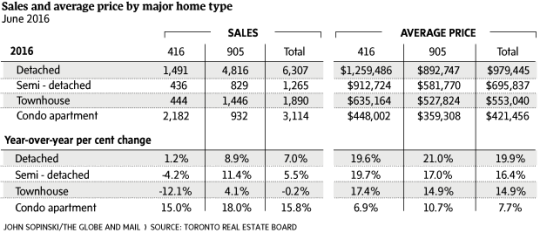
    This morning, I am looking at the following chart of average home prices in the Greater Toronto Area:

    It’s from this Globe and Mail article.

    These are staggering numbers. The average price of a detached home in the suburbs (905 area code) increased 21% year-over-year. In the city (416 area code), the increase was 19.6% YOY. These numbers are almost unbelievable.

    The article focuses on low supply (decrease in listings) and high demand. And that is certainly a big part of what’s going on here in this city, as well as in many others.

    But of course, the backdrop to all of this is our low / zero / negative interest rate environment.

    Larry Summers has a great post on his blog (which I discovered this morning via Fred Wilson) that talks about this “remarkable financial moment.” In some instances, real interest rates are actually negative! (You should read his post.)

    There are always people threatening that interests rates just have to go up. But Larry, as well as others, continue to argue that natural real interest rates are likely to remain close to zero going forward.

    Fred mentions Albert Wenger on his blog this morning and I have written about him before as well, here. In his book World After Capital, Albert argues that capital is no longer the scarce resource of our time. Instead, it has become attention.

    If you believe all of this to be true, then perhaps the numbers at the top of this post aren’t so unbelievable after all.

  • What is this a building for ants?

    One of the things you’ll often hear people deride at cocktail parties is the trend toward smaller urban dwellings. They get called “shoeboxes” and “cubby holes in the sky.” So let’s unpack that a bit today and try and better understand the economics behind it all.

    When a new building is being developed, pretty much everything gets normalized to a per square foot (or square meter) number. 

    This is important because saying that building X cost $50 million to build and building Y cost $100 million to build doesn’t tell you much if the buildings are completely different. 

    However, saying that building X cost $500 per square foot to build and building Y cost $475 per square foot to build, tells you that building Y, despite being more expensive in absolute terms, was actually cheaper and/or more efficient.

    The same is true on the revenue side. And typically, developers are looking (struggling) to meet a certain per square foot number in order to make the project financially feasible. 

    For instance, let’s say you’re building a 100,000 sf condo building. Once you subtract the non revenue generating spaces, you might determine that you need 85,000 sf x $600 per square foot in revenue in order to make the project feasible.

    But there’s a back and forth game that needs to be played here. You have to ask yourself: for the product that I’m hoping to build, does $600 psf translate into something that people can actually afford?

    You might think: everyone keeps telling me at cocktail parties that condos in this city are too small. So I’m going to build a bunch of 1,800 sf, 3 bedroom condos. Based on the above, these homes would be priced at around $1.08 million (1,800 sf x $600 psf). Your on-site signage would read: “Condos coming soon. From the low $1 millions.”

    But wait a minute, how many families can afford a condo north of $1 million? Some could, but definitely not the majority. So then you determine through rigorous market analysis that $600,000 would be a better number. That is something that is within reach of more families.

    But then you look at the math and realize that if you build that same 1,800 sf home, your per square foot revenue number now drops to $333 psf ($600,000 / 1,800 sf). 

    Given that you bought the land for $100 psf buildable (market price in the area) and that your construction costs alone are going to be $250 psf, you realize that you’re now underwater ($100 + $250 psf > $333 psf) without even adding in any soft costs (consultant fees, city fees, and so on). If you showed this to your investors on the project, they would throw you out of the room.

    So instead of building that 3 bedroom condo at 1,800 sf, you say to yourself: what if I made it 1,000 sf? You’re confident that your architect could lay out a terrific condo at that size and it now magically gets your per square foot revenue number back up to $600 psf. 

    This solves two problems: it returns the project to positive feasibility and it keeps the total sale price within reach of more people. It promotes greater affordability. So you go ahead and do it. Boom – shrinking urban dwelling.

    All of this is not to say that this is fair or unfair, good or bad. It is simply to say that this is the way it often is.

  • Warren’s blog

    I just finished reading Warren Buffet’s 2015 annual letter to Berkshire Hathaway shareholders. If you haven’t yet read one of his letters and you’re at all interested in business and investing, I would encourage you to check them out. (By going to their website you’ll also get a reminder of what the web looked like circa 1995.)

    When I read them I feel as if I’m reading a giant blog post from Warren Buffet – albeit one that only gets published once a year. They’re well-written and easy to read. They’re personal. They’re light and humorous. (He drops Tinder, the mobile dating app, in this year’s letter.) And they’re packed full of invaluable information and insights.

    To give you a sample, here are two snippets that I liked:

    “Our flexibility in capital allocation – our willingness to invest large sums passively in non-controlled
    businesses – gives us a significant edge over companies that limit themselves to acquisitions they will
    operate. Woody Allen once explained that the advantage of being bi-sexual is that it doubles your chance
    of finding a date on Saturday night. In like manner – well, not exactly like manner – our appetite for either
    operating businesses or passive investments doubles our chances of finding sensible uses for Berkshire’s
    endless gusher of cash.”

    “America’s population is growing about .8% per year (.5% from births minus deaths and .3% from net
    migration). Thus 2% of overall growth produces about 1.2% of per capita growth. That may not sound impressive.
    But in a single generation of, say, 25 years, that rate of growth leads to a gain of 34.4% in real GDP per capita.
    (Compounding’s effects produce the excess over the percentage that would result by simply multiplying 25 x 1.2%.)
    In turn, that 34.4% gain will produce a staggering $19,000 increase in real GDP per capita for the next generation.”

    Overall, he remains, and rightly so I’d say, very bullish on the United States: “For 240 years it’s been a terrible mistake to bet against America, and now is no time to start.”

    What do you think?

  • Should you buy a car or just take Uber?

    Urban dawn by Raymond  on 500px.com

    https://500px.com/embed.js

    My friend Evgeny published a great blog post today called, On Car Ownership And The Future Of Transportation

    And in it he made the argument that instead of buying a car and an expensive downtown Toronto parking spot (average price: $40,000 – 60,000), most of us urbanites would be better of just taking a taxi or Uber.

    This got me thinking: At what point does it really make sense to completely forgo owning a car? (Full disclosure: I own both a car and a downtown parking spot.) So I decided to dig into the numbers a bit more and compare 4 mobility options:

    • Owning a car ($25,000 upfront) + downtown parking spot ($40,000 upfront) and driving yourself everywhere
    • Taking a regular taxi exclusively ($3.25 base + $1.75 per km)
    • Taking an UberX exclusively ($2.50 base + $1 per km)
    • Or, taking a futuristic driverless car everywhere (here I assumed $1.50 base + $0.25 per km)

    With the above numbers, I then assumed 15,000 km traveled per year and an average trip length of 15 km (so 1,000 trips per year). The trip length and number of trips per year matter because of the “base fare” that is charged when you take a taxi or Uber.

    I also assumed that the cost of owning a car is $0.60 per km (estimated from this Globe and Mail article) and that there is an opportunity cost to NOT renting out your downtown parking spot ($200/month). That is, every month that you spend driving yourself around and parking your car, you are forfeiting parking revenue.

    Finally, I looked at a 10 year time horizon and then “discounted” all the costs back to today’s dollars so that I could compare each mobility option.

    So what did I find?

    image

    What this says is that if you’re driving 15,000 km per year (average trip length 15km), then you’re better off taking UberX everywhere, as opposed to going out, buying a car and parking spot, and driving yourself around.

    But does this hold true at different travel distances?

    Based on my model, once you hit around 18,000 km per year, then you’re better of with option 1 (owning a car). That’s because the per km savings associated with driving yourself around are enough to offset the upfront costs of the car and parking spot.

    On the flip side, when you drop below 7,500 km traveled per year, even a regular taxi starts to make sense. That’s because you’re simply not traveling enough to reap the benefits of owning a car/parking spot. Again, high upfront costs; lower per km operating costs.

    Of course, there are a number of things I didn’t consider in my model. For one, most people finance their car and parking spot (it is bundled into their home mortgage). So I’m sure there are ways that you could change the above outcomes using leverage.

    At the same time, I didn’t account for the fact that when you’re being driven around (as opposed to driving around) you have the flexibility of doing work, responding to emails, and so on. If you want to attach a value to your time, then the scale would tip back in favor of taxis and Uber.

    But all of this was really just to make one point: look how cheap it could be to ride around in a driverless car. When that becomes the reality in our cities, which it will, it’s going to completely transform our current beliefs around cars, parking, and many other things.

    I guess that’s why General Motors just invested $500 million in the peer-to-peer ridesharing company, Lyft. They know the shit is coming.

  • My identity crisis

    If you’re a regular reader of Architect This City, there are many things that you might know about me

    You might know that I was initially trained as an architect, but that I immediately transitioned into real estate development after grad school (where I studied both architecture and real estate).

    After becoming a real estate developer, you might know that I completed an MBA with a focus on innovation and entrepreneurship (which happened by default as a result of the electives I ended up being interested in).

    And finally, you might know, given the content of this blog and my startup history, that I have a significant interest in technology. More specifically though, you might know that my interest is in figuring out how technology will continue to infiltrate and impact “non-tech” industries such as real estate.

    But what you might not know is how I even ended up in architecture and real estate in the first place. Unlike a lot of people who seem to have grown up wanting to be an architect – perhaps because they had a relative who was one – I didn’t decide to study architecture until a bit later on.

    Growing up my primary interests were: art and computers.

    During high school, my art teachers used to tell my parents that I was going to be an artist. And my computer teachers used to tell my parents that I was going to be a computer geek – or maybe they said computer scientist.

    Maybe it had to do with timing and the emergence of the commercial internet in the 1990s, but computers sort of won out during that point in my life. I spent a lot of time building them from scratch, playing with software, and asking my mom not to pick up the phone because I was literally dialed-in to the internet.

    So when it came time to enrol in university, I fairly effortlessly decided on computer science. It just seemed to make sense. But after about a year I realized that it wasn’t for me. I didn’t love programming like my classmates did and the thought of doing it for a living scared me.

    At the same time, I felt like I needed to feed the artist in me. I wanted something both artistic and technical. So I decided to drop out of computer science and give architecture a try. It just seemed like the perfect marriage of my interests.

    I immediately fell in love with architecture. And I spent the next 7 years studying it across 2 degrees.

    But during that time, two things hit me. First, I came to the realization that real estate developers are the ones who really have the most say in terms of how our cities are built. And second, that technology was having a massive impact on business and life.

    This told me that design alone wasn’t going to be enough. I also needed to engross myself in real estate, finance, business, and technology. So that’s what I set out to do. And I really enjoyed it. On the technology side, it felt like I was coming full circle in a way.

    But today, I feel a bit like a 3 legged stool. There’s the design leg. The real estate/business leg. And the technology leg. And oftentimes I feel like life would be a lot simpler if I could just balance on one of those legs – instead of trying to stand on all three. But that’s simply not me.

    These are my passions and I need all of them to stand-up.

  • Frank’s Vault and virtual real estate

    Earlier this week a good friend of mine from Rotman, Frank Luengo, launched his own blog called Frank’s Vault.

    Given that he has used the same theme as I have here, I like to think it was inspired by ATC 🙂 But whatever the case may be, his mission is: “…to simplify the complicated, and to bring Bay Street and Main Street a little closer together.” In other words, it’s a finance blog. And I’m really enjoying it so far.

    Last summer Frank told me that he was thinking about starting this and so I’m thrilled that he finally decided to do it. I’ve talked many times before about the benefits of personal blogging, and so I won’t repeat them here. But I did want to mention one other thing. When Frank told me he launched, one of the first things I did was congratulate him on claiming frankluengo.com.

    And I did that because I’m a big proponent of owning your firstnamelastname.com. I look at internet domains as virtual real estate and I, therefore, look at firstnamelastname.com as your own piece of branded real estate on the internet. If you don’t buy it up, somebody else will. That’s obviously why I own brandondonnelly.com and why I host ATC on it.

    But since I’m such a believer in real estate – both the offline and online varietals – I actually own many others. I also own brandondonnelly.co, brandondonnelly.ca, and brandondonnelly.me. The latter one links to my tumblog, and the first 2 just redirect to this site. I don’t derive much utility from having all these URLs, but I just want them so that nobody else can get them.

    So if you haven’t yet thought about it, I would encourage you to think about claiming your own piece of real estate on the internet. I use Namecheap.com to buy my domains, but there are many others out there.