Daily insights for city builders, delivered every morning at 6 AM ET. I’m Brandon Donnelly — a Toronto-based real estate developer and founder of Globizen. I’ve been writing here since 2013.

Tag: film

  • Making River City

    My good friends over at Urban Capital recently released a short film about the making of their River City project here in Toronto. (If you can’t see the embedded video above, click here.)

    For those of you who aren’t familiar, River City is a 4-phase development on the east side of downtown that was really the first project in what was known as the West Don Lands area. Urban Capital secured the right to develop the then government-owned lands in 2008 through a public tender process that was run by Waterfront Toronto.

    It’s a tricky and unobvious kind of site in that it’s surrounded by infrastructure and it came with a whole host of development challenges, including flood risk. But the team figured it out and River City has gone on to win a number of awards including the Ontario Association of Architect’s Lieutenant Governor’s Award for Design Excellence.

    River City is an important project for Toronto in that it dared to be different. It’s like no other project in the city, and I’m not just saying this because they’re my friends. I’m saying it because I want our city to be a global leader in architecture, design, and development, and to continue to push the envelope.

    River City did exactly that.

  • Telling a story through spaces

    I started watching Parasite on a flight home this past weekend (I know, I’m behind). The first couple of scenes immediately hooked me and so I ended up watching the full movie over the weekend. It’s one of the most creative movies I have seen in a long time. (To be fair, I don’t watch a lot of movies these days.) I won’t spoil it all for you here, but if you haven’t seen it yet, I would highly recommend it. One of the principal themes is social inequality. And it’s interesting to see how that gets told through the spaces within the film. The poor family lives in a “semi-basement” at the end of what appears to be a laneway. And the rich family lives, higher up, in a house designed by a famous architect. Naturally it has a big and perfectly manicured backyard. At one point in the film, you also get to see which housing type is more environmentally resilient.

    I’ll leave it there. But it’s worth checking out if you are into award-winning Korean tragicomedies.

  • My Piece of the City

    A friend of mine just sent out a group city builder email about My Piece of the City, which is a new documentary that is screening all weekend here in Toronto at the TIFF Bell Lightbox.

    The film is a critique on the revitalization of Regent Park, told through local residents and their efforts to stage a community musical (which happened in real life).

    The Daniels Corporation, in partnership with Toronto Community Housing, is the developer and builder for the entire 69 acre community. The Daniels Foundation also funded the musical and this documentary.

    But, despite this backing, the Globe and Mail has said that it remains a “healthy critique” of this entire process. And the trailer certainly gives you that impression.

    I am sure that this documentary will be of interest to many of you, so if you would like to grab tickets for this weekend, you can do that here.

  • Video: New York 1911

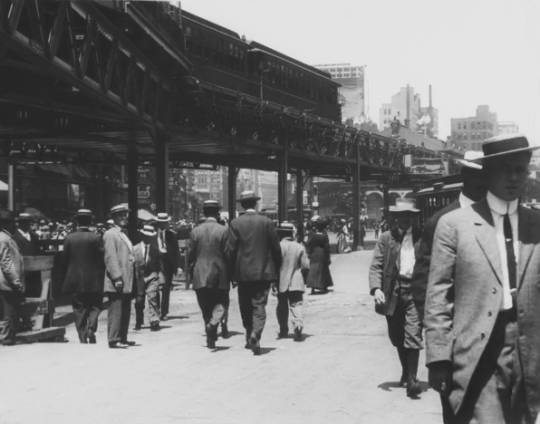
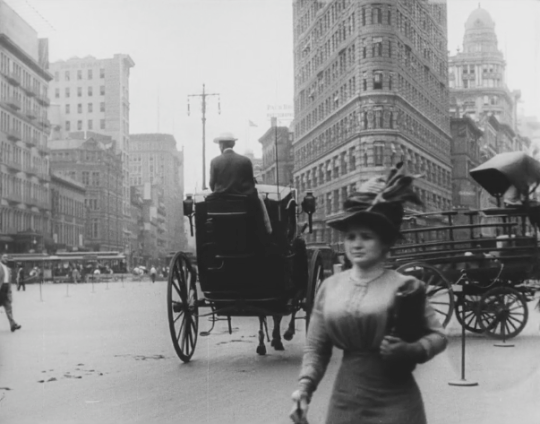
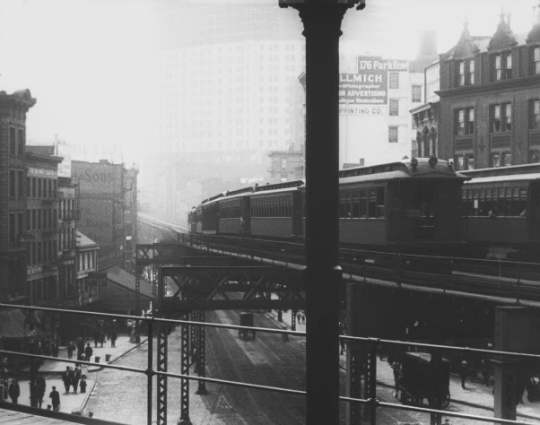
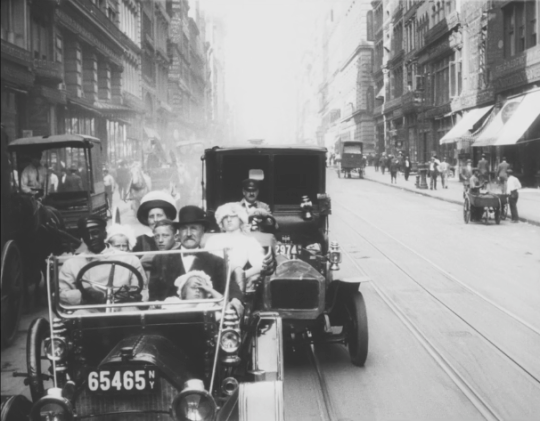
    The Museum of Modern Art (MoMA) recently restored and published a “documentary travelogue” of New York City from 1911. 

    It was originally filmed by a Swedish company, called Svenska Biografteatern, that went around the world filming noteworthy places such as Niagara Falls, Paris, Monte Carlo, and Venice.

    Not surprisingly, New York City is a vibrant and bustling place at the beginning of the 20th century. But it somehow feels serene. Maybe it’s the soundtrack. It’s also interesting to think that this was filmed only 3 years before World War I broke out.

    I particularly enjoyed seeing all of the streetcars (trams) and elevated rail running through the streets.

    Below is a screenshot of a young girl – clearly bored and/or disinterested – being chauffeured down Fifth Avenue in what was almost certainly a fancy convertible at the time.

    MoMA doesn’t allow you to embed the video, but you can watch it here through July 14. It’s 9 minutes and, if you’re a city nerd like me, I think you’ll really enjoy it. The street life footage kicks in around the 3 minute mark.

    Screenshot Images: MoMA

  • The Millennial Dream [Documentary]

    Back in 2015, I was interviewed for a documentary called The Millennial Dream. I then completely forgot about it until somebody tweeted it at me yesterday. So the documentary is out – it was released last year – and you can rent it or buy it on iTunes.

    The documentary calls into question the [North] American Dream. This idea that you just have to work hard, save up, buy a house in the suburbs, pay off your debt, and then everything will be just fine. For many, that dream is quickly disappearing, if it hasn’t already.

    Enter the Millennial Dream. Our economy is changing. Our jobs are changing. Our cities are changing. And by 2020, the Millennial generation is expected to form 50% of the global workforce. What is this generation dreaming about? That is what this documentary is about.

    But I should probably stop here because I haven’t actually seen the film. I could be overselling it. I’ll watch it this weekend and then report back. If you can’t see the trailer embedded below, click here.

    [youtube https://www.youtube.com/watch?v=CVCNXJk2fT8&w=560&h=315]

  • The Art of Design

    I don’t actually have Netflix, but they have a new original documentary series out called, Abstract: The Art of Design. It’s a look at “eight of the most creative thinkers” working in art and design. It premiered at the Sundance Film Festival this year.

    Here are those 8 people:

    1. Es Devlin (stage designer)
    2. Ilse Crawford (interior designer)
    3. Ralph Gilles (Chrysler head of global design)
    4. Bjarke Ingels (architect)
    5. Platon (photographer)
    6. Christoph Niemann (New Yorker cover illustrator)
    7. Paula Scher (graphic designer)
    8. Tinker Hatfield (Nike sneaker designer)

    The trailer feels unnecessarily dramatic for a documentary, but I’d still like to watch it. The reviews also seem to suggest that it’s pretty good. Below is the trailer. If you can’t see it below, click here.

    [youtube https://www.youtube.com/watch?v=DYaq2sWTWAA?rel=0&w=560&h=315]

    If you’ve already seen it, what did you think?

  • Important things

    image

    Last weekend I watched Minimalism: A Documentary About The Important Things. I’ve been reading the blog for awhile now (I blogged about it) and so the movie has been on my to-do list since it came out.

    Now, I am not a minimalist to the same extent as Joshua and Ryan, and some of the people featured in the film. I have not reduced all of my personal belongings to 51 things and I have not renounced any sort of permanent residency. I own some stuff.

    But I am very much attracted to the philosophy that less can be more. That less can make us happier. That quality is more important than quantity. And that we actually need far less stuff than we think we do, especially in a consumerist society like ours.

    One word that comes up a lot in the documentary is: deliberate. In other words, we should be more deliberate about the choices we make, the things we buy, and so on. Will it create value in my life?

    And that’s one of the reasons I like this notion of minimalism: It’s a challenge. You have to think. Because if you don’t, you will be told what to do and what to buy, and you will accumulate things without even knowing. It’s essentially a constant battle against excess.

    Perhaps the biggest potential for excess happens with our choice of housing, which is why small homes feature so prominently in the film. A tiny house isn’t going to be for everyone, but many people have certainly come to the realization that square footage alone does not equate to more happiness.

  • Vancouver never plays itself

    There’s something powerful about seeing/hearing cities being depicted in film, TV, and other kinds of pop culture. It creates familiarity and does a lot to drive the brand of that place.

    But how often are you just seeing one city disguised to look like another? Actually quite often.

    Here’s an interesting video that talks about how the 3rd largest film production city in North America never actually plays itself.

    [youtube https://www.youtube.com/watch?v=ojm74VGsZBU?rel=0&w=560&h=315]

    I know that there are real economic benefits to being a cheap place to film movies, but I would love to see Canadian cities play themselves. There are also big benefits to that.

    Thanks to Scott Bonjukian at The Urbanist for sharing the above video this morning.

  • The relationship between architecture and film

    There has always been a strong relationship between architecture and film. Next to actually being there, video is one of the best ways to experience architecture.

    And that’s because space is not static. A big part of how we experience space has to do with what it feels like as you move through it.

    For example, American architect Frank Lloyd Wright was notorious for his sprawling horizontal houses and low ceiling heights. In his Fallingwater House (which is stunning), I swear that my head was rubbing on the ceiling in certain rooms (I’m 6’3").

    But he did this to purposefully create a feeling of compression. Because then as you exited the room (in this case to go outside onto a terrace) the feeling of openness and expansion is all that more powerful. The contrast creates awareness.

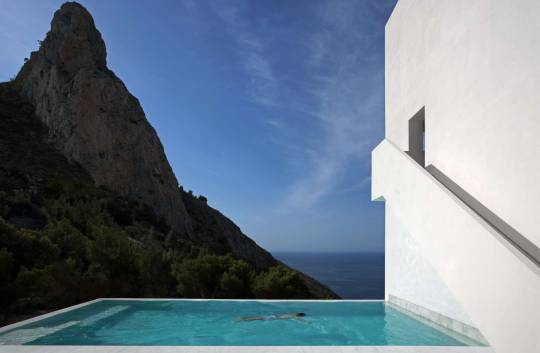
    In honor of the cinematic nature of architecture, below is a magnificent video of the Casa del Acantilado (House on the Cliff) by Fran Silvestre Arquitectos. Pay attention to the sliding planes and framed views throughout.

    The image shown at the top of this post is from Architizer.

    [vimeo 52162380 w=500 h=281]

    Casa del Acantilado | House on the Cliff by Fran Silvestre Arquitectos from Fran Silvestre Arquitectos on Vimeo.

  • The Millennial Dream

    This evening I was interviewed for a documentary called The Millennial Dream. It’s all about how Millennials – people like me – are rethinking or even rejecting some of the traditional notions of The American Dream. It’s being produced by Hemmings House.

    My part was all about housing. 

    So a lot of it was about how housing preferences have (or have not) changed for Millennials. If you’re a regular reader of this blog, you’d already be familiar with many of the topics I covered.

    What’s most interesting to me though, is not what Millennials are doing today. We already know that there’s been a return to cities and that many young people prefer walkable and authentic communities. Everyone is talking about it and it’s no longer novel.

    What’s more interesting to me is what Millennials are going to do in the next 10 years when the majority of the cohort is in their 30′s. What percentage will be married? What percentage will have kids? And, where and how will they choose to live in cities?

    Because there are some structural changes happening. Marriage rates in the US have been declining since the 1960s (see New York Times).

    And fertility rates are at their the lowest in US history. So in theory, and unless things change, Millennials should on average demand different types of housing. Fewer of them are likely to marry and they’re having fewer kids.

    But at the same time, I also believe that there have been changes in consumer preference that are not going to completely reverse as Millennials age. So city builders will need to come up with new and creative forms of housing for families who want to stay in urban centers. And that’s an exciting challenge.

    I’d be curious to hear thoughts in the comment section below. The documentary won’t be out until the end of the year, so you still have a chance to influence its direction. More voices are better than one.