
Daily insights for city builders, delivered every morning at 6 AM ET. I’m Brandon Donnelly — a Toronto-based real estate developer and founder of Globizen. I’ve been writing here since 2013.

Tag: feedback

  • Let’s fix the UPX train, together

    I am a big fan of the UP Express train that runs from downtown Toronto to Pearson Airport. 

    I love the station architecture, the branding and identity, the trains themselves (with wifi), and the local retailers they house at Union. I also happen to live a stone’s throw away from the downtown station. So I can go from door to bum in seat within 10 minutes.

    But despite all this, it has become clear that something needs to be done to fix the UPX train. Just last weekend a friend of mine and fellow urbanist, who was visiting Toronto from Vancouver, sent me a text message saying: “This UPX train is really nice, but why is it so expensive?”

    Indeed, that seems to be the general consensus. Here is the opening paragraph from a recent Globe Editorial article:

    Toronto’s high-end airport express train is a failure. A city that urgently needs better transit has been saddled with a deluxe boutique rail service that cost $456-million to build and runs nearly empty, 19 ½ hours a day.

    So today I thought we could collectively brainstorm some ideas for how Metrolinx – the public agency that operates the train – should address this issue.

    I’ll start by sharing my thoughts as a rider and then, hopefully, you all will share yours in the comment section below. I know that there are people from Metrolinx who subscribe to this blog, so I am sure your feedback will get through to them.

    My thoughts are twofold. Like many others, I think the pricing is off. But at the same time, I think there should be a focus on enhancing the value proposition of the service.

    Bur first, let’s talk about price.

    At the time of writing this, a one-way trip from Union Station to Pearson Airport on the UPX is $27.50. If you happen to have a PRESTO card, it’s $19.

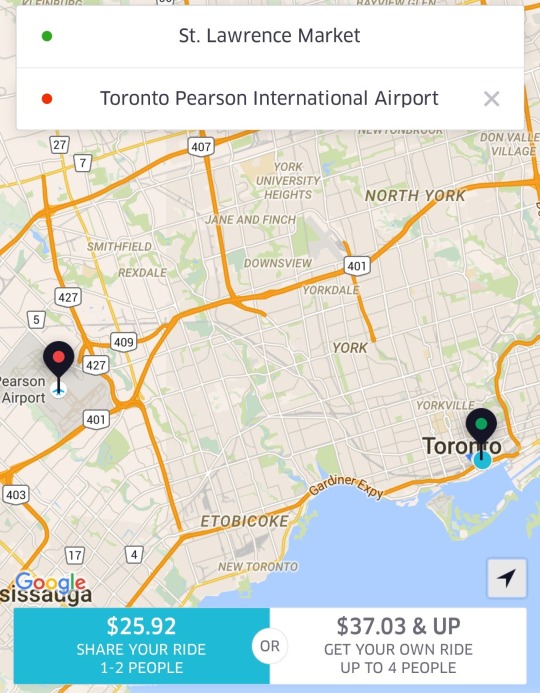
    The alternative for many is probably a taxi. So let’s also look at some Uber fare estimates. For someone like me leaving the St. Lawrence Market area, I’m looking at $25.92 with UberPOOL (meaning I’m sharing the car with 1-2 other people) or $37.03 if I insist on riding solo.
    image

    Against the non-PRESTO fare, UberPOOL is a cheaper option and it’s door-to-door service. Against the PRESTO fare, UPX is potentially $6.92 cheaper. But if you’re someone who has to take the subway to the UPX station, then it’s only $3.67 cheaper (add $3.25 for the subway) and it’s not door-to-door service. So for the vast majority of people, I suspect that UberPOOL would win out in this particular scenario.

    If you happen to be traveling with someone, then UberPOOL and UberX are probably going to be cheaper no matter how you slice it. And again, you’re getting door-to-door service. So I think the consensus is right: fares need to come down.

    But I don’t think Metrolinx should be solely focused on price. They should also be thinking about ways to create additional values for riders. 

    One of my favorite travel experiences is that of Hong Kong’s airport train. There, they have airline check-in counters in the city so you can collect your boarding pass and check your baggage up to a day before your actual flight. This is a huge value add because it means you can check out of your hotel, liberate yourself of your luggage, and spend the day in the city before leaving on the train to catch your flight. You can’t do that with an Uber. And lugging bags around a busy city, sucks.

    My point with all of this is simply that you can’t expect people to pay more or roughly the same, if they are not getting additional value. And right now, the train isn’t door-to-door and taxis are. (Though, the train has a travel time advantage during peak times.) So you either make it cheaper or you create additional value. Or, you do some combination of the two, which is where my head is at.

    What are your thoughts? Please respond in the comments below so all the feedback is public. Thanks.


  • What do you want to read about on Architect This City in 2015?

    Photograph Schönefeld by Vladimir Smirnov on 500px

    Schönefeld by Vladimir Smirnov on 500px

    Though this blog is focused on cities and geared towards city builders, I cover a lot of different topics. 

    I talk about real estate, architecture, planning, transportation, technology, and even personal topics. My primary goal is to create a worldwide community of people passionate about building great cities, but at the same time it’s still a personal blog.

    Usually I just write about whatever is currently on my mind. I never queue up posts and so each post is written the day of. But sometimes I wonder if I’m delivering on what you, the readers, really want to read and talk about. 

    So today I thought I would simply ask: what would you like to see more of on ATC in 2015? Let me know in the comment section below and I’ll try my best to deliver.

  • Show Yonge some love

    image

    Since last summer the Downtown Yonge Business Improvement Area in Toronto has been running a really creative community engagement program at yongelove.ca.

    The site includes a short history of Toronto’s most famous street, an Instagram contest (use #YongeLove to participate), and a survey where both locals and visitors can provide their feedback on what they think the future of Yonge Street should be.

    The reason this is being done is because, in 2016, Yonge Street from Davenport Road all the way south to the lake will be ripped up for infrastructure upgrades. And so it was rightly determined that now is the right time to rethink the future of Yonge. Let’s do this once.

    I’ve already talked about the Yonge-Redux proposal here on Architect This City and that seems to be where everyone’s head is at in terms of what they would like to see. I also think it’s the right thing to do for Yonge Street. If you’ve ever been on Lincoln Road in Miami or La Rambla in Barcelona, you’ll know how magical a great street can be.

    So I’d encourage you to complete the Yonge Love Survey and advocate for something awesome. It ends next month, after which time all the feedback will be forwarded to the city.

    I’d also love to hear what you think and how you responded in the comment section below. My response was more or less geared towards supporting the Yonge-Redux proposal.

  • Public consultation is broken

    Public consultation is broken. And by that, I mean that the way in which municipalities, developers, and other city builders solicit feedback from communities is fundamentally flawed.

    For new developments, the process works more or less like this: The developer makes an application to the city. The city reviews it and then agrees to move towards a public/community meeting (the goal of which is to solicit feedback on the proposal). Once a date is set, notices go out, and the developer secretly hopes that no one will show up. 

    Because what often ends up happening is that it’s only the people with the time or a bone to pick who actually go to these things. Rarely do people go simply to voice their support for a project. That’s why the benchmark for success is usually no community opposition – it’s rarely about support.

    But from writing Architect This City, I know that many of you care deeply about your community and about cities in general. The problem, is that I don’t think most of you get a chance to voice your opinions. How many of you have actually gone to a community meeting in order to show your support for a development project or city initiative? I’d be curious to know, but I suspect most of you haven’t.

    The result is a system whereby the voice of a few (often naysayers) have a disproportionate amount of weight. They set the tone. But that’s not how community input works best. It needs to be representative of a broad and diverse cross section of the population. It needs to be inclusive. Everyone in the community should have a say.

    So today I was thinking that there’s an opportunity for somebody out there to create an online platform for community feedback. Developers would post up their project and then everyone in the community, as well as in the larger city, would have an opportunity to vote on it and provide their feedback.

    To make it fair, you could assign higher weights to people the closer they live to the project. But the idea would be to make it as easy as possible for everyone to provide feedback – whether they’re on their smartphone or at the regular community meeting. 

    Obviously this would require greater openness, but I don’t think that pulling back is the answer to this problem. The solution isn’t to hide from the potential naysayers; it’s to galvanize the supporters. 

    If your community already has a platform like this, please share it in the comment section below. I’d love to see it.