Daily insights for city builders, delivered every morning at 6 AM ET. I’m Brandon Donnelly — a Toronto-based real estate developer and founder of Globizen. I’ve been writing here since 2013.

Tag: fast fashion

  • The opposite of fast fashion

    I just discovered and purchased a pair of pants from this French brand called 1083. They specialize in jeans and everything they sell is, for the most part, made in France.

    The name 1083 refers to 1083 kilometers, which is the longest possible linear dimension within the “hexagon” of France (a hexagon is often used to describe the geographic boundaries of continental France).

    As an example, their shoes have a message on the insoles that says “this shoe was produced within 1083km of where you are right now.” I thought this was a cool brand story and so I wanted to share it with all of you today.

  • Fashion nothingness

    Fashion, like architecture, says a lot. It is, according to Wikipedia, an “aesthetic expression at a particular time, place and in a specific context.” So it’s interesting to consider how fashion might translate, and not translate, around the world. This recent article by The Economist, called “The United Nations of Uniqlo,” offers up one comparison, albeit a generalized one, between Japanese and American clothing preferences. (It’s an article about the Japanese fashion label Uniqlo.)

    Japan:

    At first glance there seems nothing obviously Japanese about Uniqlo’s wares. But a strong strain of minimalism pervades Japanese culture. Buddhism remains an important influence on Japanese society even in an increasingly secular age, and among its core tenets are renunciation and detachment – concepts that mean being able to suppress one’s lust for the material elements of daily life. Mario Praz, an Italian critic, contrasts the Japanese style with the suffocating abundance of Victorian interiors in Europe and America which, he says, stemmed from horror vacui (fear of emptiness). More recently, young people in the West have also grown less enamoured with acquiring stuff, hence the widespread popularity of another Japanese export: Marie Kondo, a professional declutterer.

    America:

    The American market has proved harder to crack. The 56 Uniqlo stores in America fall far short of Yanai’s plan, in 2012, to open 200 there. They still operate at a loss. “When you think about the American market, you don’t always think of subtlety,” said Steve Rowen of Retail Systems Research, a consultancy. “This is a social-climber society. Even if you want to fly under the radar, there still has to be some indication that you’re fashion forward.” Once that urban millennial with a starter job begins to make real money, Rowen postulated, “they move past a brand like Uniqlo pretty quickly.” Americans are perhaps willing to embrace invisibility only until they are rich enough to want to be seen.

    You could probably also fashion a similar argument around housing preferences. The Japanese are known for their minimalist houses, as well for completely different views on housing in general. But we shouldn’t forget that good minimalism is expensive. Remember: “Only the rich can afford this much nothing.” Maybe that’s what Uniqlo needs to do in America. The problem is that its nothingness isn’t expensive enough.

  • A demand-driven apparel world

    Here is an interesting article from Loose Threads that talks about the profound impact that data and fast fashion are having on apparel brands, transforming them from supply-driven businesses to demand-driven ones. It adds a bit more nuance to the trope that tech is disrupting retail simply because people are choosing to buy online.

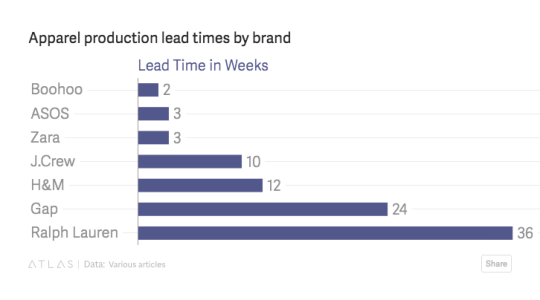
    The argument, here, is about a more fundamental shift in commerce. Brands are now forced to move faster than ever before. Product lead times are dropping (see below via LT). Customer feedback loops are almost instantaneous because of social. And the result is that customers are now the driver: Figure out what people want right now and then create that supply as quickly as possible.

    image

    Fast fashion certainly isn’t a new concept, but the data, algorithms and demand planning systems are only becoming more robust. Merchandise buying – historically the work intuitionists trying to predict what customers will want seasons into the future – is now an automated process that optimizes itself following every click, abandoned shopping cart, and social media like. 

  • Experiences over fashion — or is that really the case?

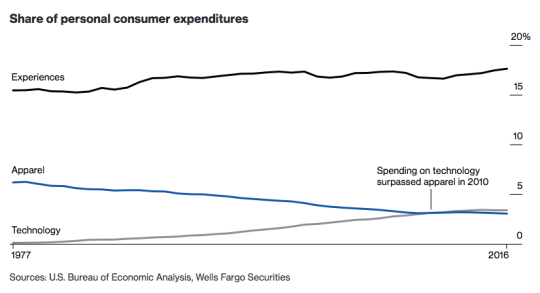
    Bloomberg recently published this interesting piece talking about the death of clothing. The reasons are as follows: we’re spending more on experiences, as well as technology (tech spending surpassed apparel spending in 2010); casual dress in the workplace has become more widely accepted; fast fashion companies like H&M and Zara are putting downward pressure on prices; and social media influencers – instead of big companies – are now the ones showing us what to buy and wear.

    Here is a graph from the article comparing experiences, apparel, and technology expenditures: 

    image

    The first thing I noticed is that experiences, while still increasing, haven’t really spiked since 1977, even though everybody seems to be talking about how social media-fueled Millennials are all about experiences. I was also surprised to see that the share of US employers that allow casual dress every day seems to be closing in on 50%. (Informal survey for the comments and for Twitter: Do you wear casual clothes to work? I’m a no.)

    But perhaps the biggest contributors to this decline are fast fashion and low-cost manufacturing. Stanley Pignal – South Asia business and finance correspondent for the Economist – pointed out on Twitter that since 1982 inflation in US apparel was only 123% compared to 248% for overall CPI. So maybe a lot of the above reasoning is just a distraction.