
Daily insights for city builders, delivered every morning at 6 AM ET. I’m Brandon Donnelly — a Toronto-based real estate developer and founder of Globizen. I’ve been writing here since 2013.

Tag: families

  • Families in multi-family buildings

    There is an ongoing debate in Toronto, and many other North American cities, about how to encourage more families to live in multi-family buildings. And here that has generally translated into (1) mandating a certain number of larger family-sized suites and (2) creating design guidelines to better equip both suites and buildings for families.

    But what we often ignore is the very real economic reality of buying a large family-sized suite. If you look at the latest Q3-2022 data from Urbanation, the average price of a new condominium in the entire Greater Toronto Area right now is about $1,427 psf.

    So if assume that a good family-sized suite is, oh I don’t know, 1,200 sf, the average price would be about $1.7mm, before you add in any parking (if necessary).

    If this is too big and you can get away with something more similar to a post-war bungalow — let’s say 900 sf — you’re still at nearly $1.3mm, again before any parking. At these sorts of prices, you have a few options, particularly if you’re willing to sprawl outward. And I think it’s important to recognize this.

    The other hurdle remains our industry’s requirement to pre-sell suites in order to obtain financing and start construction. What this effectively means is that you need buyers who can say to themselves, “I’m probably going to need a family-sized suite for the 1.4 kids I may have in 4-5 years.” This isn’t for everyone.

    So if we are truly serious about encouraging more families in multi-family buildings (which is an obviously good idea), I think it can’t just be viewed as a design problem and/or the result of greedy developers who just want to profit maximize by building smaller suites. We need to be looking at both the cost structure behind these homes and new ways to finance them.
  • The childless city debate

    There’s an interesting debate happening online right now. A recent article by Derek Thompson (of the Atlantic) made the claim that today’s urban renaissance is great for young college graduates, but not so good for kids.

    Here’s a quick synopsis:

    Cities have effectively traded away their children, swapping capital for kids. College graduates descend into cities, inhale fast-casual meals, emit the fumes of overwork, get washed, and bounce to smaller cities or the suburbs by the time their kids are old enough to spell.

    Raising a family in the city [New York City] is just too hard. And the same could be said of pretty much every other dense and expensive urban area in the country.

    Michael Lewyn (of the Touro Law Center) responded to this argument with a post titled “the myth of the childless city.” While it is true that the US fertility rate is at an all-time low, the numbers — at least some of them — suggest that cities aren’t all that childless:

    Furthermore, not all urban cores are doing poorly in retaining children. Washington, D.C. had just under 32,000 children under 5 in 2010, and has over 45,000 today. In Philadelphia, the number of children under 5 increased from just over 101,000 in 2010 to 104,152 in 2018. Even in San Francisco (which, according to The Atlantic article, “has the lowest share of children of any of the largest 100 cities in the U.S.”), the number of under-5 children increased from 35,203 in 2010 to 39,722 in 2018.

    What I would be curious to see is a more granular look at where children are being raised within specific cities, and how that may, or may not, be changing over time. City boundaries can be broad.

  • Designing for families in high-rises

    The City of Toronto Planning Division is working on an initiative called, Growing Up: Planning for Children in New Vertical Communities

    The objective is to better understand how new multi-unit housing can better accommodate families within the city. Supposedly as of 2011, 32% of families within Toronto lived in mid and high-rise buildings. At first I thought this number seemed high, but then I rationalized it to myself by thinking of all the post-war apartment buildings we built.

    As part of their study, the city published a number of case studies from Toronto and from around the world. These are projects that have successfully planned for families. For some of the projects they have floor plan and sections showing how the individual suites were designed and positioned within the building. One feature that they consider desirable is to cluster the family suites on the lower floors of the building.

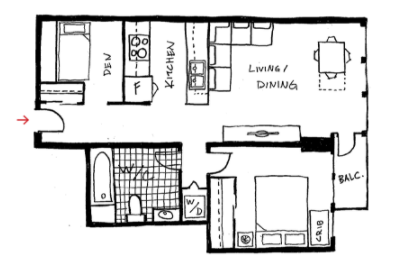
    But perhaps even more interesting is the section called CondoHacks. Here, the study team interviewed 9 families already living in vertical communities to learn about how they have “hacked” their spaces to meets their needs. It’s valuable to see how end-users actually live in specific floor plans. Lots of shared bedrooms and spaces. Here (pictured below) is an example of 2 parents and 2 children living in a 650 square foot one 1 bedroom plus den.

    image

    This a topic that I’m personally very interested in. I’m thinking a lot about how some of the projects I’m working on could better accommodate families. So it’s great to see this initiative underway. If you’d like to receive email updates from the city about this study, sign up here on the bottom right of the page. I did that this morning.

  • Why multi-family developers are shifting their customer focus

    One aspect of the Toronto housing market that I’ve been paying close attention to is the adoption of multi-family dwellings by both long-term end-users and families. 

    I’ve written about this before (here and here, over a year ago) and have argued that here in Toronto we are at an inflection point. Multi-family dwellings – both rental and condo – are evolving to now target these new customer segments. Whereas previously, the new construction multi-family housing market was heavily geared towards investors and first-buyers. And often it was simply a stepping stone towards a single family home.

    Now, every city and real estate market is different. And I have heard many people in U.S. cities say that Millennials are simply deferring what we saw with previous generations. At the end of the day they (or we, I’m a Millennial) are going to move to the suburbs and buy that car. The current trends we are seeing around city living and reduced driving are just that – short-term current trends.

    But I think it’s worth reiterating: I do not believe that the status quo is what’s happening right now in Toronto. And I’m sure it’s also happening elsewhere. Time and time again I speak to developers in this city who are starting to shift at least some, and in some cases all, of their focus towards end-users, families, and larger units – particularly for new mid-rise product in the “neighborhoods.”

    And if you think about it, this makes perfect sense. 

    The average price of a detached single family house in Toronto is well north of a million dollars. So when a developer brings to market a 1,200 sf family sized apartment at $600 psf ($720,000) or even at $700 psf ($840,000), that home now becomes a relatively “affordable” option in many desirable areas of the city. Particularly if you value location amenities and your time (i.e. shorter commutes) over raw quantity of space. I know I certainly do.

    I know this isn’t going to appeal to everyone. But there is a big market here. Get ready.

    What are you seeing in your city? Let us know in the comment section below.

  • Survey: Homes for families

    I was looking through real estate listings this morning (which I do quite often out of sheer interest), and I started noticing a number of 3 bedroom condos (here in Toronto) that were priced under $1 million.

    Now, this is a lot of money now matter how you slice it. But given that the average price of a detached home in the city is now well over $1 million, I can’t help but wonder if condos will become more accepted as the family home.

    I’ve written about this topic a lot, because it’s something I’m interested in and I like living in a condo. But I’m seeing far more of my network looking for a low-rise house upon marriage/kids than for a bigger apartment/condo.

    So today I thought I would run a very quick survey. There are only 3-4 questions depending on how you answer and it basically revolves around housing type and whether or not you have or plan to have a family. I also ask what city you live in because I think this will have an impact on preferences.

    If you have 30 seconds, I would love to get your input and I’m sure the ATC community would be interested as well. The responses are anonymous, but I’ve made them public. Click here if you can’t see the survey below.

    [googleapps domain=”docs” dir=”a/brandondonnelly.com/forms/d/1wyMguhSlNv6pe6DS3duyJUqpzjImHI_KiYer1CKTVxo/viewform” query=”embedded=true” width=”640″ height=”600″ /]

  • Stuck in condoland?

    Toronto Life recently published an interesting article called Stuck in Condoland. A lot of people have mentioned it to me, so there seems to be a lot of interest in the topic. It basically profiles the lives of a few young families who live downtown and are trying to raise young children in relatively small condos (think 700 square feet).

    I thought it was interesting because I like the idea of small and efficient living. The average post-war bungalow in Toronto was probably less than 1,000 square feet. And so this modern notion that you need a big house in order to properly raise a family is a relatively recent phenomenon. Although we’re a richer city today and that’s what happens when people become wealthier: they consume more.

    But the article also makes it seem that developers only want to build small condos and that larger condos and single-family homes just aren’t profitable enough. Thus the reason all these families are being forced to into tiny shoeboxes in the sky. But that’s not really true.

    Look, just like every other for-profit business on the planet, developers are concerned with making money. And so they will always look for ways to increase efficiency, drive down costs, and so on. But there are certain realities of the market that developers don’t have control over.

    First, developers aren’t building new single family homes in the city (at any sort of meaningful scale) because there’s no land to do so. And because the land use policies in place and the current thinking around how we can more sustainably build our cities for the future dictate that we should be building more intensely. In other words, building up. So it’s not a question of developers not wanting to build single family homes; it’s a question of not being able to.

    Second, trust me when I say that if the market wanted large 3 bedroom family units, developers would build them. Mandating them is a useless exercise if people don’t want them or are unable to afford them.

    The challenge we face is that a reinforced concrete condo tower is more expensive to build than a wood-framed single family house. So until land values get to a point where single family homes become the more expensive option (compared to condos), I don’t think we’ll see a huge rush towards 3+ bedroom suites.

    This is my hypothesis at least. Because when you buy house, you’re really buying two things: the house itself and the land. If the house itself (wood) is cheaper to build on a per square foot basis than a condo (concrete), then the variable that will make a difference is the land. And as people like to say: “buy land, they ain’t making any more of it.”

    So what I’m saying is that I just don’t think the situation is as simple as: “developers are bad, all they want to do is build tiny condos and make lots of money.” It’s more complicated than that. But I do believe the question of how families are going to live in the city is an important one.

  • I’d raise kids in an apartment

    One of the North American truisms that I often like to challenge is the belief that kids should be raised in a house.

    I’m interested in this topic, not because I’m planning for a kid, but because Toronto has gone through such a dramatic transformation over the past 15+ years to become a city where more and more people are living in multi-family dwellings (condos, apartments, and so on).

    However, there’s still the belief amongst many circles that condo living is merely a stepping stone on the way to a house. Since Millenials have effectively added a new life phase between University and marriage, condos have become the home of choice for many twenty and thirty somethings. But how long will they stick around? I see a lot of people in my network getting married and subsequently moving from a condo to a house.

    Why is this?

    Is it because of schools? Is it a cultural belief that families require a house and a backyard? As someone who grew up in the suburbs, I can tell you that I never played in the backyard. I played on the street with other kids. I used a shared public space rather than a private one.

    On a practical level, I think the condo-to-house tradition has a lot to do with the fact that condos are just more expensive on a per square foot basis than wood-framed houses. For the same price that you might pay for a small 2 bedroom condo in Toronto, you could still conceivably buy a 3 bedroom house in some inner city neighbourhood.

    But the supply of single family homes in the city is limited. We’re not adding anymore. So as the price of these homes continues to increase – at what is now a faster rate than high rise housing – we may eventually reach a point where there’s no longer a cost savings associated with low-rise housing. In fact, they’d just be a luxury for the well-heeled.

    In this scenario, I think we’d naturally see an increase in larger condo units – something the city has been trying to artificially encourage. And out of necessity, we’d see more and more families in condos. However, it’ll take a change in mindset. Are you ready for it? I’d like to think that I am.