Daily insights for city builders, delivered every morning at 6 AM ET. I’m Brandon Donnelly — a Toronto-based real estate developer and founder of Globizen. I’ve been writing here since 2013.

Tag: failure

  • You have to try

    Now that some of the dust has settled around Apple Vision Pro, it is clear that nobody really knows if it is going to work. (Though, it’s too expensive and it’s too heavy are missing the bigger picture.) It sounds like it delivered what it said it was going to deliver as a product, and the potential is there for a “spatial computing” future. But who knows for sure. Here’s an excerpt from an essay that Benedict Evans recently published called, “A month of the Vision Pro“:

    Second, taking one step further back again, even if my doubts are all wrong, we won’t know any of this for years, and right now this is all still in the experimental category. Apple sells more watches in a typical quarter than Meta has active Quest users. Even the iPhone took years to start selling. It’s possible than in five years this will have started to work, and it’s possible than in five years we’ll have concluded that this [AR/Apple Vision Pro] is a niche, and we’ll have to wait for glasses, contact lenses or neural implants.

    But ultimately, this is okay. You have to try, because:

    Thank you to Lucas Manuel for sending me the above quote.

  • The game of life

    “Anxiety is experiencing failure in advance.” — Seth Godin

    I mention and quote Seth Godin fairly often on this blog and so it only seems right to share this recent podcast that he did on the Tim Ferriss Show. Broadly speaking, the conversation is about “the game of life, the value of hacks, and overcoming anxiety.” I think most of you will find it useful regardless of what you do and what you’re involved in. It’s over an hour long, but there’s a full transcript available if you’d prefer to read, rather than listen. If you’re looking for something even shorter, here’s a quick video by Tim Ferris that has Seth talking about why worrying isn’t productive and that it’s really in service of our need for status quo and reassurance.

  • Experimenting at the right scale

    Jeff Bezos published his annual letter to shareowners this week. You can find it here. And as is his usual practice, he has attached his 1997 letter to shareholders at the bottom of it. This is his “Day 1” and he clearly likes the reminder.

    I was somewhat surprised to learn that 58% of physical gross merchandise sales on Amazon are now by independent third-party sellers. This number has been steadily increasing almost every year since 1999.

    And this is despite the fact that first party sales — products sold by Amazon — have grown at a compound annual growth rate (CAGR) of 25% during this same time period. Amazon excels at the fulfillment component and you can have them do that for you as a third-party seller.

    There are a number of other interesting facts sprinkled throughout the letter, but I particularly liked the bits on “intuition, curiosity, and the power of wandering.” Here is an excerpt on how Amazon is working to scale the size of its failures:

    As a company grows, everything needs to scale, including the size of your failed experiments. If the size of your failures isn’t growing, you’re not going to be inventing at a size that can actually move the needle. Amazon will be experimenting at the right scale for a company of our size if we occasionally have multibillion-dollar failures. Of course, we won’t undertake such experiments cavalierly. We will work hard to make them good bets, but not all good bets will ultimately pay out. This kind of large-scale risk taking is part of the service we as a large company can provide to our customers and to society. The good news for shareowners is that a single big winning bet can more than cover the cost of many losers.

    A lot has already been said and written about accepting failure in life and business. Nobody wants to fail, but it can happen when you’re trying to “imagine the impossible.”

    The two nuances here are that failures should scale along with the company. And that “large-scale risk taking” can actually be construed as a service. It might mean that the impossible becomes possible.

  • The cost of failure

    Kevin Rose is an internet entrepreneur. He has built a number of consumer products, including Digg in 2004. Previously he was a venture capitalist with Google Ventures, but now he’s doing that with True Ventures. He also hosts a podcast.

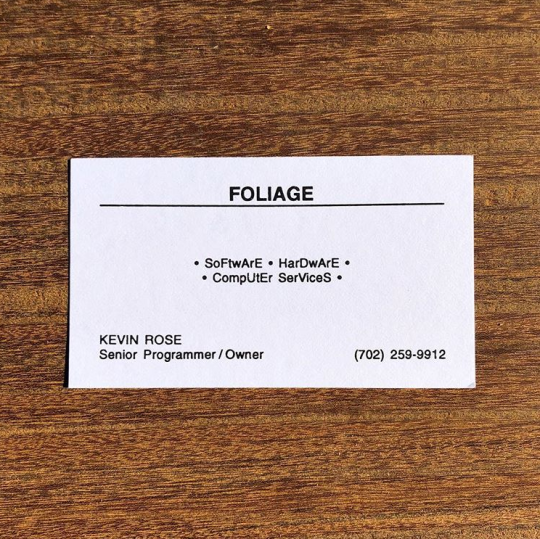
    This past weekend he posted the following photo to his Instagram:

    image

    Here’s the story. 

    After begging his mom to take him to the printers, he got this business card made when he was 13 years old. Foliage Software wasn’t a real company, of course. But it had business cards and he was not only a Programmer and the Owner, but a Senior Programmer and the Owner.

    I laughed as soon as I saw this post because it is exactly the sort of thing that the 13 year old version of me would have done and probably did. (The combination of upper and lower case letters on the card also helped with the humor.) I’m sure if I dug around my mother’s house I would find a trail of my failed business schemes and project ideas.

    But that’s entirely the point he is trying to make. Try. Fail. Learn. Refine. All of these actions will increase your odds of success at the next go around. Nobody will remember the failures anyways.

    Seth Godin perhaps said it best with: “The tiny cost of failure is dwarfed by the huge cost of not trying.”

  • What’s next for Walmart?

    Today I was surprised to learn from Charlie Gardner’s blog that groceries now represent 56% of Walmart’s sales. This is a huge number that I frankly wouldn’t have expected. 

    Groceries have relatively low online penetration, which makes them great for brick-and-mortar retailers. I’ve written about this topic before in the context of big box stores and online shopping. But I clearly didn’t realize that it had become such a big segment for Walmart. 

    What’s also noteworthy about grocery shopping though, is that customers appear to be less likely to travel far distances for it, even for lower prices. This means that the radial impact of Walmart the supermarket is less significant and far tighter (~2 miles) than Walmart the discount store. Click here for that study.

    This is important because a big catchment area has been central to the Walmart model. They consume cheap land on the outskirts of cities and then offload the transportation costs (indirect costs) to consumers in exchange for everyday low prices (direct costs). Studies show that we, consumers, typically undervalue indirect costs.

    Charlie argues in his post that this does not mean that we should write off big box retailing. And I would agree. The Walmart Express concept may have failed, but they are clearly looking for ways to rethink their model. Urban stores will need to form part of that.

  • Enabling innovation by lowering the barriers to entry

    Yesterday afternoon Sam Altman of Y Combinator published a blog post talking about a new YC Fellowship program for even earlier stage companies. 

    For those of you who aren’t familiar with Y Combinator, they are a super successful funding platform for early stage startups. They are located in Mountain View, California.

    What’s unique about their approach is that they invest a relatively small amount of money ($120,000 for 7% of your company) in a relatively large number of companies. Their most recent cohort was around 85 companies and they do that twice a year.

    The rationale behind this approach is that it can be incredibly hard to predict which people and ideas will produce the next great company. Oftentimes the best ideas appear really shitty at first. (Here’s a post by one of the cofounders of Airbnb talking about the company’s early rejections.)

    So instead of putting all of their eggs in one basket, YC invests smaller amounts in more companies.

    But beyond this being beneficial to them, it’s also a model that I think helps to reduce the barriers to people starting a company. It gives more people the chance to prove that their company has the potential to be something great. 

    And that’s precisely what makes this new YC Fellow program/experiment so interesting to me.

    Instead of $120,000, YC fellows will receive $12,000 and they won’t have to move to the Bay Area (although it’ll be encouraged). They’ll still get mentorship and advice like the regular YC program, but it’ll be a kind of light version. 

    Though this is almost certainly just the beginning. Here’s how Sam ended his announcement post:

    “Someday if it works, we’d love to fund 1,000 companies per year like this.”

    Now all of a sudden that’s some scale.

    What’s exciting about this is that I believe our cities have the potential to be far more innovative than they are today. Every city is trying to be the next Silicon Valley, but every city is not the next Silicon Valley.

    I saw a great tweet the other day that went something like this (I wish I could remember who the author was):

    “Entrepreneurs aren’t risk takers. They’re just rich kids with big safety nets.”

    It’s a bit of a tongue-in-cheek generalization. But to unlock the full potential of our cities, we should be figuring out how to get everyone participating and building their ideas, not just those with a head start. 

    I think there are a lot of people around the world who could be doing great things, but they just haven’t been able to take that first step for one reason or another.

    Hopefully organizations like Y Combinator will be able to help them take it.

  • The 5 objectives of Rejection Therapy

    In the business world – particularly in the startup world these days – there’s a lot of emphasis on the importance of failure. The mantra is: “fail early and fail often.” Because if you’re not failing, then you’re likely not pushing yourself hard enough and getting out of your comfort zone. 

    Some people think we’ve gone too far in our celebration of failure, but I think there’s a lot of value in not being afraid of making mistakes. I try and adopt the same mentality when I snowboard. If I’m not physically falling, then I’m likely not trying things I’ve never done before. (I may have taken that philosophy too far this winter.)

    Here’s a video from Gary Vaynerchuk’s #AskGaryVee show where Jack and Suzy Welch are guests and the first question has to do with this exact topic: the importance of failure.

    Given all of this, I was fascinated to learn about something new this week called Rejection Therapy. I was out for beers with some good friends of mine earlier in the week and one of them – who is an educator here in the city – started telling me the story of Jason Comely.

    Jason was a freelance IT guy from Cambridge, Ontario. His wife had recently left him for someone “better” and he went into a deep slump. Eventually, he realized that he had become terrified of rejection. His wife had rejected him and he never wanted that to ever happen again.

    Initially he withdrew from life. 

    But eventually he decided that he was going to experiment with the exact opposite approach. He decided that he was going to force himself to get rejected by someone every, single, day.

    It didn’t matter how it happened, but he had to get rejected. He would walk up to strangers and ask for a ride home. He would ask for a discount before buying something. The list goes on. 

    Eventually he thought it would be a good idea to start documenting all of his rejections: this is what I did today and this how I got rejected. It became a game for him. When he would get his rejection for the day, he would celebrate it. Then he thought to himself: why not turn this into an actual game that other people could purchase? And that’s what he did.

    He calls it Rejection Therapy and here are the five objectives that he lays out:

    1. To be more aware of how irrational social fears control and restrict our lives
    2. Smash the tyranny of fear and reap the treasures (treasures include wealth, relationships and self-confidence)
    3. Learn from, and even enjoy rejection
    4. To not be attached to outcomes, especially when it involves the free agency of other people
    5. Permit yourself to fail

    Playing Rejection Therapy may not be for everyone. But I think the lessons are universally applicable. There’s value in trying. There’s value in asking. There’s value in making mistakes. And there’s value in not being afraid of someone saying no.

  • Taking the bus

    According to Salvador Dalí and Margaret Thatcher I’m a loser and a failure. I came across these quotes on Tumblr (via goingurban) this morning:

    “A man of forty who still rides the metro is a loser.” -Salvador Dalí

    “A man who, beyond the age of twenty-six, finds himself on a bus can count himself as a failure.” -Margaret Thatcher

    Now as much as I like dislike buses (and prefer the train varietal), I’ve made it pretty clear that I’m a believer in mass transit.

    If anything, I think these quotes show how much the world has changed, although perhaps only in certain geographies. Depending on where you live (I’m thinking Los Angeles or, maybe, Oklahoma City), it probably still sucks not to have a car.

    That’s too bad.