Daily insights for city builders, delivered every morning at 6 AM ET. I’m Brandon Donnelly — a Toronto-based real estate developer and founder of Globizen. I’ve been writing here since 2013.

Tag: facebook

  • 10x the scale

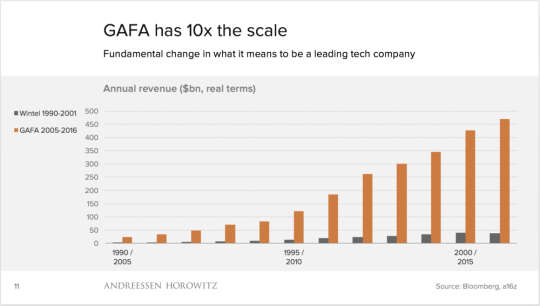
    Below is a chart from Benedict Evans comparing annual revenue from the Wintel era (Microsoft + Intel) to the current GAFA era (Google, Apple, Facebook, and Amazon). 

    His argument is that, today, “the scale of tech winners” is about 10x what it was during the previous cycle.

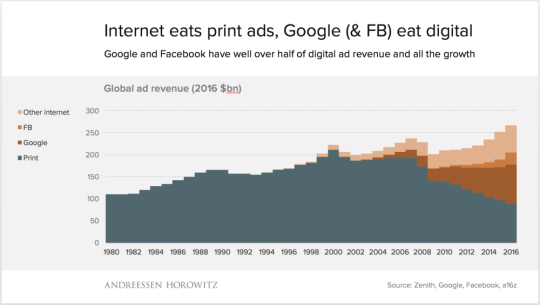
    And here is a chart, from that same post, showing how the internet ate print ads when it comes to global revenue:

    A lot of this has to do with the unprecedented growth of smartphones and the sheer number of people who came and are coming online. Mobile is 10x the PC market.

    But the other interesting narrative from the post is the argument that these companies (GAFA) have learned from previous generations just how aggressive you need to be to survive.

    The shift to mobile posed a structural threat to Facebook. At the time of its IPO, there were serious doubts as to whether the company would be able to pull off this transition.

    Which is why the founder went out and spent 10% of the company to acquire companies that would help with this transition and ensure its survival. That seems to have worked.

    In the words of Andrew Grove: “Only the paranoid survive.“ And in today’s tech world, the rewards for surviving are that much bigger.

  • Why I write about tech on my city building blog

    I had a friend ask me this week about how I decide what to write on this blog. His comment was that I tend to write about a variety of different topics. He wondered: Isn’t it better to focus on one particular niche?

    The simple answer is that I write about what interests me. And secondary to that is any concern around what will get the most clicks. In fact, I try not to fall into the trap of worrying about the latter. Sometimes it can be paralyzing to fixate on what will appeal most to the tens of thousands of people who read this blog on a regular basis.

    The reality is that my interests are much broader than, say, just design and real estate; though these two topics are clearly central. 

    I learned a long time ago while studying architecture and art history that what we make as a society is generally a product of the cultural milieu at the time. In other words, the built environment doesn’t happen in a vacuum. It is the physical manifestation of what we believe to be true at a particular moment.

    Today, it’s pretty hard to ignore the importance of tech. Think of some of the most valuable companies in the world right now: Apple, Google, Amazon, Facebook, and so on. Now, technology has always shaped our cities, but what makes this moment different is the decisive shift toward software.

    It’s arguably no longer about who can build the best mousetrap. It’s about who can build the best software layer on top of that mousetrap.

    In 2011, venture capitalist Marc Andreessen (previously the co-founder of Netscape) published a widely shared essay called, “Why Software Is Eating the World.” And over the past 6 years he has been proven to be very right.

    The 3 main points he aimed to make with that essay are as follows:

    1. Every product or service that can become software will become software.
    2. Every company will have to become a software company.
    3. The winning companies will be the best software companies.

    Depending on your industry, this may sound ludicrous to you. Certainly in 2011 it probably seemed that way. 

    But a perfect example of this phenomenon is the iPhone. The phone itself is manufactured in China, albeit where a lot of great hardware innovation is taking place. 

    But at this point, phones have become fairly commoditized. The profits that Apple makes from the iPhone disproportionately come from the software layer and the app ecosystem it has developed.

    You could make a similar argument with Tesla. Autonomous navigation – which most of us can agree will have a profound impact on cities – is largely a software challenge. 

    And so if you believe that autonomous vehicles will be a fundamental part of the future of mobility, then it’s not that hard to believe in point number three: the winning car company will also have to be the best car software company.

    Some industries have been less touched by tech and software – real estate being one of them. But if Andreessen is right and it’s not a question of if, but a question of when, then it behooves all of us to think about the potential impacts.

    I love how Andreessen ends this podcast discussion with Barry Ritholtz of Bloomberg and so I’m going to repeat it here to close out this post. He says: “There are no bad ideas. There are only early ideas.” 

    And that’s why I write about tech on my city building blog.

    Photo by Michal Pechardo on Unsplash

  • Motivation and coordination

    Albert Wenger of Union Square Ventures recently gave a talk at the 2017 Blockstack Summit about “Decentralization and the Knowledge Age.”

    He starts by talking about motivation and coordination.

    The state, he argues, is good at coordination, but not so good at motivation. The market, on the other hand, is good at motivation, but not so good at coordination. Money and self-interest are powerful incentives.

    He then talks about how networks have improved the market, the firm, and the state. When the cost of sharing information drops, everything gets better.

    But there are downsides to networks. For one, they form monopolies. Consider Facebook in social. Google in search. Amazon in ecommerce.

    They also create environments ripe for censorship and “algorithmic abuse.” Everything you see in your feeds is optimized to make you respond and/or feel a certain way. The line between delivering you relevant content and deliberate manipulation is perhaps a fine one.

    So what’s the solution? Decentralized blockchain networks are one exciting possibility. But they also have their own limits and drawbacks. Albert touches on those in his talk.

    The video is about 24 minutes. If you can’t see it below, click here.

    [youtube https://www.youtube.com/watch?v=LgQT874KHuw?rel=0&w=560&h=315]

  • Instagram Stories has more active users than all of Snapchat

    Instagram has a company chart that shows: Days to Reach the Next 100 Million Users. It is only the chart where they want to see it decline. The first 100 million users took 28 months. And the last took only 4 months. Instagram now has 700 million active users.

    Instagram is also saying that they have 200 million people using their Stories feature – you know, the feature they blatantly stole from Snapchat. This would mean that more people are using Instagram Stories than Snapchat has daily users (~158 million).

    Anecdotally, I can tell you that I’ve almost completely stopped using Snapchat. (Snapchat battery usage over the last 7 days = <1%.) I still prefer Snapchat’s direct messaging functionality, but not enough to continue using the platform. Instagram now provides basically the same functionality – plus my photos – in a single app. 

    But more importantly, Instagram’s network and my network are bigger there. And network effects are clearly the most important thing. In fact, by directly copying Snapchat, Instagram (Facebook) made sure that this competition was only about network size and not about features. Monopoly power.

    In real estate, if you own a property in a great location, your position is pretty defensible. (Though you may not be completely immune.) But in tech, that is clearly not the case. Someone might copy everything you’ve done and beat you at your own game.

    As someone who used to be very bullish on Snapchat, I am now wondering if I need to remove my Snapchat handle from the header of my blog emails. I mean, I’m not there very often anymore. But maybe, just maybe, Snapchat will find a way to compete outside of network effects at a game that Instagram/Facebook can’t play.

    How would you or are you placing your bets?

  • What Facebook knows about you

    Here is an eye-opening article from data scientist Vicki Boykis outlining the number of ways in which Facebook collects data about its users. It’s called: What should you think about when using Facebook?

    One of the more surprising tidbits from Boykis’ article is that Facebook collects keystrokes. That means if you start typing a status update but never actually post it, that information is still fair game.

    Facebook previously used this data for a study on self-censorship. That sounds like like a fascinating study, but I’m sure the thought is also scaring many of you if you care about privacy.

    Here is a quote from the article that gets at the core of what is going on:

    “The fundamental purpose of most people at Facebook working on data is to influence and alter people’s moods and behaviour. They are doing it all the time to make you like stories more, to click on more ads, to spend more time on the site.”

    A worthwhile read. And in case you didn’t already know, if you go to Settings -> Download a copy of your Facebook data, you can get a pretty good dump of your activity, including every private message you’ve ever sent on the platform.

  • The Anti-Portfolio

    In the world of venture capital, it is not uncommon to make most of your money off only a small fraction of your investments. Here’s how Fred Wilson describes his firm’s “batting average”:

    “I’ve said many times on this blog that our target batting average is “1/3, 1/3, 1/3” which means that we expect to lose our entire investment on 1/3 of our investments, we expect to get our money back (or maybe make a small return) on 1/3 of our investments, and we expect to generate the bulk of our returns on 1/3 of our investments.”

    I’m guessing that this is one of the reasons why mistakes are more readily embraced – or even celebrated – in venture capital and in tech. It’s part of the DNA of the industry.

    A perfect example of this is something called the Anti-Portfolio. Venture capital firm, Bessemer Venture Partners, has a page up on their website dedicated to “honoring those we missed.” It is a list of phenomenally successful companies that for various reasons BVP decided not to invest in. That is, they had the opportunity but they decided to pass.

    Here’s a taste (copied verbatim from their site):

    • [Apple] BVP had the opportunity to invest in pre-IPO secondary stock in Apple at a $60M valuation. BVP’s Neill Brownstein called it “outrageously expensive.”
    • [Facebook] Jeremy Levine spent a weekend at a corporate retreat in the summer of 2004 dodging persistent Harvard undergrad Eduardo Saverin’s rabid pitch. Finally, cornered in a lunch line, Jeremy delivered some sage advice “Kid, haven’t you heard of Friendster? Move on. It’s over!”
    • [Google] Cowan’s college friend rented her garage to Sergey and Larry for their first year. In 1999 and 2000 she tried to introduce Cowan to “these two really smart Stanford students writing a search engine”. Students? A new search engine? In the most important moment ever for Bessemer’s anti-portfolio, Cowan asked her, “How can I get out of this house without going anywhere near your garage?”

    As I was going through BVP’s Anti-Portfolio, I immediately thought about how different this sensibility is compared to the real estate industry. I mean, could you imagine a developer celebrating all of the sites she or he passed on and all of the projects that lost or made no money?

    One of the reasons you do this is to learn from your mistakes. So perhaps we could all use some sort of “anti-portfolio.”

  • High resolution population maps

    image

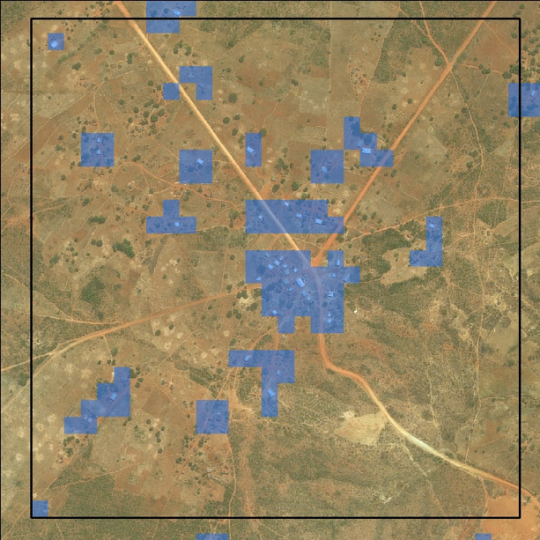
    Facebook, as part of their internet.org initiative, is working on bringing internet access to people in rural areas all across the world. For obvious socioeconomic reasons, this is an important initiative. From a business standpoint, it also grows the base of potential Facebook users at a time where that top line number is starting to plateau.

    In order to understand how people are settling and aggregating throughout the world, Facebook has been using high-resolution population maps and then creating models to drill down and analyze individual buildings. 

    This is interesting because: how else could you track informal settlements? So far this seems to be the most effective method. In fact, in architecture school I worked on a project in Dhaka, Bangladesh and I remember relying heavily on aerial photography because I simply couldn’t find the data I was looking for.

    Here’s an excerpt from a recent World Bank post. They, along with Columbia University, are collaborating with Facebook.

    Facebook’s computer vision approach is a very fast method to produce spatially-explicit country-wide population estimates. Using their method, Facebook successfully generated at-scale, high-resolution insights on the distribution of buildings, unmatched by any other remote sensing effort to date. These maps demonstrate the value of artificial intelligence for filling data gaps and creating new datasets, and they could provide a promising complement to household surveys and censuses.

    And here’s an excerpt from a recent Facebook post on the same topic:

    From this preliminary analysis, we’ve determined that slightly less than 50% of the population lives in cities. However, 99% of the population lives within 63 km of the nearest city. Hence, if we are able to develop communication technologies that can bridge 63 km with sufficiently high data rates, we should be able to connect 99% of the population in these 23 countries. [”These 23 countries” represents about 1/3 of the world’s population.]

    I would imagine that this type of model works better in sparsely populated / low-rise areas. Still, I am very interested in thinking about ways in which our current survey and census methods could be improved. Here in Canada we conduct our national census every 5 years. In today’s world that feels like eons. One day, I am sure, it will be real-time.

    Image: World Bank

  • Snap Inc.

    Snap Inc. (Snapchat) nailed the launch of Spectacles. I want a pair.

    If you haven’t been following, it all started with a pop-up vending machine in Venice Beach. But like Snapchat itself, it was an ephemeral installation that eventually disappeared, moving on to Big Sur, California. At the time of writing this post, the countdown is on to discover where the vending machine will pop up next. It’s a viral marketing play that aligns very well with their brand.

    But there’s even bigger news.

    Earlier this week it was revealed that Snap Inc. has filed for an initial public offering. It plans to go public by as soon as March 2017 and expects to be valued somewhere around $25 billion. Remember when everyone flipped out because Evan Spiegel had rejected Facebook’s acquisition offer of $3 billion?

    Here’s their revenue story from Vanity Fair:

    Last year, Snapchat brought in $59 million in revenue—a low number that reflected the embryonic stage of its business. This year, however, Snapchat predicts it will generate revenues between $250 million and $350 million. And in 2017, the company estimates it will reach revenues between $500 million and $1 billion, based on “bullish sales targets.”

    I’ve been a Snapchat fan for awhile now, so I am thrilled to see the company going public. As Fred Wilson wrote on his blog this morning: “Snap is a great company led by a creative and ambitious founder and they have a loyal and growing use base. I think Snap can be an excellent public company.”

    If you’ve got people’s attention, you can figure out how to monetize it.

  • Where do you shop?

    Matthew Townsend of Bloomberg recently published an interesting article talking about the dominance of Amazon.com (and online shopping in general); the shift towards experiences over stuff; and the languishing brick-and-mortar brands that keep saying it’s the macroeconomy, rather their product/approach, which is causing sales to slump.

    Here are a 3 excerpts that stood out for me:

    Lurking behind the cliché is a hard truth these executives are eager to avoid. “All this pleading that the consumer isn’t spending is an excuse, largely from management teams whose product is less relevant,” Kernan said. “The consumer is actually driving the U.S. economy, so it’s a little ridiculous when we hear the excuse of the macro environment is not good.”

    Another hurdle that isn’t going away is the shift to increased spending on experiences such as travel and classes, which make for much better posts on Instagram, Facebook, and Snapchat. “Social media has really fostered a have-done environment, which is not what retailers sell,” Perkins said.

    One characteristic of these struggling brick-and-mortar chains has been direct competition with Amazon. If they don’t go head-to-head with the online giant, they rely heavily on people visiting shopping centers anchored by retailers that do, such as ailing department-store chains Macy’s and Sears. One measure of store visits in the U.S. paints a dire picture, with only a dozen positive weeks over the past two years.

    According to Bloomberg, 55% of online product searches start at Amazon.com. And while online sales in 2016 have only accounted for 11% of all (U.S.) retail revenue, it has represented 54% of all growth! That’s a big number, especially when you think about what that will mean over time.

    Talking about the growth and threat of online shopping has become a boring truism. I know that. But are retail executives taking it seriously? The Bloomberg article gives you the sense that many are not – or at least they’re not publicly acknowledging it.

    When I look around my place right now and think about where I bought each item – everything from the shoes at my door to the protein powder in my cupboard – it’s pretty amazing to think about how much I now buy online. And I’m sure that many of you are the same.

    Groceries aside, I’m probably 85-90% online. What about you?

  • The back-end of our cities

    I love cities. We all love cities right now. 

    Everyone, for good reason, seems to be fixated on both people returning to cities (like those narcissistic Millennials) and people urbanizing for the very first time. This latter scenario is happening rapidly across the developing world and in many cases – but not all cases – it is helping to lift people out of extreme poverty.

    But by most measures, urban areas represent only about 2-3% of the world’s land area, despite housing over 50% of our population. So here’s an interesting thought for this morning: What is happening and what will happen with the remaining 97-98%?

    In this recent talk by architect Rem Koolhaas, he attempts to dissect the future of living, loving, and working through the lens of architecture. However, he starts by saying that architecture is, in fact, too slow to properly capture the zeitgeist of any time period. It is, “an unbelievably slow art.” That said, Koolhaas has a remarkable ability to identify what is happening (see Delirious New York) and then call it out in a way that you probably haven’t thought about. 

    In the above talk, he hones in on the impact of Silicon Valley – certainly the spirit of our time – on the rural landscape outside of our cities. Interestingly enough, he also talks about how the tech industry has begun to borrow terminology from architecture in order to describe itself.

    Screenshot from the video:

    image

    Despite their ethereal appearance, technology giants still have large physical footprints for servers, production, logistics, and so on. But there’s no reason – or way – to accommodate them inside of our cities and so they cluster outside, in the 97-98% areas. These are places like the Tahoe-Reno Industrial Center, which is the home of Tesla’s new Gigafactory.

    Because of sheer scale and because there’s no need for them to possess much in the way of humanistic qualities, these are spaces which are void of architecture, urbanism, and, in some cases, a light spectrum beyond what is absolutely necessary for the specific function of the building (discussed in the video).

    Of course, the periphery has long serviced the core. But Koolhaas’ thinking has, as it often does, made me consider this phenomenon in a slightly different way. He paints a picture of a spiky world where we are all crammed into sensor and app-driven cities (the front-end), all of which are then powered by big mechanistic boxes that many of us may be naive to (the back-end). In some ways it feels like the Matrix. What we see and experience could just be the tip of the iceberg.

    Architecture may be unbearably slow, but as a society we have always built what matters to us most at the time. At one point it was places of worship. But today, at least for part of our landscape, it is boxes not intended for us to really experience. Maybe that’s not really architecture. Maybe it is simply the back-end for our cities.