Daily insights for city builders, delivered every morning at 6 AM ET. I’m Brandon Donnelly — a Toronto-based real estate developer and founder of Globizen. I’ve been writing here since 2013.

Tag: exurban

  • Canada is a suburban nation

    Dr. David L. A. Gordon leads a research project at Queen’s University that is focused on determining the proportion of the Canadian population that lives in a suburb. Why this is interesting is because the data isn’t normally looked at in this way. As I understand it, the way Statistics Canada thinks about things is that you’re either rural or you’re urban, living in a major population center.

    But this isn’t exactly right. Obviously there’s a difference between living in a dense transit-oriented community and living in a car-centric one. The former is actually “urban” and the latter is not.

    So what the research team set out to do was more accurately classify Canadian cities. And after doing that, they ended up with four categories within each census metropolitan area: (1) active core, (2) transit suburb, (3) auto suburb, and (4) exurban. See above example. What they then discovered is that about 66% of Canadians live in a suburb. And in our largest cities — Toronto, Montreal, and Vancouver — the figure is over 80%.

    Canada is often referred to as one of the most urbanized nations in the world. But as we can see here, that’s not exactly true. Canada is more accurately a suburban nation.

    Image: Canadian Suburbs
  • New York is the only US city with an urban core growing faster than the suburbs

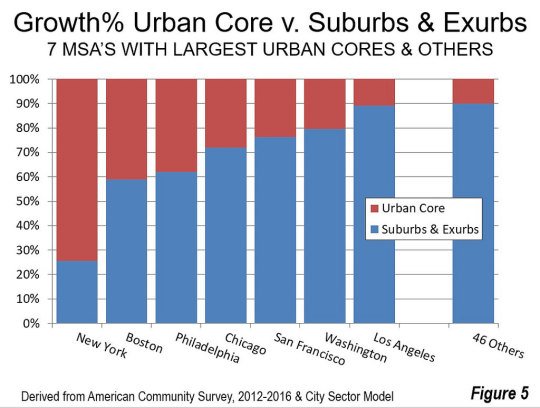
    The latest data from the American Community Survey (2012 to 2016) has placed the suburban and exurban share of the US population (53 major metropolitan areas) at 85.5%. Back in 2000 this number was thought to be around 83.5%.

    Since 2010, automobile oriented suburbs and exurbs have also accounted for 90.5% of population growth. The US – and Canada would be no different – is by and large a suburban nation. And the data suggests this isn’t about to change.

    The one exception is the New York metro area. From 2012 to 2016, 74% of its growth happened in the urban core. No other major metropolitan area in the US comes close to this sort of urbanity. Below is a chart from New Geography that shows you how NYC compares.

    All of the data for this post was also taken from New Geography.

  • The top 10 most suburban cities in America

    According to NewGeography, ~85% of the population in the 53 major metropolitan areas in the U.S. lives in the suburbs or the exurbs. (Data from 2011-2015.) And according to some definitions, a number of these cities could be classified as being 100% suburban.

    NewGeography recently looked at America’s most suburbanized cities using the “City Sector Model” of classification. Here’s generally how it works:

    1. Urban core-CBD: Employment density > 19,999 people per square mile
    2. Urban core-inner ring: Population density > 7,499 per square mile and > 19.9% transit/walk/bike modal split
    3. Earlier suburb: Not urban core or exurb, and median year house built before 1980
    4. Later suburb: Not urban core or exurb, and median year house built after 1979
    5. Exurb: Outside of 2010 principal urban area or under 250 people per square mile 

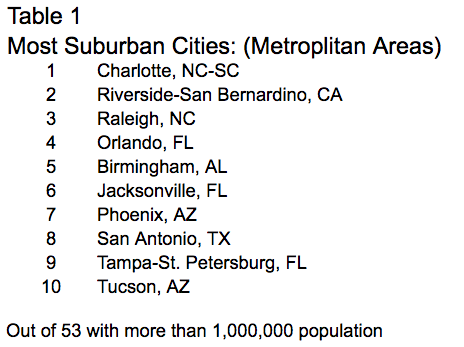
    Based on the above criteria, here are the top 10 most suburban cities in America:

    image

    All of these cities have virtually no urban core. To break the 10 way tie, they were simply sorted based on the size of their exurban population. To see all 53 metropolitan areas, click here.