
Daily insights for city builders, delivered every morning at 6 AM ET. I’m Brandon Donnelly — a Toronto-based real estate developer and founder of Globizen. I’ve been writing here since 2013.

Tag: experience

  • In defense of Instagrammable moments

    Surface Magazine – and more specifically the CEO of Surface Magazine – recently published this article criticizing the “trend” toward designing for Instagrammable moments.

    Here is an excerpt:

    We—and yes, this includes architects, too—have succumbed to the pressures of gaining followers, likes, and comments. High-priced, difficult-to-attain architecture degrees are now, incomprehensibly, being used to create “Instagrammable” installations for things like impromptu selfie fashion shoots and hotel lobby photo booths. The whole thing is, I must say, sad. It’s embarrassing enough that our team at Surface has received press releases from architects promoting their latest project with “Instagram-friendly interiors.” They can’t be serious.

    And here are his final words:

    If retail is dead, then its rebirth will depend on creating memorable atmospheres that don’t call for #✌💙👯🙋📷.

    I certainly appreciate the push for lasting and memorable spaces, but, at the same time, I can’t say I’m nearly as fussed about lobby selfies and the alleged timelessness of Instagram. 

    In fact, I think it would be an interesting exercise to study how social media may be impacting the way we design physical spaces.

    Maybe it is simply a fad being promulgated by “knucklehead junior marketers” or maybe 100 years from now nerdy architectural historians will look back on that quaint period of time when we designed spaces to service rudimentary 2D images shared amongst friends.

    Whatever the case may be, I think that architecture, like all art, should embody the milieu in which it was designed. 

    But often we have biases telling us that what is new is not as good as what’s existing and already accepted.
  • That emotional connection

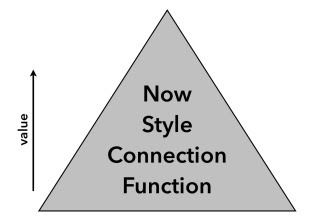
    Marketing guru Seth Godin recently published this value
    triangle on his blog
    :

    image

    No matter what business you’re in, it’s worth giving some thought to this. What do you offer?

    At the bottom of the triangle is function. A hotel room functions as a place
    to sleep. A smartphone functions as a device to make calls, send text messages,
    and download some apps. A condominium functions as a place to live, eat, sleep, have sex, and so on. But all functions being equal, most of us will buy whatever product is the cheapest.

    That is until there’s an emotional connection. I love the
    way Seth frames it: “Where do people like me do things like this?” It is about defining
    who you are. Am I the kind of person who buys A or am I the kind of person who buys
    B? If I care deeply about the environment and B promises to respect that, I am
    likely to buy B.

    But then, moving even further up the triangle, if two items offer the same function and the
    same emotional connection, many of us will go for the one that appears sexier, shinier (the new iPhone 7 is very shiny), and more
    stylish. It just deepens the connection.

    Finally, at the very top of the triangle is now. This is
    about scarcity. What’s hot right now?
    Think of that new restaurant that just opened downtown that you haven’t been
    able to get a table at. It’s now and you want to Instagram the food so badly so
    that you can show everyone you were there. You want to be now.

    The point of all of this is that we consume things for
    reasons that go well beyond simple function. That’s just the start of it all.
    One could argue that all of this is simply smoke and mirrors, but that’s a
    topic for another blog post. This is our reality.

    To relate this topic back to architecture and real estate, I
    am curious how many of you have made a housing decision that you believe went
    beyond function. How much of it was based on connection and style?

    Not surprisingly, for me, architecture and design matter a
    great deal.

    Earlier this summer I was driving around the city with my
    father and he was pointing out to me all of the new build single family homes
    that were sprouting up. He then asked me what I thought of them. I responded: “They’re
    shit.”

    What I was really saying with that glib remark was that
    those homes – no matter how expensive – didn’t reflect my own belief system
    about the world. Sure they served their function, but they didn’t offer the
    connection and style that “people like me” like to praise. To borrow once again
    from Seth: we are all part of a certain tribe.

    What tribe do you belong to? And does your housing choice
    reflect that?

  • The impression you are leaving

    image

    “Toronto is a city that has long struggled to make any sort of impression on the imagination.”

    That is how Monocle correspondent Christopher Frey started his recent architectural feature on Toronto’s iconic City Hall. To watch the video click here. It’s about 5 minutes long.

    As a born and raised Torontonian who loves this city, I absolutely hate that sort of introduction. But at the same time, it doesn’t surprise me. Growing up in this city, there were always the haters. However, I think it’s important to keep 2 things in mind.

    Firstly, Toronto has gone through a dramatic transformation over the last decade or so. In fact, I recently had a friend say to me: “Brandon, 10 years ago you told me that Toronto was going to be a super cool global city. I didn’t believe you then. But you were right.” This is what I was getting at in my Guardian Cities piece when I talked about how people are becoming noticeably more passionate about this city. (I actually wrote about what my friend said but they edited that part out.)

    Secondly, if you’ve ever read Seth Godin’s book All Marketers Are Liars, you might remember this line:

    To illustrate what he means by this, Godin uses the example–among many others–of Riedel wine glasses. Riedel is a high end glassware company founded on the belief that every type of wine needs its own unique glass shape. And indeed, their customers believe that the right glass makes all the difference in terms of how their wine will taste. That’s why they buy them.

    However, when you blindfold those same people, they are no longer able to tell the difference between a Riedel wine glass and some cheap alternative. The wine all of a sudden tastes the same. What that tells us is that when we believe something is supposed to be better, we actually experience it differently. You could say that we’re actually lying to ourself.

    And I’ve thought about this same phenomenon when it comes to cities. When people visit a place like New York they’re supposed to like it. That’s what everybody tells them. New York is great. You’ll love it. But ultimately, that “supposed to” changes how people experience the city.

    Which is why when Toronto gets introduced as being bland and banal I get upset. Not only because I disagree, but because I know it’s creating a “supposed to” in somebody’s mind. And that’s not the story we should be telling as a city.

    Image: Wikipedia

  • Telling Toronto’s story

    If you’re a regular reader of ATC, you’ll know that I often talk about cities in the same way that many people talk about products and services. (See: The business of cities.) And I do that because cities are our new economic unit and so I find it helpful to think of them as businesses fighting to attract and retain the best talent and win over customers (i.e. residents and businesses).

    Which is why I’m intrigued by Jason Logan’s pitch to invent the position of Creative Director at the City of Toronto. Here’s his pitch:

    “This is an open challenge to the all the mayoral candidates. In the past 10 years, Toronto has undergone a cultural, artistic, and technological renaissance: The ROM, the AGO, and OCAD U all underwent architectural makeovers; TIFF rose to prominence as one of the most prestigious film festivals in the world; Nuit Blanche was unleashed in 2006, and Luminato in 2007, both to huge acclaim; the high-tech industry has created 30,000 new jobs; and The New York Times admitted that Toronto’s culinary scene is more ethnically diverse than the five boroughs. But here’s the thing: The story we tell ourselves and the world about our remarkable city needs an overhaul. Toronto Needs a Creative Director is a campaign committed to building a better story by better mobilizing the arts, culture, and technology sectors to enhance civic engagement. The CDTO (the office of Creative Direction for the City of Toronto) would function as a lab for incubating ideas where art, culture, politics, science, and technology intersect.”

    Truthfully, I’m not yet sure if a Creative Director is the ideal approach. I haven’t had a chance to give it enough thought. But I am certain that Toronto would benefit from a bunch of smart people who were focused on telling our story to the world, crafting our brand and identity, and honing the experience of living or visiting this great city.