Daily insights for city builders, delivered every morning at 6 AM ET. I’m Brandon Donnelly — a Toronto-based real estate developer and founder of Globizen. I’ve been writing here since 2013.

Tag: europe

  • EU regions, by economic development

    The European Union uses something called the Nomenclature of Territorial Units for Statistics (or NUTS) in order to geographically subdivide its member states and collect statistical data. There are three scales: NUTS 1, 2, and 3. And generally speaking, they follow existing administrative boundaries. Or at least that’s the goal.

    In addition to being used for collecting statistical data, they also form the basis for how the EU implements its “cohesion policies“, which are designed to direct funds toward less developed regions within the Union based on GDP per capita (PPP).

    Because these NUTS impact funding allocations and because they can be redrawn if certain criteria are met, there’s not surprisingly an incentive to gerrymander. The Pudding has a great visual essay that explains why this happens and how Hungary split its central region into two new ones, isolating its capital, Budapest.

    Big cities tend to be, of course, more developed than their surrounding areas. But it is interesting to see by how much. Though an extreme outlier, the Inner London – West region has a GDP per capita that is 625% the EU average (2017 numbers).

    Image: The Pudding

  • One great big exit (not the Brexit kind)

    Wired’s oral history of how the London startup scene came to be is a good reminder that, typically, a city needs some great big exits (acquisition or IPO) to really kickstart an ecosystem. In the case of Silicon Valley, you could perhaps trace things back to Fairchild Semiconductor (1950s). But a more recent example of this phenomenon would be the PayPal Mafia, whose members have gone on to found Tesla, LinkedIn, YouTube, and other companies that you may have heard of.

    Put simply: success begets success. When a startup does really well and the founders and employees of that company get rich, it is likely that many will go on to found/fund other successful companies in that same city. In the case of London, that catalytic startup was arguably Skype (at least according to Wired). Microsoft acquired the company in 2011 for $8.5 billion, giving birth to the Skype Mafia. Of course, that wasn’t the only ingredient, but it sure helped (excerpt from Wired):

    Since 2008, according to data compiled by Dealroom.co, the UK has created 60 unicorns (tech companies valued at $1bn or more) – 35 per cent of the 169 created across Europe and Israel. In the past three years, the UK has created more unicorns (25) than France, Germany, the Netherlands and Sweden combined (19). And London has produced 23 unicorns with a combined value of $132bn, compared with Berlin’s eight, worth $32bn.

    The world has changed since Skype was founded. It’s now cool to be doing a startup. But given that every city seems to be trying to establish a thriving startup scene, I think it’s valuable to point out just how important a single big exit can be, not just for the people within the company, but for the broader city. Easier said than done, right?

    Photo by Benjamin Davies on Unsplash

  • The capital of the future: Shanghai

    Joe Berridge’s recent opinion piece in the Globe and Mail makes the case for why Shanghai is destined to become “the capital of future.” Brash city building, massive scale, and entrepreneurial hustle are among some of the reasons why he believes the city is on a path to global supremacy. And similar to other great capitals, it has benefited from a strategic geographic position on an important waterway — in this case the Yangtze River.

    By way of comparison, Toronto is said to be the fastest growing urban region in both North America and Europe right now. We add somewhere around 125,000 people each year. Shanghai, on the other hand, is adding between 700,000 and 800,000 people each year — much of it from internal migration. The city currently has a population of around 24 million people and it is expected to grow to somewhere between 35 and 45 million people by 2050. (Figures from the Globe.)

    Notwithstanding all of our successes as a global city region, as I was reading Berridge’s piece I couldn’t help but come back to this comparison. Shanghai opened its first subway line in 1993. Today it has one of the most extensive networks in the world; whereas, it would probably take Toronto this long to figure out if that first line should be light rail or a below-grade subway. And we haven’t even gotten to the number of stops yet.

    But that’s one of the differences between top-down and bottom-up city building: speed.

    Photo by Denys Nevozhai on Unsplash

  • Barcelona from above

    Barcelona is one of the densest cities in Europe. And Márton Mogyorósy’s recent photo series, called Barcelona from above, does an excellent job of demonstrating that. My favorite photo is this one here, showing La Barceloneta neighborhood adjacent to the beach:

    None of the buildings are particularly tall (maybe 6 or 7 storeys at the most), but the streets are probably only about 6m wide, including sidewalks. This is one way that you can achieve density without height and it is a good example of what I was getting at in my post, European-style height, but not density.

  • Cumulative electric vehicle sales around the world

    When I was shopping for a new car last year I gave serious thought to buying an electric vehicle. In fact, it is what I initially set out to do. But I couldn’t find a model that I liked and I didn’t feel like the charging infrastructure was in place for me to go on snowboarding trips to places like Quebec or Vermont. So I went with an ICE vehicle. But we all know it is only a matter of time before we hit that tipping point, which is why 100% of the parking spots at our Junction House project will be ready for an electric vehicle charging station.

    According to a recent briefing from the International Council on Clean Transportation (ICCT), there were 3.1 million electric passenger vehicles in use around the world at the end of 2017. Almost all of them (98%) were located in China, Europe, Japan, and the United States, and nearly half of them (44%) were located in just 25 cities. Shanghai leads the world (or at least it did at the end of 2017) with 162,000 cumulative sales since 2011. This represents 5% of all global electric vehicle sales during this time period.

    The footnote to this is that most of Shanghai’s electric vehicles are actually plug-in hybrid electric vehicles, whereas in the case of Beijing — which is second only to Shanghai in terms of cumulative sales — it is virtually all battery electric vehicles. Digging even deeper, if you look at the share of electric vehicles sales in each city, it becomes clear that, on a per capita basis, the real leader is actually Norway. Between 40-50% of all cars sold in Oslo and Bergen were electric in 2017.

    Here is a chart from the ICCT:

    What is clear from these leading cities is that there are supportive policies and incentives in place to accelerate the adoption of electric vehicles. The chicken-and-egg dilemma, which is what I ran into, is that you really need the installed charging capacity. The ICCT estimates that the top 25 electric vehicle markets have about 24x the available charging per capita compared to other cities. That certainly helps.

  • Toward a Concrete Utopia: Architecture in Yugoslavia, 1948–1980

    image

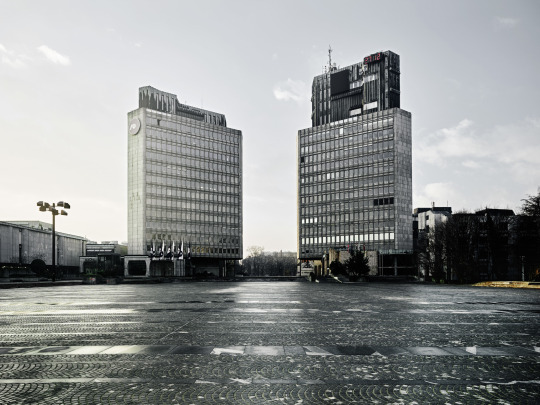
    A new exhibition on postwar architecture in (the former) Yugoslavia opens up today (July 15) at the Museum of Modern Art in New York. It’s called, Toward a Concrete Utopia: Architecture in Yugoslavia, 1948–1980and it runs until January 13, 2019.

    Here is a bit more about the exhibition:

    Situated between the capitalist West and the socialist East, Yugoslavia’s architects responded to contradictory demands and influences, developing a postwar architecture both in line with and distinct from the design approaches seen elsewhere in Europe and beyond. The architecture that emerged—from International Style skyscrapers to Brutalist “social condensers”—is a manifestation of the radical diversity, hybridity, and idealism that characterized the Yugoslav state itself.

    And here is a panel discussion about the exhibition (click here if you can’t see the video below):

    [youtube https://www.youtube.com/watch?v=M2S0bBTHu-8&w=560&h=315]

    Architecture tells you a lot about a place and what was happening at the time in which it was built. I would love to see this exhibition and I hope to do exactly that if I’m in New York City before the new year.

    Image: MoMA

  • European cities by rail connectivity

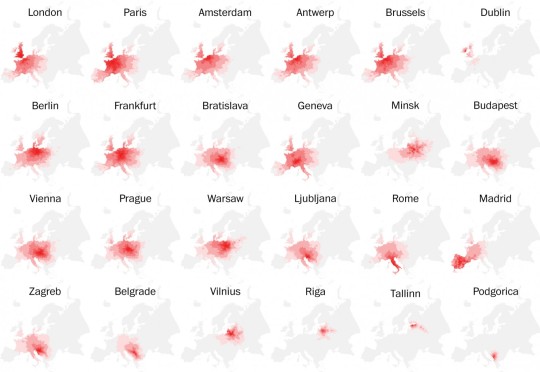
    This is a terrific set of maps published by The Washington Post (2015) using data originally collected and published by Peter Kerpedjiev:

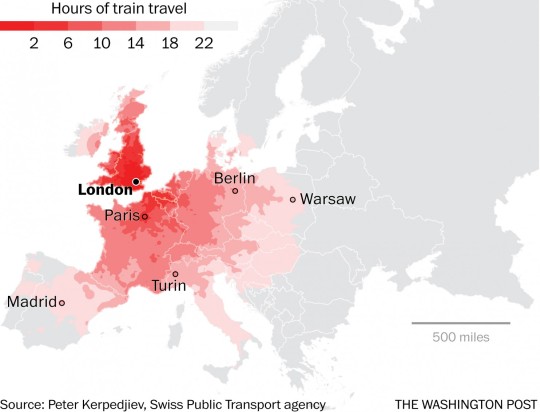
    What they show is how far you can travel in a 24 hour period using only trains and brisk walking from a collection of 28 European cities. In a few cases, such as from London to Dublin, a ferry ride is also included.

    Here’s a zoom in on London:

    The obvious takeaway is that Western Europe is very well connected, whereas many parts of Eastern Europe are not. Some cities, such as Tallinn (Estonia) and Podgorica (Montenegro) are almost completely disconnected.

    Of course today there’s stiff competition from air travel.

  • The Entrepreneurs, Barcelona

    Last week Monocle published their latest edition of “The Entrepreneurs” series. In this episode they look at Barcelona and a handful of entrepreneurs that are helping to grow the city. The video is only about 7 minutes long.

    I enjoy Monocle’s short films and I’ve always been impressed by Barcelona as a city. So here’s the video:

    [youtube https://www.youtube.com/watch?v=Q1wLBjlecac?rel=0&w=560&h=315]

  • Last call at the bar

    Earlier this week I attended the CityAge conference here in Toronto and participated in a panel discussion about talent. 

    The questions were all about how cities can attract and retain talent, and how they can best leverage the talent they already have. These are questions that a lot of cities around the world are thinking about.

    In my responses I talked about things like transit connectivity, which is a problem that all of us in Toronto recognize we have. But I also focused a lot on quality of life, on sense of place, and on being a cool place to live. These are important factors.

    The example I then gave is Berlin. Some say Berlin is now over. But for many years Berlin has been dubbed one of coolest cities in the world. And I personally think a lot of that has to do with the arts, culture, and nightlife scene that emerged in the 90s. 

    But this wasn’t a government initiative to make Berlin a hub for talent. It was largely a grassroots movement that took hold for a myriad of reasons, one of which was simply empty buildings that people could colonize for parties. And it transformed the place into a city that later became known as “poor but sexy.”

    That brought me to another point, which is that Toronto’s 2AM last call at the bar is laughable by global city standards. And we know that. That’s why whenever we host an event of any sort of notoriety – such as the Toronto International Film Festival – we extend it to 4AM. The people coming here from all around the world expect that.

    This may seem like a small thing. And I am sure many of you here in the city would like things to stay just the way they are. But I think we need to loosen up.

  • The world in 2050

    The United Nations recently released its 2015 version of World Population Prospects. It looks as if they put out and revise this report every 5 years.

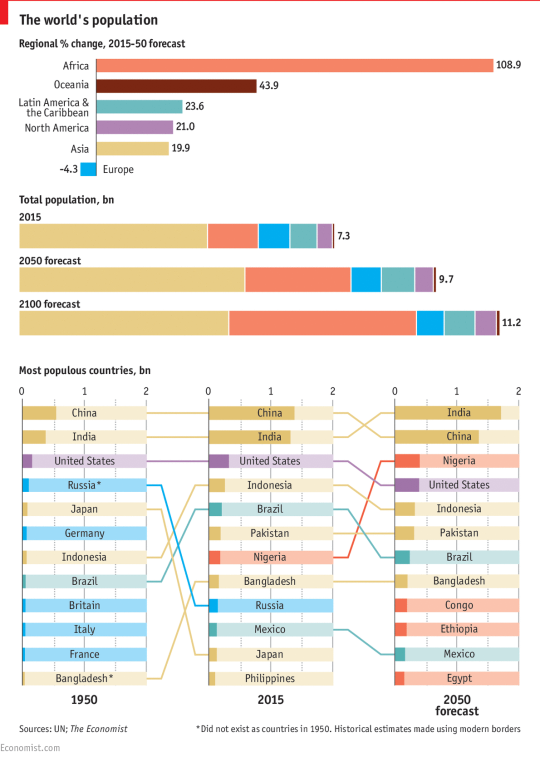
    The Economist then took some of their data and assembled it into the following charts:

    image

    It’s obviously extremely difficult to predict what will happen in the world by 2100, but to the extent that forecasting is possible, the world’s population is expected to reach somewhere around 11.2 billion people. Today it’s 7.3 billion.

    The bulk of this growth is expected to happen first in Africa, and then in Asia. By 2100, Africa’s share of the global population is expected to grow to 39% and Asia’s share is expected to decline to 44%.

    If you’ve been following population trends, most of this shouldn’t come as a surprise to you. The meaningful population growth happening in the world today is happening in the developing world. 

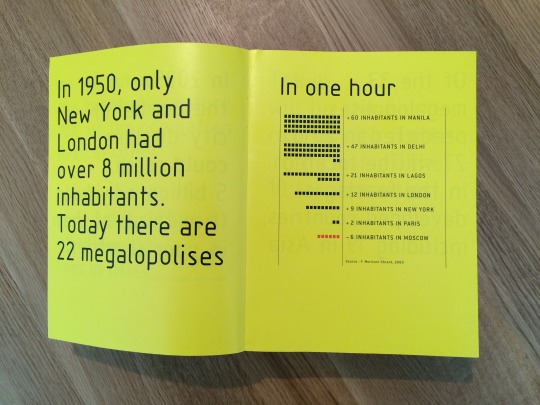
    That’s why architects, such as Rem Koolhaas, have been studying cities like Lagos (Nigeria) since the late 1990s and early 2000s. Below is a photo from a book/research project that I love called Mutations (2000). I pulled it from my bookshelf this morning.

    image

    It’s interesting to think about what all of this will mean for the global economy and for global governance. 

    The United States is about to be alone when it comes to advanced economies with a globally competitive population. Europe is shrinking, which leads me to believe that a strong EU is likely important. And we now have lots of megalopolises with big populations, but with very low income levels.

    Nigeria is the largest economy in Africa, but per capita income is somewhere around $3,000.