
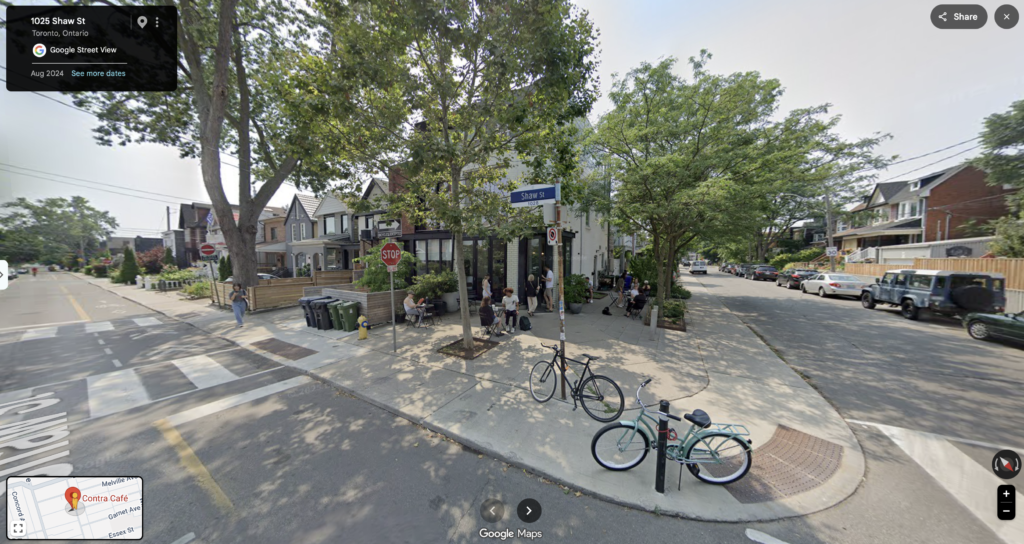
Many cities today treat local retail the way medieval towns treated tanneries: as an offensive nuisance that must be segregated from where people live. This has led us to our current debate over whether small-scale retail should be allowed deep inside residential neighbourhoods. It’s allowed, sometimes.
The detractors like to get people excited by suggesting that this will lead to all-night raves, multinational chains, or streets being overrun with cars. But of course, that is not what we’re talking about.
There are lots of case studies that we can point to. Japan, for instance, has a national zoning code that permits small-scale shops, home offices, and cafes in even its lowest-density, residential-only zone. From there, all subsequent zones work cumulatively, meaning more intensive zones generally inherit all previous uses. The result is a land-use approach that is default mixed-use.
Of course, there are also lots of examples that we can point to here in Toronto, and that’s because corner stores used to be a part of our daily life. But these remnant examples are generally found in the oldest, and most urban, parts of the city, and rejected in the inner suburbs.
It is no surprise that Toronto is once again divided on this issue and across its typical built-form lines. This division runs deep, and it will almost certainly resurface when Torontonians head to the polls this Monday.
At the end of the day, corner stores and local retail are an inherently urban sensibility. It is about not having to get into a car to grab a coffee or a soft washed-rind French cheese from Haute-Savoie. But we know that not all communities want to be urban.
One resident’s feature is another’s bug.