Daily insights for city builders, delivered every morning at 6 AM ET. I’m Brandon Donnelly — a Toronto-based real estate developer and founder of Globizen. I’ve been writing here since 2013.
For some reason, I woke up extra early this morning, well before my alarm. As soon as I came to and noticed the time, I immediately reached for my phone to pull up Twitter and see what happened with the UK referendum. And frankly, I was shocked to see that they had voted to leave the EU.
Once I saw what had happened, I then went to my computer and started looking for maps of the voting results.
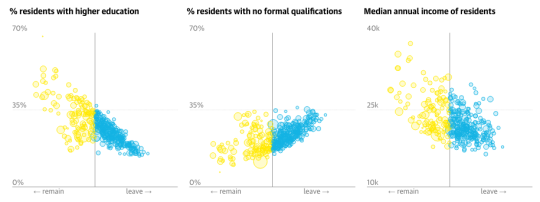
They also found that the best predictor of how people voted (with Scotland being a bit of an exception) was whether or not they had a degree. Residents with higher education were more likely to vote “remain.”
Here’s another vote map from the Telegraph, broken down by 12 regions:
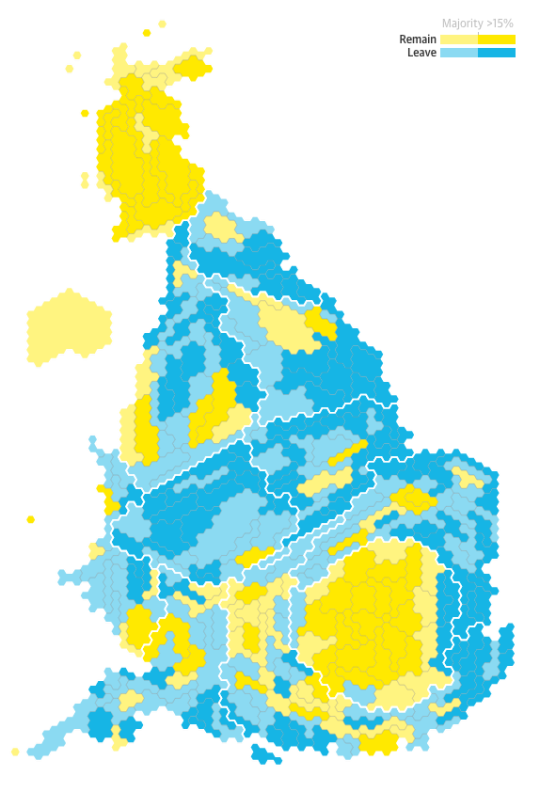
According to these regions, only Northern Ireland, Scotland, and London voted to remain. If we get a bit more granular though, the map turns into this:
Not surprisingly, it is London and other big cities (remain) vs. the rest of England (leave). Here’s another case of urban divide.
Buy real estate. It always goes up. That’s the mantra, right?
Few things in life are that black and white.
A small town in Sicily called Gangi is in the midst of a novel urban renewal experiment. They are giving away houses for free to people who will agree to renovate them within a 4 year time period.
This morning I stumbled upon a blog post by a Berlin-based venture capitalist (Ciarán O’Leary) talking about how Lisbon feels like the next Berlin. In other words, it feels like the next great European startup hub.
The tech scene is organic – it happened on its own, came out of nowhere. That is much more fun and sustainable than any kind of political or targeted economic strategy.
There are a ton of constraints (funding, local talent base, etc.) so entrepreneurs need to hustle to make things happen. Hustle is good.
Berlin was an economic void, Portugal had a massive economic crisis and Lisbon sure isn’t letting that crisis go to waste.
Entrepreneurship has the real chance to be a center stage act, not a side gig. It’s everywhere.
The city is very, very cool. You just want to be here.
You can have a great life on a startup salary.
Everyone speaks english; everyone is welcoming and open. That matters a lot when you want to attract international talent and funding.
And while being “very, very cool” may not seem immediately relevant to creating a robust startup environment, it really is. It may be the most important point. It makes the city a magnet for talent.
Just the other day I was trying to explain Berlin to someone and I used a similar lexicon. I said: “It’s an unbelievably cool city. It bleeds hipness. You will love it.”
I was catching up with a friend of mine over coffee this morning and he was telling me about his recent trip to Porto, Portugal. I’ve never been, but it’s fairly high up on my list of places to visit.
He was telling me about how beautiful the center of the city is and how it’s a UNESCO World Heritage Site. But he was also telling me how eerie it was to see so many abandoned and decaying buildings.
And part of the reason for this – I learned – is that up until fairly recently, Portugal had some incredibly onerous pro-tenant rent controls in place that dated back to the beginning of the 1900s.
Because of this, landlords in many cases could not, and cannot, actually afford to maintain their properties. Buildings were left to decay, and in some cases they were completely abandoned. That was their only option. And it led to a virtually non-existent rental housing market (according to the IMF).
Clearly, this is a problem. If you have a market distortion as serious as this one – where there’s virtually no incentive to invest – you’re on a highly unsustainable economic trajectory.
The hope was that the reforms would allow Portuguese landlords to charge more reasonable and market-oriented rents, as well as do other crazy things like evict tenants that don’t actually pay their rent. Not surprisingly, many fought the changes.
I don’t know precisely how these reforms have ultimately played out in the market over the past few years (if you do, I’d love to hear from you in the comments below), but I do believe that liberalization of the market was, and probably still is, needed.
While paying €5 a month for a 4 bedroom apartment in a desirable central neighborhood might be great for that one individual family, it’s not so great for the economy as a whole. And ultimately that comes around to impact even that household.