Daily insights for city builders, delivered every morning at 6 AM ET. I’m Brandon Donnelly — a Toronto-based real estate developer and founder of Globizen. I’ve been writing here since 2013.

Tag: essay

  • Doing great work

    Paul Graham just published his latest essay and it is a recipe for “how to do great work.” I highly recommend it, but you should know two things: (1) it assumes that you’re “very ambitious” and (2) it’s quite long. It’s possibly his longest essay.

    However, this second feature acts as a kind of filter. Because if you do actually make it to the end, his assumption is that it says something about both your level of ambition and your overall commitment to doing great work. You are presumably not the majority.

    As I read through it (albeit relatively quickly), I immediately started copying and pasting excerpts that resonated with me. Eventually I stopped this because there were just too many of them. But as a preview, here are some of the ones that I did pull out:

    • Four steps: choose a field, learn enough to get to the frontier, notice gaps, explore promising ones. This is how practically everyone who’s done great work has done it, from painters to physicists.
    • Develop a habit of working on your own projects. Don’t let “work” mean something other people tell you to do. If you do manage to do great work one day, it will probably be on a project of your own. It may be within some bigger project, but you’ll be driving your part of it.
    • The educational systems in most countries pretend it’s easy. They expect you to commit to a field long before you could know what it’s really like. And as a result an ambitious person on an optimal trajectory will often read to the system as an instance of breakage.
    • The trouble with planning is that it only works for achievements you can describe in advance. You can win a gold medal or get rich by deciding to as a child and then tenaciously pursuing that goal, but you can’t discover natural selection that way.
    • To the extent you can, try to arrange your life so you have big blocks of time to work in. You’ll shy away from hard tasks if you know you might be interrupted.
    • There may be some jobs where it’s an advantage to be cynical and pessimistic, but if you want to do great work it’s an advantage to be optimistic, even though that means you’ll risk looking like a fool sometimes. There’s an old tradition of doing the opposite. The Old Testament says it’s better to keep quiet lest you look like a fool. But that’s advice for seeming smart. If you actually want to discover new things, it’s better to take the risk of telling people your ideas.
    • People who do great things don’t get a lot done every day. They get something done, rather than nothing.

    You really should read the entire essay, though. It’s worth it.

  • The maker’s schedule

    Four years ago I wrote about a great essay that Paul Graham had published way back in 2009 about two different kinds of schedules: the manager’s schedule and the maker’s schedule. Put differently, the manager’s schedule is one of command. It is for bosses to drop in for 15, 30, or 60 minutes at a time, say a bunch of things, and then jump to the next meeting.

    The maker’s schedule, on the other hand, is one of doing, whether that be programming or working on an excel model. And the reality is that you can’t make or do much with only 15, 30, or 60 minutes. To make anything of real substance you need longer uninterrupted blocks of time. You need time to get into the zone.

    I’m reminded of this dichotomy now, more than ever, because of video conferencing. It has never been easier to overload a calendar with meetings. Consequently, it has never been easier to screw up a maker’s schedule.

  • Knock knock — more on Opendoor

    Packy McCormick’s latest “Not Boring” essay is up and it’s about Opendoor. It’s a good follow up to last week’s announcement.

    Maybe that’s why housing is one of the last major categories that technology has left alone. Sure, companies have tried. Tons of them. The startup graveyard is filled with companies led by entrepreneurs who realized that the way we buy and sell homes sucks, but couldn’t ultimately figure out how to change it. They weren’t thinking big or long-term enough. The companies that have made the biggest impact, like Zillow and Redfin, make it easier to search for houses, but then kick buyers over to agents to go through the offline process, the same way it’s always been done. 

    This is topic/problem that is near and dear to me because I spent a year of my life working on a startup that initially set out to solve this exact problem. But like countless others, we couldn’t figure out how exactly to change things. So we pivoted.

    Has Opendoor finally cracked the code? I don’t know. But they’re on to something. It is, however, worth noting that the company was founded in 2013. And so what is happening today is already 7 years in the making — and probably longer if you consider the founder’s past startups.

    Tough problems clearly require time. Money doesn’t hurt either.

  • A theory of genius

    I thoroughly enjoy the way that Paul Graham reasons through arguments. There’s something hyper rational about it. And even if you happen to disagree with his position(s), you still end up appreciating the way he has taken you through his logic. I guess that’s what you get when you combine a computer scientist with someone who clearly likes to write.

    His latest essay is about how to do great work. Conventional wisdom, he explains, has it that you really need two things: ability and determination. That’s how you win. And that’s how you create new things. But Paul makes the case for a third ingredient — one that is arguably even more telling than the first two. Here’s an excerpt:

    If I had to put the recipe for genius into one sentence, that might be it: to have a disinterested obsession with something that matters.

    Aren’t I forgetting about the other two ingredients? Less than you might think. An obsessive interest in a topic is both a proxy for ability and a substitute for determination. Unless you have sufficient mathematical aptitude, you won’t find series interesting. And when you’re obsessively interested in something, you don’t need as much determination: you don’t need to push yourself as hard when curiosity is pulling you.

    He refers to this as his “Bus Ticket Theory of Genius,” because bus ticket collectors are an example, in his view, of a group with a “disinterested obsession.” They’re not collecting bus tickets for any particular reason, other than because of interest. And when you have this kind of obsession with things that (ultimately) matter, it can lead to important discoveries.

    Think Darwin and his obsession with natural history.

    But the other reason this topic resonates with me is because it makes the case for passion projects, side hustles, creative pursuits, and all other irresponsible things that seem to get harder to fit in the older we all get. I am believer in this. There’s tremendous value in indulging in the things that stoke our curiosity, even if they might seem to silly to others.

    And so I will leave you all with this final thought/excerpt:

    It might be at least as useful to ask yourself: if you could take a year off to work on something that probably wouldn’t be important but would be really interesting, what would it be?

  • Manager vs. maker

    image

    I am a big believer in making things. 

    That could be writing a blog post, recording a podcast, coding an app, designing a building, making something tangible, or whatever. It is the act of creating something. And it’s one of the reasons I love what I do. At the end of the day, I have had a hand in (hopefully) creating something awesome that didn’t exist before.

    I don’t think everyone feels this way but, for me, when I don’t block time to “make things” I can sometimes feel antsy. I need time to do creative things. It makes me feel like I’m being productive. It makes me feel like I’m producing output, as opposed to just sitting in meetings and making sure everything is on track. Maybe that’s the architect in me.

    Paul Graham describes these two mindsets as that of a manager and that of a maker. And in a great essay published in 2009, he talks about how different these two people’s schedules can be. Below is a longish excerpt that I think you’ll find valuable for life and business.

    “There are two types of schedule, which I’ll call the manager’s schedule and the maker’s schedule. The manager’s schedule is for bosses. It’s embodied in the traditional appointment book, with each day cut into one hour intervals. You can block off several hours for a single task if you need to, but by default you change what you’re doing every hour.

    When you use time that way, it’s merely a practical problem to meet with someone. Find an open slot in your schedule, book them, and you’re done.

    Most powerful people are on the manager’s schedule. It’s the schedule of command. But there’s another way of using time that’s common among people who make things, like programmers and writers. They generally prefer to use time in units of half a day at least. You can’t write or program well in units of an hour. That’s barely enough time to get started.

    When you’re operating on the maker’s schedule, meetings are a disaster. A single meeting can blow a whole afternoon, by breaking it into two pieces each too small to do anything hard in. Plus you have to remember to go to the meeting. That’s no problem for someone on the manager’s schedule. There’s always something coming on the next hour; the only question is what. But when someone on the maker’s schedule has a meeting, they have to think about it.

    I find one meeting can sometimes affect a whole day. A meeting commonly blows at least half a day, by breaking up a morning or afternoon. But in addition there’s sometimes a cascading effect. If I know the afternoon is going to be broken up, I’m slightly less likely to start something ambitious in the morning. I know this may sound oversensitive, but if you’re a maker, think of your own case. Don’t your spirits rise at the thought of having an entire day free to work, with no appointments at all? Well, that means your spirits are correspondingly depressed when you don’t. And ambitious projects are by definition close to the limits of your capacity. A small decrease in morale is enough to kill them off.”

    This really resonates with me. It’s a great reminder, regardless of which schedule you’re currently on. Because even if you’re firmly ensconced in one of the two camps, chances are you work with people in the other one. And understanding where they’re coming from is important.

    Paul then goes on to talk about speculative business meetings in his essay. These are the “let’s grab coffee” meetings. They’re costly if you’re on the maker’s schedule, but they’re expected if you’re on the manager’s schedule. I have learned to cap these throughout the week. They can easily overwhelm a calendar.

    The big takeaway for me after reading Paul’s essay is that – if you make things – you have to be draconian about blocking time for that. I completely agree that even one meeting can derail an ambitious make session. So I am going to work harder at doing just that.

    Would you consider yourself to be a manager, maker, or both? I aspire to be both.

  • The Next Urban Renaissance

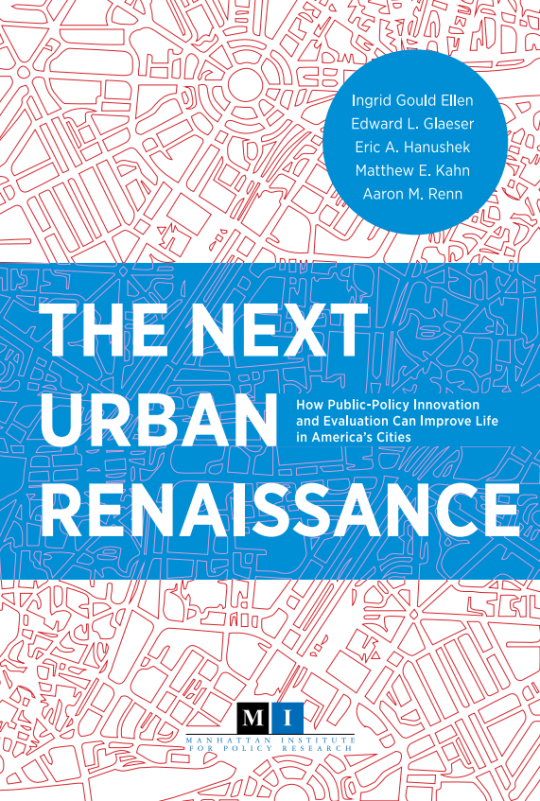
    The Manhattan Institute for Policy Research has just published a free book called, The Next Urban Renaissance: How Public-Policy Innovation and Evaluation Can Improve Life in America’s Cities.

    Here’s an excerpt from the foreword:

    This collection of essays brings together the best ideas from scholars with expertise across a broad spectrum of urban issues. The common theme of the papers is to innovate, evaluate, and leverage the remarkable private talent that is so abundant in America’s great cities. Public capacity is sharply limited; the ingenuity of urban entrepreneurs seems practically boundless. Local governments should be more entrepreneurial and do more to use the talents of the entrepreneurs around them.

    As a further preview, two of the ideas suggested in the book include: 1) reducing or eliminating parking requirements for new developments (which is something I’ve written about before on ATC) and 2) implementing a split-rate property tax for land and its improvements.

    If you’d like to download the free PDF, click here.

  • How much does it matter what message a city sends you?

    In keeping with the recent theme about cities, their brands, and the messages they send, I thought I would revisit an old essay (2008) written by Paul Graham (of Y-Combinator) called “Cities and Ambition.” In it, he talks about the various messages that cities send us, such as:

    • You should make more money (New York)
    • You should be better looking (Miami?)
    • You should be smarter (Cambridge)
    • You should be more powerful (Silicon Valley)

    But the most interesting part of his argument is the belief that we are largely products of our environment. No matter how strong or formidable our personalities might be, the message a city sends us is hugely important. In fact, it might be impossible to escape it. Here’s how Paul puts it:

    How much does it matter what message a city sends? Empirically, the answer seems to be: a lot. You might think that if you had enough strength of mind to do great things, you’d be able to transcend your environment. Where you live should make at most a couple percent difference.

    But if you look at the historical evidence, it seems to matter more than that. Most people who did great things were clumped together in a few places where that sort of thing was done at the time.

    You can see how powerful cities are from something I wrote about earlier: the case of the Milanese Leonardo. Practically every fifteenth century Italian painter you’ve heard of was from Florence, even though Milan was just as big. People in Florence weren’t genetically different, so you have to assume there was someone born in Milan with as much natural ability as Leonardo. What happened to him?

    If even someone with the same natural ability as Leonardo couldn’t beat the force of environment, do you suppose you can?

    I don’t. I’m fairly stubborn, but I wouldn’t try to fight this force. I’d rather use it. So I’ve thought a lot about where to live.

    To some, this thought may depress you. I mean, if you happen to live in a city or place with the “wrong” message, you might feel as if you’re missing out. I know that thought certainly crossed my mind when I read his essay. But different messages resonate with different people, and so maybe the message your city is telling you is exactly the one you need to accomplish great things.

    In Toronto, I’d say that the message is similar to that of New York: You should make more money. Oh, and also that you should buy more condos 😉

    What message does your city tell you?