Daily insights for city builders, delivered every morning at 6 AM ET. I’m Brandon Donnelly — a Toronto-based real estate developer and founder of Globizen. I’ve been writing here since 2013.

Tag: england

  • Climate lessons from 16th century England

    We don’t like coal today, but it certainly transformed Victorian-era architecture:

    “It is the biggest transition in the history of our species, with the possible exception of starting to use fire at all in the first place,” says Barnabas Calder, author of the groundbreaking study “Architecture: From Prehistory to Climate Emergency.” Fireplaces had to be redesigned for coal, smaller, and more efficient, and could now be distributed throughout the house, warming a sequence of smaller rooms that contained heat more efficiently. Brick, which also requires substantial amounts of energy to produce, became affordable. And glass, too, was accessible to ordinary people. “Coal affects the way you can achieve comfort conditions in a building, and it is a very affordable way of producing a significant amount of warmth, which allows for bigger windows. Even more significant is that it opens up a series of new building materials.”

    But as new technologies transformed how we thought about it architecture, they also transformed how we thought about climate. Buildings used to have to be carefully “tuned” to their local environment. You had to think about where the sun was coming in, how you were going to trap it during the winter months, and how you were going to release it during the summer months, among many other things.

    Eventually though, this stopped mattering.

    We had building systems that could take care of these matters, which then meant that we were free to aspire to build the exact same architecture in Phoenix as in London. But we now know that that this doesn’t make much sense. And this recent architectural tour from the Washington Post, which starts in 16th century England, is a good reminder that the lessons learned many centuries ago are in fact still relevant today.

    Maybe even more so.

  • Wooden sash windows only

    There is, of course, part of me that admires what King Charles III has been trying to do in Poundbury (a small master-planned community on the outskirts of Dorchester, England). It is a community that has deliberately rejected the modern suburban in favor of traditional main-street urbanism. It is denser than you’d expect. It has a mix of uses. And it has been generally designed around people, rather than the car.

    On the other hand, I could never ever live there:

    To live here is to live under Charles’s rules (it is not clear whether William intends to be more flexible). Currently, Poundbury residents are embroiled in a debate about windows: The Duchy says that only wooden sash windows are permitted. Many residents would like to replace theirs with vinyl or fibreglass windows, which are easier to maintain and, crucially, more energy-efficient – and Poundbury is theoretically a ecologically advanced town. So far, the Duchy is not willing to budge.

    The last thing I want in my life is someone telling me what kind of windows I can install and what kind of architectural styles are suitable. Messy and organic urbanism suits me just fine.

  • Housing supply in Tokyo

    It has been well documented that Tokyo tends to build a lot of housing. And the argument goes that this has helped to maintain a certain level of housing affordability. The city is constantly building and rebuilding. It also has different views about housing. Now, we could, of course, debate how much of its relative affordability is a direct result of supply but, regardless, there seems to be a lot of it. In 2014, the city of Tokyo saw 142,417 housing starts, according to this recent FT article. This is compared to ~5,000 units across the Bay Area (2015 data), 83,657 units for the state of California, and 137,010 units for all of England.

    If you’re wondering how Toronto is doing, here are the latest numbers:

  • Two-up, two-down

    Feargus O’Sullivan is doing a series in CityLab right now on the “home designs” that define four European cities: London, Berlin, Amsterdam, and Paris. The first one is on London’s classic “two-up, two-down” design, which refers to a two storey home with a living room and kitchen on the ground floor and two bedrooms on the second. It’s a simple design, but one that has supposedly endured.

    O’Sullivan argues that for many, or perhaps most in Britain, this is what a “home” feels like. It’s grade-related and there are two floors. Indeed, only 14% of British people live in an apartment, compared to 57% in Germany (a majority). This percentage is much higher in London, with about 43% of people living in an apartment. But about 25% of the population still lives in some sort of attached house.

    Home equals house. And for us North Americans, this is of course relatable. But the Germany example is a reminder that this is not necessarily universal. Attitudes toward housing are cultural. And cultures can and do change. I am seeing that happen right now in Toronto. Some of us are becoming less like the British and more like the Germans.

  • The Interlock in London’s Fitzrovia

    This is a terrific infill project by Bureau de Change (architect) for HGG London (developer). It’s a five-storey mixed-use development in London’s Fitzrovia neighborhood.

    The design ambition was to respect the area’s history, materiality, and proportions, but also create something entirely new. The result is a blue clay (brick) facade that transforms and looks like this:

    And it was done by inventing a collection of misshapen blocks — 44 of them to be exact. Over 5,000 blocks were ultimately used for the facade and it was assembled on site using a 1:1 printed template. Each block came with a set of instructions.

    There’s something nice about working at this scale and being able to get into this level of detail. It’s 21st century craftsmanship (the entire facade was modeled in 3D before it was built).

    If you’d like to learn more about The Interlock, click here. All photos by Gilbert McCarragher.

  • The world’s biggest fishing port

    Here is an excerpt from a Guardian article that was published last year (by Tim Burrows) about Grimsby, England:

    In Grimsby’s 1930s heyday, fishermen used to head to Freeman Street as soon as they were off the trawler, straight to the Lincoln or the Corporation Arms to spend their bountiful earnings. A century previously, Grimsby had been a fairly sleepy fishing village, but by the 1890s it was on the way to becoming the biggest fishing port in the world. In the mid 20th-century, trawlers were bringing in 500 tonnes of fish a day.

    Today, Grimsby still has a thriving indoor market (paid for by the EU and the Enrolled Freemen of Grimsby, an organisation that dates back to the 13th century), but the further north towards the docks you walk, the emptier and more dilapidated things get. A local businessman says sex workers wait around at night for lorries to take them to the deserted docks. “It’s a legacy of the old fishing days.”

    There is scant legacy to be found elsewhere. After a long decline, the fishing industry died in the mid 1980s, its owners selling their trawlers to companies in Aberdeen or Japan. Unlike Hull across the river, currently basking in its year as Capital of Culture, Grimsby is the Humber city that never was.

    More than 70% of people in Grimsby, England voted to leave the European Union in the 2016 “Brexit” referendum. It was one of the highest shares in the country. But with one of the highest unemployment rates in the country, that outcome is not all that surprising.

    Supposedly, at its peak, there were eight onshore jobs for every one at sea in Grimsby. And like all thriving cities, there were economies of agglomeration, which resulted in things like the largest ice factory in the world. The fishing fleets needed crushed ice — and lots of it.

    The Grimsby story is, of course, not a unique one. You just have to replace fishing with some other industry. Many cities have managed to diversify their economies either out of necessity or because they saw the writing on the wall. But for others it has been a real struggle.

    It’s one of those things that is perhaps simple, but far from easy.

  • One lease for the world

    image

    If you’re looking for more evidence that the way we live and work is changing, then check out a new startup called Roam. They describe themselves as an international network of communal spaces. So far, they have locations in Ubud (Bali), Miami, and Madrid. Buenos Aires and London are coming soon.

    The way it works is that you start by signing a lease for either a week or a month. You get a private room and bathroom, but everything else, from the co-working spaces to the kitchens, are shared amongst the community. Like other co-working and co-living environments, the community they build is critical.

    However, what really differentiates Roam is that you can sign one lease and then live all over the world, freely traveling across their properties. All of the locations are offered up at the same price and you can stay for as long as you’d like.

    In my line of work, I don’t have the flexibility of living like a global nomad. But today, there are many people who can. And I also know that there are many people who would prefer to live like this. It’s liberating in so many ways.

    My friend and I actually had a similar idea to this back in University and we spent some time working on it. At the time, and this was over a decade ago, we felt that there was a segment of people who increasingly wanted to live like global citizens. I still believe that to be true and, clearly, so do others.

    To date, Roam has raised $3.4 million in funding.

    Image: Ubud kitchen via Roam

  • Riding an escalator for the first time

    image

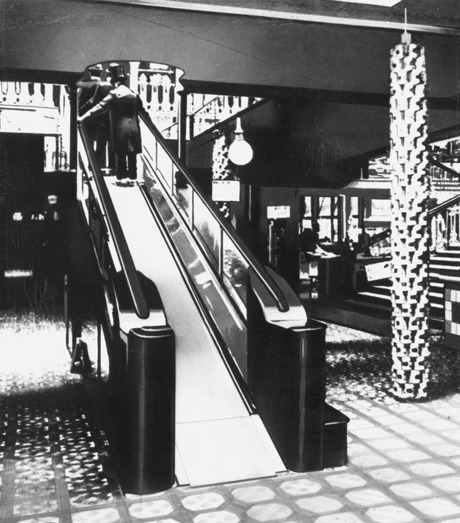
    On Wednesday, November 16th, 1898, Harrods department store in London opened up the first escalator – or moving staircase as it was called – in England. The first escalator-like machine in the world had actually been patented many decades before in the US, but this was the first real application in England and likely one of the first in the world.

    At the end of the 1800s, this was a big deal. Victorian England had never seen or experienced anything like this before and people were genuinely concerned about its use. More specifically, people worried what such a rapid change in elevation would do to the body. It was believed that it could discombobulate your inner workings. People were unnerved.

    Which is why when it was first introduced at Harrods, people were offered brandy and other substances at the top of the escalator in order “to revive them after their ordeal.” Riding an escalator was no small feat for these people.

    Now to us today, this sounds ludicrous. Most of us probably ride a few escalators a day. They’re ubiquitous. But I tell this story because I think it clearly underlines how disruptive the new and unknown can feel, and how difficult it can be for us to accept sometimes.

    If you go back throughout history, you could easily replace escalators for many other new technologies: the printing press, the automobile, the internet, and so on. And in some cases we were wrong to worry, and in other cases we were right to worry.

    Cars, for example, have had a pretty dramatic impact on our lives and the way we build our cities. And since the very beginning, they had no shortage of critics. But does that mean we should have never invented the car? I don’t think so.

    As I said earlier this week week, the goal in my mind is to find the right balance between preservation and progress. Just as we shouldn’t be so quick to erase our architectural history, we shouldn’t be so quick to erase our way of life.

    But at the same time, it’s important to remain open minded to what’s coming. I’m optimistic about the future. Change can be a great thing, even if it may feel as uncomfortable as riding an escalator for the first time. Maybe you just need a bit of brandy to calm your nerves.

    Image: Pinterest

  • A century of homeownership and renting in England and Wales

    This morning while I was reading about gentrification in Berlin, I clicked through to an interesting overview of homeownership and renting in England and Wales over the last century. Here’s a video. If you can’t see it below, click here.

    [youtube https://www.youtube.com/watch?v=LDnGryGJ1ZA]

    The video starts in 1918, where the vast majority of households (77%) rented. As of 2011, this number has reversed. 64% of households in England and Wales now own their home.

    If you compare this housing trend to what happened in the United States and Canada, you’ll see a similarity. Although, the US was ahead in terms of promoting homeownership. They reached 50% ownership somewhere in the mid 1940s, whereas England and Wales didn’t reach this number until around 1971.

    image

    All of this is an interesting reminder that our obsession with homeownership is a relatively new one. But it’s also not a universal one. The homeownership rate in Berlin is 15.6%, and it’s only 49.5% in London. People in big cities tend to rent more.