Daily insights for city builders, delivered every morning at 6 AM ET. I’m Brandon Donnelly — a Toronto-based real estate developer and founder of Globizen. I’ve been writing here since 2013.

Tag: energy

  • Low-carbon cement

    By some measurements, cement production alone is responsible for about 8% of human-caused carbon dioxide emissions every year. And so there is an imperative to find suitable low-carbon alternatives. Here is what is currently happening in the US (via Grist):

    On Tuesday, Terra CO2 Technology was picked to receive a $52.6 million federal grant to build a new manufacturing plant just west of Salt Lake City. The company has devised a method that turns common minerals into additives that can help replace Portland cement — a key component in concrete, and one of the most carbon-intensive materials in the world.

    In addition to this new facility, the company is set to start construction on its first plant in the Dallas-Fort Worth area:

    The project is expected to break ground in January 2025 and begin shipping out materials by late summer 2026, Yearsley said. The facility will be capable of producing up to 240,000 metric tons of SCM [supplementary cementitious materials] per year when completed, or enough to serve roughly half of the local metropolitan market.

    And all of this is part of a broader initiative by the US Department of Energy:

    The Utah facility is one of 14 projects provisionally selected this week to receive $428 million in total awards from the U.S. Department of Energy’s Office of Manufacturing and Energy Supply Chains. The initiative, which is funded by the Bipartisan Infrastructure Law, aims to accelerate clean energy manufacturing in U.S. communities with decommissioned coal facilities. Officials said the projects are expected to create over 1,900 high-quality jobs across a dozen states.

    For the rest of the article, click here.

  • Ontario should have more solar energy

    I have a very close friend (Peter Vogel) who is in the solar business. He runs business development for a company called Otter Energy. And by volume, I believe they are the largest in Ontario. Since 2009, they have installed over 350,000 panels.

    So when Peter and I hang out, I get the benefit of learning about solar. And he is great at reminding me that installing panels on the roof of buildings in Ontario makes a ton of sense from both an environmental and financial standpoint.

    Generally speaking, the amount of benefit you will see depends on the building’s ratio of roof area to overall building area. Low-rise buildings with a lot of roof area (think industrial assets), are absolute no brainers. But it can also work very well on many other asset classes, including mid-rise multi-family.

    Here are some high-level figures that he recently walked me through:

    • As a rule of thumb, solar in Ontario typically generates between 12-14 kWh’s per year per square foot of roof area (usable flat roof).
    • The average payback period for an install is usually somewhere between 4.5 to 7 years.
    • However, on income producing properties, the permanent decrease in operating expenses and the corresponding increase in net operating income (NOI) will increase your asset value on day one.
    • Consider spending $100k on solar panels to increase your NOI — through lower electricity costs — by $10k. If you were to then capitalize this increase in NOI by 5%, it would mean your asset value has right away increased by $200k. If the cap rate for this asset is even lower, say 4%, the increase goes up to $250k.
    • These multiples can get even better with larger installs. Here are some numbers from a real-world 100,000 sf commercial building in Ontario. In this case, the solar system cost about $800k (net) and resulted in annual operating cost savings of about $140k. This means, that at a 5% cap rate, the owner spent $800k to increase the value of their asset by $2.8 million on day one.
    • Of course, in addition to all of this, you get long-term energy cost certainty. That’s worth something too.

    The business case is compelling. So I think more building owners should be looking at solar. We are certainly looking at it from a development perspective. If you’re interested in learning more, feel free to reach out to my friend. There are a lot of details that help strengthen the case for solar, including depreciation allowances and tax credits.

  • DroneBase adds thermal imaging missions

    I was reading today about how DroneBase has partnered with FLIR Systems to offer infrared and thermal imaging missions. FLIR actually invested in DroneBase. For those of you who aren’t familiar with DroneBase, they operate the largest drone network in the world and have a wide variety of services geared toward the real estate industry.

    This news is noteworthy because infrared thermography cameras allow you to see and measure the thermal energy emitted from objects — such as buildings. For the real estate industry, or even for individual homeowners, it would allow you to quickly visualize things like leakiness (lack of air tightness), water damage, and so on.

    These kinds of scans already exist, but putting thermal sensors on drones has the potential to make this technology much more scalable and cost effective. I am sure we will be seeing more of this. And when we do, I bet we’ll discover that many buildings don’t actually perform all that well from an energy standpoint.

    Photo by Goh Rhy Yan on Unsplash

  • Clean disruption of energy and transportation

    I just came across the below talk by Tony Seba about the coming “clean disruption” of energy and transportation. The talk follows his book of the same name. Click here if you can’t see it below. It runs about an hour, but I would encourage you to give it a watch. 

    [youtube https://www.youtube.com/watch?v=2b3ttqYDwF0?rel=0&w=560&h=315]

    The first few minutes will be things I’m sure many of you have heard before, such as the failure of Kodak to embrace digital cameras (film business considered too valuable), Moore’s Law, and so on. But he then moves on to cost curves, battery storage, solar power, and autonomous electric vehicles (A-EVs).

    You all know that I am fascinated by these topics, so here’s one piece that stood out for me: 2021 is his prediction for the year in which A-EVs become real and disrupt both internal combustion engine (ICE) vehicles and individual car ownership.

    Obviously this won’t happen overnight, but Tony’s belief is that 2021 will be the year that the economics of A-EVs become so compelling (10x) that it will crush our current business models.

    The argument is that on-demand ride hailing/sharing and A-EVs will converge and that Transportation as a Service (TaaS) will provide our mobility needs at a fraction of today’s costs. We’ve talked about this prediction before on the blog, but never has a timeline been attached to it.

    All of this reinforces two thoughts that I’ve been having over the past few years. One, I will probably never buy another combustion engine vehicle. And two, I should probably avoid buying another vehicle, period, until the next wave of business models becomes clearer. Leasing likely makes more sense at this stage if you need a car.

    In fact, Tony believes that with the collapse of individual car ownership, the resale value of cars could become negative. That is, you’d have to pay people to take a car off of your hands, because everyone will recognize the cost advantage of just using TaaS.

    We are doing everything we can to future proof our development projects so that they are ready for electric vehicles. But if A-EVs and TaaS completely erase individual car ownership within the next 5 years, then all of us in the industry are going to need to do much more to ready our buildings and cities.

  • Current state of renewable energy

    image

    The United Nations and Bloomberg New Energy Finance recently published a report covering global trends in the renewable energy space for 2017

    Here are some of their key findings:

    – 2016 was a record year in terms of renewable power capacity installed worldwide. This includes wind, solar, biomass and waste-to-energy, geothermal, small hydro, and marine sources.

    – The share of global electricity generated from renewable sources rose from 10.3% (2015) to 11.3% (2016).

    – However, overall investment in renewables declined in 2016 for two main reasons. Costs went down (good news). And China and Japan exhibited a dramatic slowdown in terms of investment activity (bad news).

    – Acquisitions of renewal assets, such as wind farms and solar parks, hit a new peak at $72.7 billion.

    – A number of promising new pricing records set in 2016: $29.10 per MWh for solar in Chile and $30 per MWh for onshore wind in Morocco.

    – In one year, the cost of solar generation dropped on average about 17% and onshore wind dropped about 18%.

  • What technological deflation could be doing to the economy

    Earlier in the week, I came across this post (via Fred Wilson), arguing that rapid technological progress is causing systemic deflation in the broader economy.

    Here’s a chart that illustrates the author’s point:

    What is happening here is that despite advances in technology and increases in productivity, real wages have been stagnant for decades. (This chart is for the US, but it likely applies to many other countries.)

    This is an interesting paradox. For a long time, increases in productivity were met with corresponding increases in income. So why the divergence?

    The author believes that it’s because the gains brought about by “extreme technological progress” are being unequally applied to the economy. In other words, they do not benefit the majority of people. He then goes on to argue that we could be entering an entirely new macroeconomic era: 

    “Economic growth may be over soon, at least in absolute terms. On the other hand that will be at least partially offset by the technological deflation. So instead of the decline of the innovation it will be just the opposite, the explosion of the innovation that will turn the economy to the decline. And moreover, it will not be a tragedy since we will be able to produce higher standard of living with fraction of the GDP today. Few adjustments needs to be done into our economic system to cope with the change for sure.”

    When you read things like this it makes the idea of a “basic income guarantee” seem far more palatable.

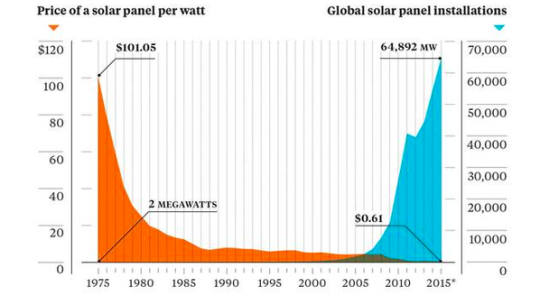
    The other chart that stood out to me was this one below, which shows the declining cost of solar panels and the rise of global solar panel installations. 

    It’s a great reminder that it’s only a matter of time before we wean ourselves off of oil. And, that we could be headed towards some sort of third industrial revolution where the marginal cost of energy is almost zero. Already about 25% of Germany’s electricity comes from renewables.

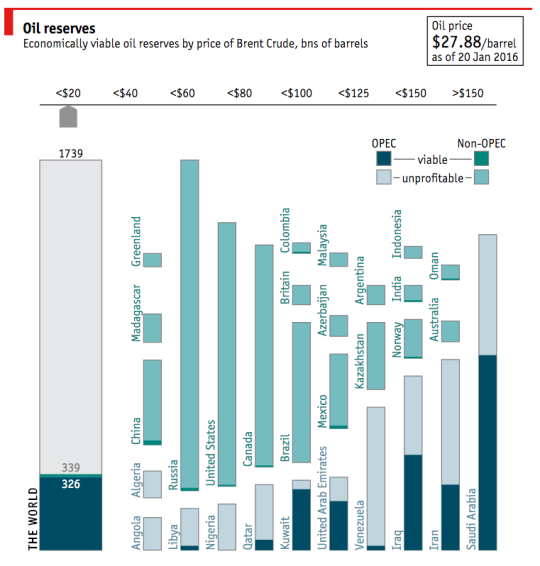
    On that note, I am going to end with a fantastic interactive chart from The Economist (screenshot below) that outlines oil reserves around the world by country. If you click through to their website, you can then toggle the price of oil (per barrel) to see how much of those reserves are actually viable.

    With the price of oil where it is today ($27.88 per barrel as of January 20, 2016), there are only a handful of countries with profitable oil. I am sure you could have guessed which ones.

    What will happen if, or should I say when, that oil is no longer needed? 

  • A history of energy and cars (and how Tesla is changing the world)

    image

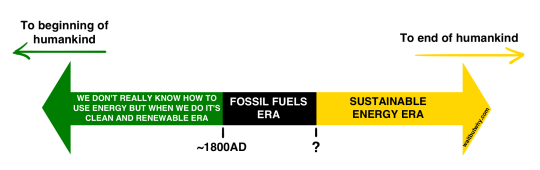
    I spent this morning reading a long – but incredibly worthwhile – article by Tim Urban on Wait But Why called, How Tesla Will Change The World. (Are they all this long? It was my first time reading WBW.)

    The article, of course, talks a lot about Tesla, but it’s so much more than that. It talks about (1) the history of energy, (2) the history of cars, and then about (3) Elon Musk and Tesla. If you have the time, I highly recommend you give it a read.

    But since it is long and many of you probably won’t do that, here’s an extract from the third section on Tesla (EV = electric vehicle/car):

    EVs aren’t there yet. Right now, there are legit cons. But as the next few years pass, EVs will get cheaper, battery ranges will get longer and longer, Superchargers will pop up more and more until they’re everywhere, and charging times will just decrease as technology advances. Maybe I’m missing something, and I’m sure a bunch of seething commenters will try to make that very clear to me, but it seems like a given to me: the gas era is over and EVs are the obvious, obvious future.

    The car companies, as I mentioned, aren’t happy about all of this—they’re acting like a kid with a cupcake whose parents are forcing them to eat their vegetables.

    But how about the oil industry?

    Unlike car companies, the oil industry can’t suck it up, get on the EV train, and after an unpleasant hump, continue to thrive. If EVs catch on in a serious way and end up being the ubiquitous type of car, oil companies are ruined. 45% of all the world’s extracted oil is used for transportation, but in the developed world, it’s much higher—in the US, 71% of extracted oil is used for transportation, and most of that is for cars.

    As Tim states at the end of his article, this piece is all really about change and progress. Progress is not inevitable. It doesn’t just happen as time marches on. It happens because of strong willed people who believe in something that many others probably don’t. 

    Because with many changes – regardless of how critical or beneficial they may be to society as a whole – there will almost always be entrenched interests that would rather see things stay exactly the same. But in my view, that shouldn’t get in the way of doing the right thing.

    Image: Wait But Why

  • Tesla introduces a battery for your home

    image

    By accident, this week on Architect This City seems to be turning into Elon Musk week.

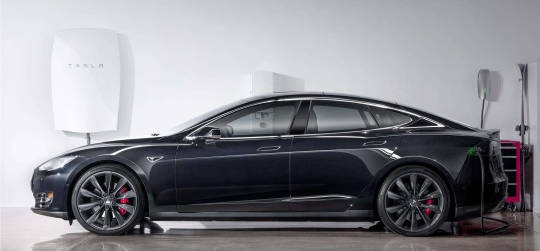
    Yesterday, Musk announced something called the Powerwall home battery. Measuring about 3′ x 4′, the shield looking battery pack will charge using the electricity generated from solar panels (or from the grid when rates are at their lowest) and then power your home.

    It’s designed for consumers and will cost between US$3,000 – $3,500 depending on capacity. The individual Powerwalls can also be daisy chained to increase capacity. It will be available starting this summer.

    A wall battery may not seem all that interesting to some, but I think this is actually a big deal for a few reasons.

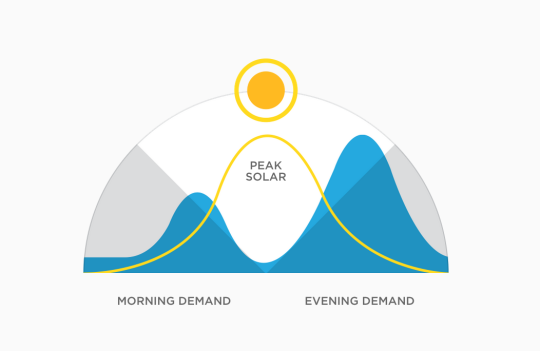
    Renewable energy is often both intermittent and produced when you don’t need it. Here’s a great chart from Tesla that shows what I mean:

    image

    During peak solar hours, most people aren’t home and most people aren’t consuming at peak levels. That’s why it’s important to be able to store the energy that you collect, whether it be from solar, wind or other renewal energy source. And from what I hear from my friends in the industry, storage has been a bit of an Achilles heel for adoption.

    It will also help to further decentralize energy production. What is produced locally (from say solar panels) will be stored locally for when it’s needed locally. This is in contrast to centralized production or producing energy locally and then feeding any excess capacity into the grid for use somewhere else. That requires transmission and will be by definition less efficient.

    Finally, the other interesting thing about Powerwall is that it closes the loop on two of Musk’s businesses: SolarCity and Tesla. SolarCity is about the production of renewable energy and Tesla is about the consumption renewable energy. But as the chart above shows, storage is often needed to link those two activities in an efficient way.

    All of this makes me excited about Powerwall.

    If any of you are an expert in this industry (which I am not) or you just have additional thoughts, I would love to hear from you in the comment section below.

    Images: Tesla

  • The new Toronto 2030 District

    Photograph Financial District, Downtown Toronto, Canada by Yeonju SEONG on 500px

    Image: Financial District, Downtown Toronto, Canada by Yeonju SEONG on 500px

    Today I learned about something new called 2030 Districts. They are: “designated urban areas committed to meeting the energy, water, and transportation emissions reduction targets of the 2030 Challenge for Planning.”

    Toronto’s new 2030 District is downtown, which is bound by the lake in the south, Bathurst Street in the west, Dupont Street and Rosedale Valley in the north, and the Don Valley in the east. 

    It’s the first district outside of the US. The other established districts are in Seattle, Pittsburgh, Los Angeles, Denver, Stamford, San Francisco, and Dallas.

    The goals for Toronto’s district are as follows (quoted from 2030 Districts):

    • To cut district-wide emissions in half, including zero-emissions from new buildings by 2030.
    • Support a better understanding of where and why energy use, water use, and GHG emissions occur across the District.
    • Work in partnership with building owners, service providers and conservation groups to accelerate the adoption of best practices for building design and management.
    • Facilitate broad stakeholder dialogues to uncover and overcome systemic barriers to long term reductions in energy use, water use and GHG emissions.

    I’m looking forward to following and learning more about this initiative. I think many of us can agree that producing less, not more, GHG emissions in the future would be preferable. And we know that the bulk of it comes from both buildings and transportation.