Daily insights for city builders, delivered every morning at 6 AM ET. I’m Brandon Donnelly — a Toronto-based real estate developer and founder of Globizen. I’ve been writing here since 2013.

Tag: employment

  • 3 ways to get into real estate development

    The most popular post on this blog is this one here called, “What real estate developers do and why I became one.” This post alone has been responsible for a good chunk of the organic traffic that this site receives since I wrote it back in 2014. If you search for “real estate developer” in Google it usually comes up on the first page.

    Probably because of this post, the number one question I receive in my inbox is about how to become a developer or how to transition into development from some other discipline. Usually this comes from someone who is early on in their career and/or is in architecture (which is not surprising given my background as a fake architect).

    I have tried to respond to this question publicly and at scale with a number of different posts. But many of you probably haven’t seen them before, and so I figured it would be a good idea to summarize some of them here (they’re usually tagged with “developer dirt“):

    If you’re looking for a more succinct summary of what to do, here is what I would suggest to you. You basically have three options.

    1) You can convince someone to take a chance and hire you, even though you likely don’t have any development experience. Maybe you have a background in something relevant such as real estate law, architecture, or politics (good). Or maybe you don’t (less good). Either way, the best way to position yourself is to understand what it is that developers do and figure out a way to create value for them from day one. You want to be in a position to say, “Yeah, I know I don’t have any direct development experience, but I can do X, Y, and Z for you starting today and I think that would be helpful to you for the following reasons.”

    2) Get a relevant degree. I’m thinking an MBA in real estate or some sort of master’s in real estate development. The reality is that the development business has, in many ways, become more institutionalized. It has gone, though obviously not entirely, from rich private families developing with their own balance sheets to more institutional capital sources, such as pension funds. Because of this, there are going to be hiring managers out there who need to check off certain boxes. For example, does this person have a real estate degree? This may make it harder for someone to take a chance on you if you don’t have the right experience and/or credentials.

    3) Just go out and do it. Despite becoming more institutional, the development business remains, in my view, a deeply entrepreneurial endeavor. You have to be able to problem solve and you have to be creative. The best developers I know don’t focus on can’t, they focus on how. Because there are too many obstacles in this business. A can’t mentality wouldn’t get you very far. So consider renovating a triplex, building a laneway suite, or doing something else that allows you to take a piece of real estate and create some additional value. Because that’s all that development really is at the end of the day.

    If you found this post useful, please consider sharing it with someone that you think would benefit from it. And if there are other topics that you would like me to cover (or cover in more detail), please feel free to leave a comment below or to at me on Twitter. I prefer Twitter over email because it forces brevity. Happy Canadian Thanksgiving, all.

    Photo by Bernard Hermant on Unsplash
  • We are hiring

    We are looking to hire a Project Coordinator to join the Development team here at Slate Asset Management in our Toronto office.

    This is an ideal position for someone who is passionate about development and cities; who wants to be part of an entrepreneurial and growing team; and who is able to be hands on and take ownership over what they do.

    The Project Coordinator would work closely with the full Development team and support all aspects of project delivery from acquisition to exit/stabilization. Eventually, we want this person to lead a portfolio of their own development projects.

    We’re looking for someone with the following skills and characteristics:

    • Demonstrated passion for city building, design, and urban affairs
    • Experience in real estate and/or development
    • Understanding of planning & land use policies, development finance, and design & construction (though, the right attitude and work ethic goes a long way)
    • High energy, with the ability to thrive in a fast-paced entrepreneurial environment while at the same time being extremely detail oriented
    • Strong communication skills, both written and verbal (well-reasoned opinions are crucial)
    • Proficiency in Excel, SketchUp, CAD/Revit and other relevant software considered an asset
    • Degree(s) in related field(s)

    If you’re interested after reading all of this, please send your resume and cover letter to brandon@slateam.com. Your short cover letter should include why you want to work at Slate, as well as your favorite recent development project (it can be anywhere in the world but make sure to include why).

    Alongside this, we would like to see a link/URL that helps us get to know you better. This could be your Twitter or Instagram, a personal blog, a portfolio, or something else that represents who you are. If you don’t have any of these, well then you’ll have to get creative.

    Thanks for your interest.

  • The U.S. cities that gained the most workers over the last 12 months

    One of the great things about social media is that it gives us access to data that previously didn’t exist or was difficult to collect.

    Take, for example, LinkedIn’s monthly report on employment trends called the Workforce Report. They look at which industries are hiring, where people are moving for jobs, and so on. Click here for the June 2017 edition. 

    Note that architecture/engineering hiring appears to be up nationally, which is usually a positive leading indicator.

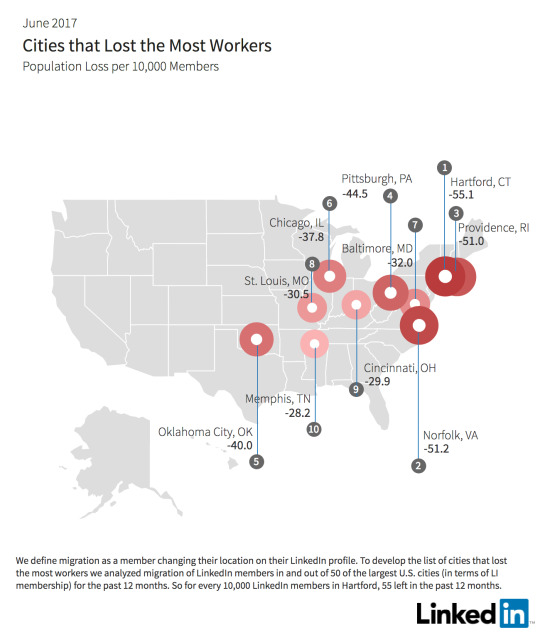
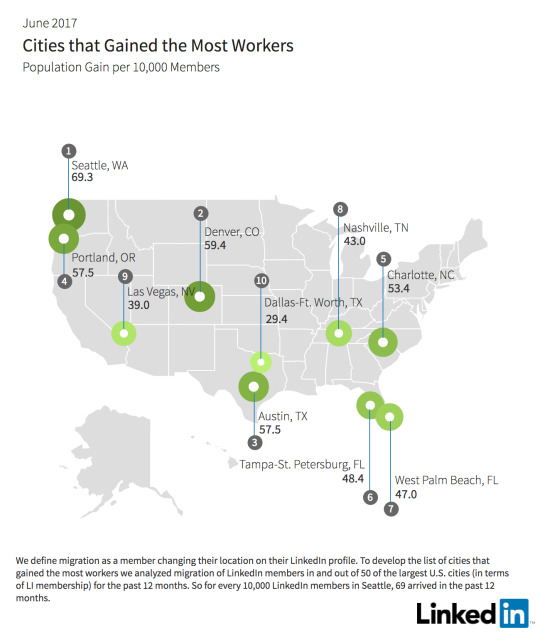
    I’ll leave you all to go through the report, but I did want to pull out a few of their maps and one of their takeaways. Below are maps of the cities that lost the most workers and gained the most workers over the last 12 months.

    The established trend of people moving from colder northern cities to warmer amenity-rich cities seem to play out here.

    That said, one of their “key insights” is that fewer workers today are moving to the San Francisco Bay Area. Since February 2017, there has been a 17% decline in the net number of workers.

    They blame housing affordability (ahem, lack of supply). People are simply turning to other great cities like Seattle, Portland, Denver, and Austin. They’re growing and cheaper.

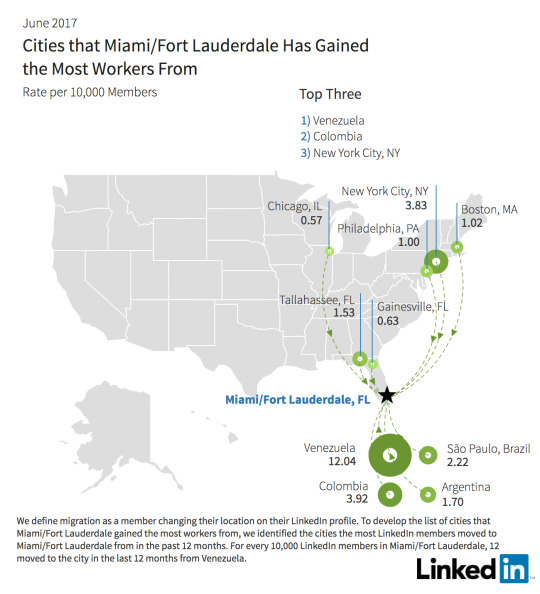
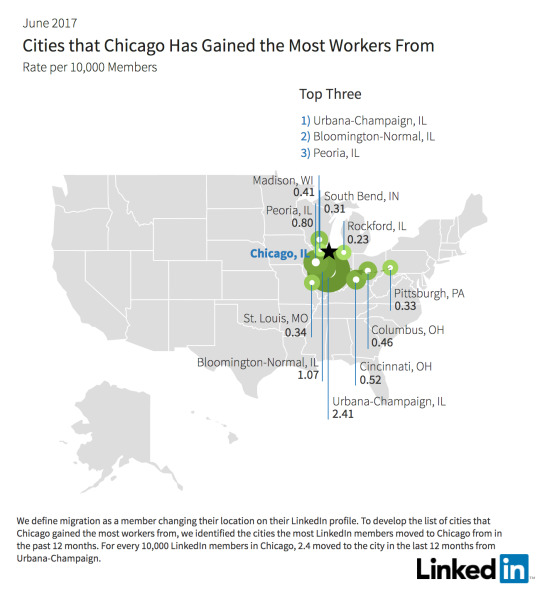
    One of the other cool things about the report is that you can drill down into individual cities to see where people are moving from. I looked up Miami and Chicago just to do a quick comparison. 

    Not surprisingly, Miami is seeing a significant contingent from South America. What’s interesting about this random comparison is how international Miami is and how regional Chicago is in terms of their draws.

    I would love to see similar data for Canada. This is valuable stuff.

  • 3 thoughts on employment

    There’s lots of talk these days about how technological innovation and globalization are taking our jobs.

    Of course, these are not unreasonable concerns. The data suggests a hollowing out of the middle class and the threat of automation feels perhaps more real than over with the recent advancements in AI and robotics.

    But here are 3 things to consider and discuss:

    1) It doesn’t feel realistic to believe that the jobs which went overseas will ever return en masse – as nice as it may sound to argue that. They went overseas to take advantage of a particular cost structure and those motives haven’t changed.

    2) It is not guaranteed that technological innovation will destroy more jobs than it creates. In fact, historically the opposite has often been true. The jobs that were lost by technological innovation were replaced by new / more jobs and greater economic surpluses. For instance, think of agriculture.

    3) But could this time be different? If we are indeed entering a new economic period, then it strikes me that 1), above, becomes even further away from the right solution. Some of the proposed solutions include universal basic income and a robot tax (links to interview with Bill Gates).

  • The tech ecosystem in Toronto (and New York)

    Tech Toronto recently published a new study called, How Technology Is Changing Toronto Employment

    They estimate that there are over 400,000 tech jobs in Toronto, out of a total of 2.7 million people employed. That number includes tech people working for non-tech companies, and tech and non-tech people working for tech companies. So tech jobs are thought to represent about 15% of the city’s employment.

    Within this 400,000 or so jobs, an estimated 93,000 people are self-employed (23% of tech jobs). And the belief is that there are around 2,500 to 4,100 active “startups.”

    Zooming out, it is also one of the fastest growing industries in the city:

    image

    To try and put this into perspective, a similar report for New York – published in 2014 – reported 291,000 tech jobs out of 4.27 million people employed. I was a bit surprised by these numbers, but the Toronto report seems to have been modeled after the New York one. So presumably they use similar methodologies.

    Of course, there’s the big question of quality over quantity. There’s a certainly a difference, in terms of impact to the economy, between a back office tech job and fast growing startup that will eventually reach the coveted $1 billion valuation number and create thousands of new jobs.

    Obviously every city is hoping for the latter.

  • The war on work

    Air Canada bumped me from my flight this morning and so I am spending the day hanging out at Toronto Pearson Airport. I can think of more enjoyable ways to spend Canada Day, but at least there’s a nice seating area in Terminal 1 with free wifi and lots of plugs.

    I just finished watching the below talk by Harvard economist Ed Glaeser at the Manhattan Institute. His overall thesis is that unemployment is a far worse problem than income stagnation and that the US needs to stop creating incentives for people not to work. He refers to it as a war on work.

    He addresses a few topics that we’ve talked about here on this blog, such as guaranteed basic incomes, as well as others that we haven’t talked about, such as raising the minimum wage. To give you one spoiler: He argues that a higher minimum wage has been shown to cause an overall drop in employment, which he, again, believes is a deeper problem.

    Glaeser delivers a passionate performance. So if you have 30 minutes to spare – perhaps you’re stuck in an airport somewhere – I recommend you give it a watch. If you can’t see the video below, click here.

    [youtube https://www.youtube.com/watch?v=8xaNV_6wgak?rel=0&w=560&h=315]

  • Why Google is worried about being welcoming to employees who want to build new businesses

    Here on ATC, we’ve talked a lot about the changing nature of work and what that could mean for cities. 

    We talk (and debate) about the value of density and of being in close proximity to others so that ideas can percolate – whether that means open office floor plans or community coffee shops.

    But alongside all of this, there are some fascinating structural changes taking place within organizations. Below is an excerpt from a recent New York Times article called, How Larry Page’s Obsessions Became Google’s Business

    But corporate success means corporate sprawl, and recently Google has seen a number of engineers and others leave for younger rivals like Facebook and start-ups like Uber. Mr. Page has made personal appeals to some of them, and, at least in a few recent cases, has said he is worried that the company has become a difficult place for entrepreneurs, according to people who have met with him.

    Part of Mr. Page’s pitch included emphasizing how dedicated he was to “moonshots” like interplanetary travel, or offering employees time and money to pursue new projects of their own. By breaking Google into Alphabet, Mr. Page is hoping to make it a more welcoming home for employees to build new businesses, as well as for potential acquisition targets.

    What I find interesting about the statements I’ve bolded is that they represent a radically different approach to business and employment. Of course, it’s not really a new thing. Google has been encouraging its employees to work on personal projects since, I think, the very beginning. 

    But as you read the above article, you really get the sense that Page believes that this kind of organizational culture is fundamental to the long term competitiveness of the company. It’s something he is genuinely worried about.

    As counter intuitive as it might seem to encourage employees to work on other things besides the core business, one could argue that it’s almost essential in a world of rapid and constant innovation. Would you rather an employee or a competitor discover what’s next in your industry? If it’s the former, you have a chance of absorbing it into your current business. If it’s the latter, you’re already too late.

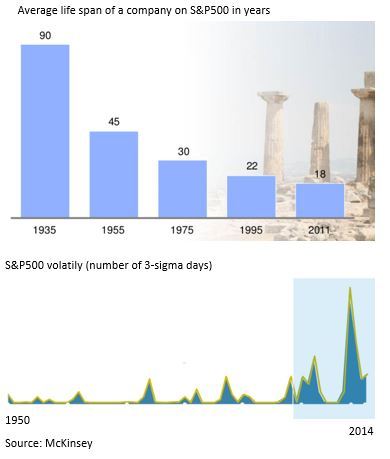
    If you go back to the article I posted earlier this week, you’ll see that creative destruction is happening a lot faster than it did in the past. The average life span of many, or most, companies seems to be decreasing.

    The tech sector seems to be ahead of most other industries with respect to this kind of thinking. But I believe that it will continue to percolate through the economy. And when it does, it will probably have many impacts on the kinds of spaces we design and build in our cities.

  • But what about employment?

    The Neptis Foundation here in Toronto just recently published a fantastic report looking at the regional economic structure of the Greater Golden Horseshoe area. It’s called Planning for Prosperity.

    In it they identity the polycentric nature of employment in the Toronto region by way of downtown Toronto and three suburban “megazones.” Here’s one of their maps showing overall employment density and the megazones (light blue circles):

    Here’s a snippet to give you an idea of the scale of these megazones:

    “The Airport megazone, one of the three employment megazones outside Downtown Toronto, is the second largest concentration of employment in Canada, after Downtown Toronto. It represents almost 300,000 jobs, more than the central business districts of Montreal, Vancouver, or Calgary individually.”

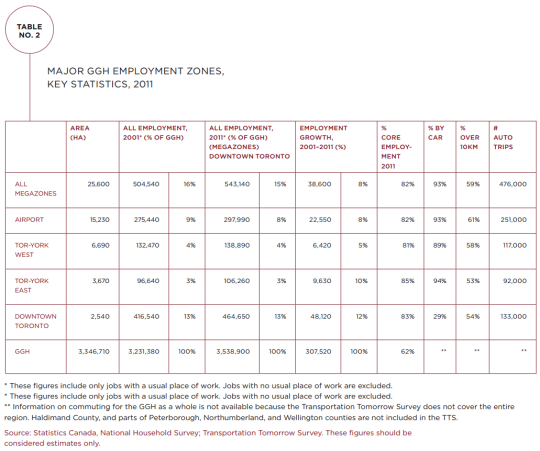
    And here’s a chart showing the hard numbers:

    Downtown Toronto dominates in terms of employment. But it’s also fascinating to see how much more efficiently it provides that employment. It has the smallest physical area of all the employment zones (2,540 hectares or 6,276 acres) and the lowest percentage of car trips (29%).

    But the big takeaway from their report is that we have not been focused enough on employment in our planning. Instead, we seem to be thinking residentially. Here’s a final snippet:


    “This study shows that the Growth Plan and The Big Move, which are currently under review, do not address the challenges and opportunities of a globalizing regional economy or the reality of a transforming economic landscape.

    The Growth Plan’s focus has largely been on managing residential growth rather than non-residential and employment-related development. Indeed, the Growth Plan is based on shockingly little hard evidence on the evolving economy of the region. Plans for city-regions a fraction of the size of the GGH typically involve more economic research, analysis, and evidence.”

    Clearly we need to be looking at both the residential and non-residential sides of the equation as we grow the region. To read the full report, click here.

  • Comprehensive to the core

    The City of Toronto recently started an initiative called “Comprehensive to the Core.” It’s a look at how downtown Toronto–which is growing at 4 times the rate of the rest of the city–should continue to grow moving forward so that it remains a great place to live, work, learn and play.

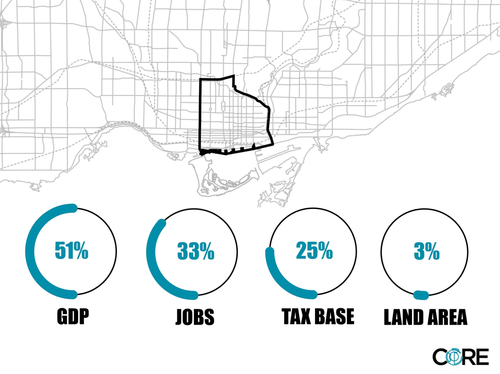
    Here’s a presentation that was delivered last month by the city. It’s mostly infographics and so it’s a quick and fun read. And here’s an infographic that does a nice job of summarizing what’s happening in the core of Toronto.

    What it’s saying is that downtown Toronto–which they consider to be bound by Bathurst Street in the west, the Don Valley Parkway in the east, the lake in the south, and Dupont Street in the north–is responsible for 51% of the city’s entire GDP. It’s also responsible for 33% of all jobs in the city and 25% of the city’s entire tax base. And yet in terms of size, it represents only 3% of the city’s land area.

    That’s a powerful reminder of the economic potential of density and agglomeration economies. It’s also a reminder that we shouldn’t let politics deprive our economic engine of the services and investments it needs.