Daily insights for city builders, delivered every morning at 6 AM ET. I’m Brandon Donnelly — a Toronto-based real estate developer and founder of Globizen. I’ve been writing here since 2013.

Tag: electricity

  • Insufficient electrical capacity until 2035

    One of the things that you need to do when you’re constructing a building is arrange for new utility connections. Sometimes there’s enough capacity to support what you’re building and sometimes the capacities need to be upgraded (which usually becomes the responsibility of the developer).

    But according to this recent Financial Times article, some new applicants in west London are now being told that there won’t be “sufficient electrical capacity for a new connection” until, oh I don’t know, maybe 2035. And it could affect all new housing projects with 25 or more units.

    This is a pretty wild piece of news. And it certainly won’t be good for overall housing supply. The three west London boroughs that are being impacted by this capacity issue were responsible for about 5,000 new homes between 2019-2020. That’s about 11% of London’s total housing supply.

    So what and who is to blame for this? The Greater London Authority is saying that data centers are at least partially responsible. Too many new data centers in the area with high electrical loads.

    I don’t know exactly what is going on here (maybe some of you do), but now feels like a good time to turn our attention to solar power. I recently visited a large 3,000 panel rooftop installation here in the Greater Toronto Area, and so naturally there is a blog post in the works. Stay tuned.

  • Crypto energy consumption

    One of the main criticisms of cryptocurrencies is that they consume a lot of energy and are therefore not sustainable. But all blockchains are not created equal and there are different ways in which transactions on a blockchain can be validated.

    Bitcoin and Ethereum use something known as “proof of work” (though Ethereum plans to change this sometime next year). This method of validation does indeed use quite a bit of energy.

    But another way to validate and maintain security on a network is through something known as “proof of stake.” This is what Solana and many other blockchains are now using. Put differently, there’s no “mining” required, which is the work that is so energy intensive.

    To demonstrate the difference, the Solana Foundation recently published this comparison chart:

    To try and further put this into context, the entire Solana network is currently doing about 20 million transactions per year. Right now, they are claiming that this is equivalent to the electricity usage of about 986 American households.

    If you’d like to take a look at the footnotes, click here.

  • Shenzhen has just electrified its entire bus fleet

    image

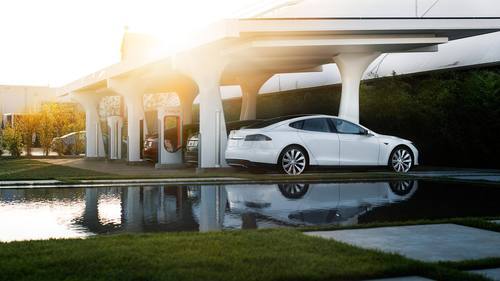
    This is impressive: Shenzhen recently finished converting its entire bus fleet to electric vehicles. That’s 16,359 buses and around 8,000 charging stations according to Electrek.

    It is estimated that this all-electric fleet saves 345,000 tons of fuel per year and reduces carbon emissions by 1.35 million tons.

    Shenzhen is now working on doing the same to its 12,518 taxis. Already 62.5% of them are electric-powered and the goal is 100% by 2020. 

    But let’s not forget that China still generates most of its electricity from coal. Coal represented 72% of its electricity generation in 2015. And in 2014, carbon emissions from China allegedly made up almost 30% of the world .

    Photo by Anton Strogonoff on Unsplash

  • Current state of renewable energy

    image

    The United Nations and Bloomberg New Energy Finance recently published a report covering global trends in the renewable energy space for 2017

    Here are some of their key findings:

    – 2016 was a record year in terms of renewable power capacity installed worldwide. This includes wind, solar, biomass and waste-to-energy, geothermal, small hydro, and marine sources.

    – The share of global electricity generated from renewable sources rose from 10.3% (2015) to 11.3% (2016).

    – However, overall investment in renewables declined in 2016 for two main reasons. Costs went down (good news). And China and Japan exhibited a dramatic slowdown in terms of investment activity (bad news).

    – Acquisitions of renewal assets, such as wind farms and solar parks, hit a new peak at $72.7 billion.

    – A number of promising new pricing records set in 2016: $29.10 per MWh for solar in Chile and $30 per MWh for onshore wind in Morocco.

    – In one year, the cost of solar generation dropped on average about 17% and onshore wind dropped about 18%.

  • What technological deflation could be doing to the economy

    Earlier in the week, I came across this post (via Fred Wilson), arguing that rapid technological progress is causing systemic deflation in the broader economy.

    Here’s a chart that illustrates the author’s point:

    What is happening here is that despite advances in technology and increases in productivity, real wages have been stagnant for decades. (This chart is for the US, but it likely applies to many other countries.)

    This is an interesting paradox. For a long time, increases in productivity were met with corresponding increases in income. So why the divergence?

    The author believes that it’s because the gains brought about by “extreme technological progress” are being unequally applied to the economy. In other words, they do not benefit the majority of people. He then goes on to argue that we could be entering an entirely new macroeconomic era: 

    “Economic growth may be over soon, at least in absolute terms. On the other hand that will be at least partially offset by the technological deflation. So instead of the decline of the innovation it will be just the opposite, the explosion of the innovation that will turn the economy to the decline. And moreover, it will not be a tragedy since we will be able to produce higher standard of living with fraction of the GDP today. Few adjustments needs to be done into our economic system to cope with the change for sure.”

    When you read things like this it makes the idea of a “basic income guarantee” seem far more palatable.

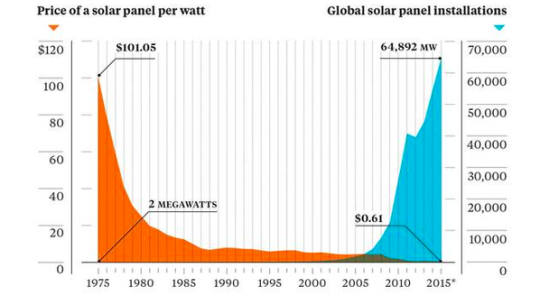
    The other chart that stood out to me was this one below, which shows the declining cost of solar panels and the rise of global solar panel installations. 

    It’s a great reminder that it’s only a matter of time before we wean ourselves off of oil. And, that we could be headed towards some sort of third industrial revolution where the marginal cost of energy is almost zero. Already about 25% of Germany’s electricity comes from renewables.

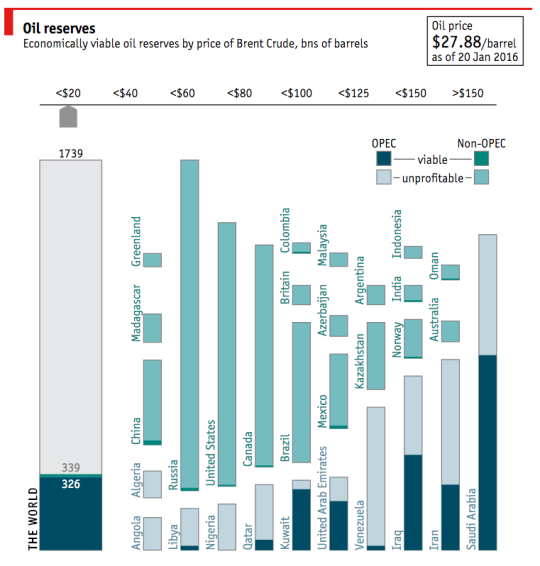
    On that note, I am going to end with a fantastic interactive chart from The Economist (screenshot below) that outlines oil reserves around the world by country. If you click through to their website, you can then toggle the price of oil (per barrel) to see how much of those reserves are actually viable.

    With the price of oil where it is today ($27.88 per barrel as of January 20, 2016), there are only a handful of countries with profitable oil. I am sure you could have guessed which ones.

    What will happen if, or should I say when, that oil is no longer needed? 

  • The landscape of electric charging stations

    The car had a profound impact on the landscape of our cities (and that’s probably the understatement of the year). Not only did it force the decentralization of our cities (i.e. sprawl), but it dotted the landscape with gas stations and other things that cars required.

    According to the Verge, the first gas station was built in 1905 in Missouri. And it was really thought of as a side business for pharmacies and other business owners. But as of 2012, there were 121,466 gas stations throughout the United States. It obviously became a big business.

    But as we make the transition from gasoline cars to electric ones, we’re going to need a new network of “refill” stations. In fact, this network is probably more important than the cars themselves if the goal is widespread adoption.

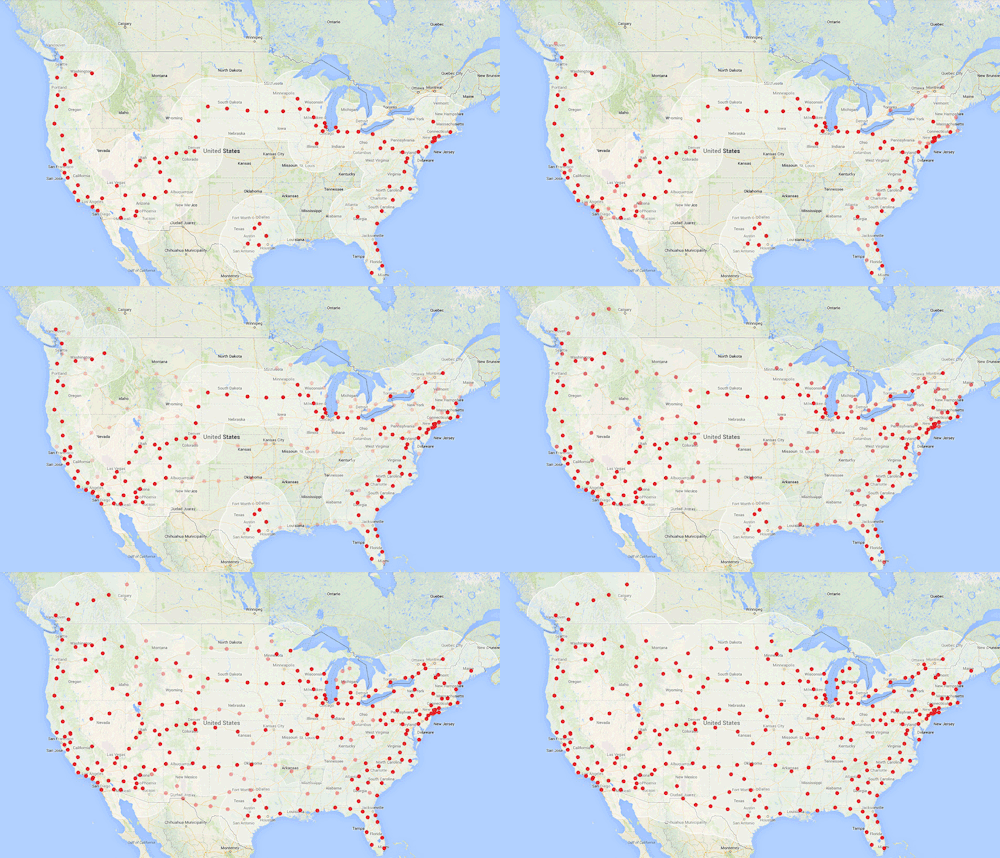
    Below is an animated GIF depicting Tesla’s plans to blanket North America with its Supercharger stations by the end of 2015. By then they will have covered off 98% of the US population and many of the most densely populated parts of Canada.

    But there are two important differences when it comes to comparing Supercharger stations vs. traditional gas stations.

    First of all, these won’t be the only places where drivers will be able to recharge. People will also charge their Tesla at home. In fact, I would assume that for regular city driving, most people would do just that. It’s far more convenient to just drive home, plug in your car, and have it recharge while you’re sleeping (just like we already do with our smartphones). And if this is the case, then these Supercharger stations will be primarily used for long drives, which means we probably won’t need as many within our cities.

    Secondly, these Supercharger stations are free to Tesla drivers (provided you purchase that option with your car). This is really interesting, because it changes the economics of the industry. Selling gas is no longer a profit center. 

    But what I wonder – especially now that Tesla has open-sourced its technologies – is how these free Supercharger stations will ultimately fit into the broader electric vehicle market. Will other manufacturers create Tesla Supercharger compatible cars? Or will we see a rival set of charging stations emerge?

    My sense is that Tesla is doing what it can to ensure it becomes the standard.