Daily insights for city builders, delivered every morning at 6 AM ET. I’m Brandon Donnelly — a Toronto-based real estate developer and founder of Globizen. I’ve been writing here since 2013.

Tag: electric vehicles

  • Electric vehicles are approaching price parity

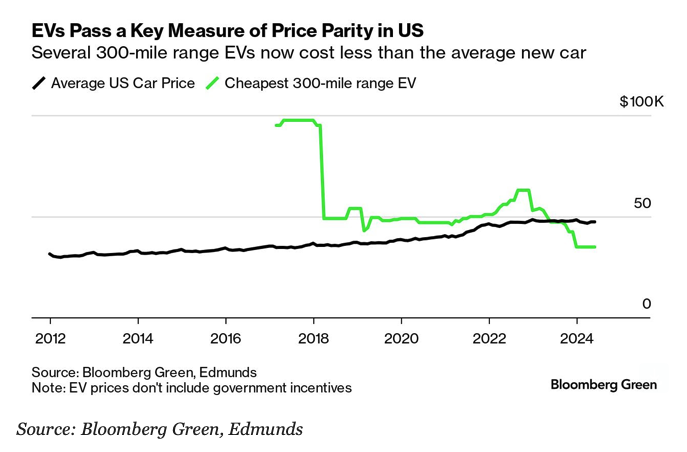
    According to Bloomberg Green, there are now at least three car manufacturers — Tesla, Hyundai-Kia, and GM — with electric vehicles that (1) have a range greater than 300 miles (480 kilometers) and (2) cost less than the average price of a new vehicle in the US (which is currently around $47,000). This means that we are now approaching price parity:

    This is an important adoption milestone, even if it does, at this point, feel totally expected. The International Energy Agency (IEA) is forecasting full price parity by 2030. But in my mind, I’m already done with ICE vehicles. When I bought my current car over 6 years ago, I knew it would be the last internal combustion engine I ever own.

  • Nearly 1 out of every 10 cars sold is now electric

    I’ve said this before, but the car I currently have will certainly be the last internal combustion engine vehicle that I own. I truthfully even felt a bit weird buying it 6 years ago, but at the time, there weren’t that many options other than a Tesla. And I didn’t want a Tesla.

    Today, there are lots of EV options, and the numbers are starting to show that. When the final figures come in, it is estimated that the US will have sold 15.5 million new cars last year. And of these, about 1.44 million units are expected to have been electric.

    This means that we are just under 1 out of every 10 new cars sold in the US. The trend line is also working in the right direction. 1.44 million new EV units is roughly the total number of EVs sold between 2016 and 2021 in the US. 

    So things are accelerating. And presumably there are other people like me waiting on the sidelines. I am deliberately roughed in for an EV charging station in my new parking spot and, if/when it comes time to purchase a new car, that’s exactly what will get installed.

    (I added “if” because, depending on how mobility evolves over the next 5-10 years, there’s a chance I may no longer want to own a car.)

  • Self-driving cars, plugs, and electrical grids

    This is going to be old news to many of you, but this past week I experienced Tesla’s self-driving capabilities for the first time. And I must say that I was very impressed. It did everything from navigate stop-and-go city traffic to navigate lane changes on the highway. Overall, it makes my five-year old car feel pretty quaint. The software is that much more sophisticated and one has to assume that all of this autonomy stuff will only get significantly better as LIDAR becomes common place in production vehicles.

    In other car news, North America appears to be narrowing in on an EV charging plug standard. It is Tesla’s plug, but it is now appropriately called the North American Charging Standard (NACS) plug. And last week, Electrify America — which is the largest non-Tesla, fast-charging network in the US — announced that it would be adding the plug to its network. The company also happens to be owned by Volkswagen. So big and important companies seem to be coalescing around this plug type.

    Lastly for today, here’s a post by Fred Wilson talking about (1) bi-directional EV charging, (2) the apartment buildings he and his wife are developing, and (3) our ongoing transformation away from a centralized electrical grid to a decentralized one. What he talks about in his post is something that we are actually piloting in a few of Slate’s office buildings right now. It’s still early days, but I think it’s really exciting. Tech seems to be enabling a broader shift toward decentralization. And in the case of our electrical grid, it’s going to lead to a more resilient one.

  • EVs are cool, but what about high-speed rail?

    As many of you know, I am an advocate for high-speed rail in Canada. Specifically along the Windsor-Quebec City corridor, which is the most densely populated part of the country. And so I found this comparison interesting:

    “If there is one project that would create thousands of jobs, improve business productivity, clean up the air, reduce the output of greenhouse gases and cut the demand for endless highway construction, it would be high-speed electric rail between Toronto, Ottawa and Montreal, where population densities are high enough to make the project sensible. Cost estimates are all over the map. The University of Toronto’s Munk School of Global Affairs & Public Policy put the price tag at about $12-billion, which is $2-billion less than the bucks being thrown at the Volkswagen battery plant alone. But forget it – the Canadian government wants more cars, not fewer. Canadian cities will remain car sewers forever.”

    The above excerpt is from this opinion piece talking about EVs and the public subsidies being paid to encourage battery production within Canada. I get that we want to be part of this important mobility shift. But we are way behind when it comes to high-speed rail.

    And by behind, I mean that we don’t have it at all in this country.

  • Global electric vehicle adoption

    This is the current state of global electric vehicle adoption:

    • Last year was the first year that global electric-vehicle sales reached 10% of all car sales — the total was around 7.8 million cars (see above chart)
    • Fully-electric vehicles accounted for about 5.8% of all car sales in the US, 11% of all car sales in Europe, and about 19% of all car sales in China — China is leading in this department
    • The US saw 807,180 fully-electric vehicle sales last year — Tesla remains the biggest EV maker in the world
    • In Germany, electric vehicles accounted for about 25% of all new vehicles produced last year — BMW reported a 5% decline in new-car sales, but saw its EV sales more than 2x
    • Similar story with Volkswagen: 7% decline in new-car sales; 26% increase in EV sales
    • This year, some are predicting that China will see EV sales increase to every third car, and that it will reach its tipping point sometime between 2025-2030

    It is obvious where all of this is heading. It is simply a question of how fast, and who will be the leaders at the end of the day.

    All data sourced from the WSJ

  • California is set to ban gasoline cars by 2035

    According to this recent New York Times article, California is set to put into effect a new mandate that would require 100% of passenger vehicle sales in the state to be fully electric by 2035. Included within this mandate are also interim targets: 35% of all sales by 2026 and 68% of all sales by 2030.

    When I first read the article, my first thought was: “Isn’t 2035 kind of far away? Can’t we do this sooner?” And this is usually how my mind works when I see some date in the future. But then I remembered that EV sales last year in the US only totaled somewhere around 5% of all sales.

    So there is work to be done, and mandates like this will certainly help. As I understand it, this will be the first mandate of its kind in the US and also one of the strictest in the world. A lot of other countries have simply set targets, rather than all-out bans.

    This is what it means to lead. You do things before others.

  • What am I paying more for?

    So here’s the thing. The whole reason we are all talking about how to build more sustainably is that there isn’t often a quantifiable ROI for doing so. If building a net-zero building cost less than building a regular building, everybody would be building one. But that is not the case, which is why our industry, and others, are grappling with how to justify the added costs, even though we all know it’s absolutely the right thing to do.

    The questions we are asking ourselves look something like this: If I spend X% more on this build, what kind of rent premium could I command? And in some cases this premium is quantifiable and in some cases it matters a great deal. For instance, in the case of a new office building, you might need to spend the extra money so that you can attract the right tenants. While in other cases/asset classes, you might feel as if there’s no rent premium and nobody will ever pay more.

    But I like how Seth Godin thinks about it in this recent post: people never pay extra. If you’re paying more for an electric car, for example, you aren’t actually paying extra. What you are paying is a price that you feel is fair for what you are receiving. And what is it that you’re receiving? Well, in this case, you’re getting an electric car, but you’re also buying in Seth’s words, “sustainability, community awareness, cachet, status, safety, quiet, and the feeling of being an early adopter.”

    These things have value to some people. And as long as you can deliver on your promises, extra isn’t extra at all. But perhaps more importantly, this early adoption can help encourage change. Electric cars are becoming cheaper and cheaper, and I think it’s pretty clear that they will soon replace combustion engine vehicles. This model of starting at the top of the market and then moving down seems to have worked.

    Now, the auto industry isn’t perfectly comparable to the building industry. They have been good at improving productivity and bringing down costs, and we have been awful at it. Depending on how you measure it, construction productivity growth over the last half century is sitting somewhere between flat to some negative number. But I don’t think this dubious achievement changes Seth’s message. Think about what you’re offering. Maybe extra isn’t extra.

  • How do you charge an electric vehicle if you park on-street?

    Last year, about 10% of all new motor vehicles registered in Canada were some form of electric vehicle (battery, hybrid, or plug-in EV). But this number is rising. And even though we’re still early on in the adoption curve, you can live a pretty great life with an electric vehicle today.

    The caveats are perhaps as follows: (1) it really helps to have some kind of garage or driveway (so you can install a dedicated charging station) and (2) depending on your lifestyle, you may encounter the occasional feeling of “range anxiety.”

    I drive to the mountains to go snowboarding every winter and my sense is that we need to get far more serious about blanketing our most densely populated regions with charging stations.

    But here’s another problem that came up this week in conversation: How do you charge your EV if your only option for parking is on-street?

    Do you have to run a cable from your home across the sidewalk? And then what happens if the spot in front, or nearby, isn’t available? Is it really going to be feasible/desirable to have charging stations on the sidewalks of every residential street when EV penetration reaches the majority?

    This is clearly a problem that will need to be solved, and I know that many people and cities are working on it as we speak. I don’t know how advanced this is, but Norway, for instance, is working on wireless charging roads that power up vehicles from below.

    What other possible solutions have you seen out there?

  • The century of gasoline vehicles is coming to an end

    Chrysler announced last week that it will become an all-electric vehicle company by 2028. This is a pretty big deal and, as I understand it, a first for the legacy US automakers. At this point, it now feels difficult to argue that this shift isn’t going to happen. Though I remember lots of people in the past asserting that the masses would never ever switch over to electric.

    I guess that’s the status quo bias at work. Because if you flip the script and assume that the status quo is already electric (that is, we all come home after work, plug in our cars, and charge them up at low rates), it would be pretty hard to argue for a switch to gasoline-powered cars. Here, try this new thing. It’ll cost you more to fill up and you get to pollute the environment more. But hey, it sounds cool when you do a cold start.

    Do we have Tesla to thank for exposing this?

    Here’s some further evidence from the Exponential View.

    In the UK last month (December 2021), 41% of new car registrations were electric or some kind of plug-in electric hybrid. That is up from 29% for the same period in 2020 (see above). Pure EVs also make up about 2/3 of these registrations and look to be picking up momentum. That’s certainly what I would expect to see when we revisit these numbers next year. The century of gasoline vehicles is coming to an end and it’s going to happen well inside of this decade.

    When I was buying a new car back in 2018, I wanted to buy an electric vehicle. I don’t have a charging station in my parking garage, but I would have gotten one. The problem is that I couldn’t find the kind of car that I wanted in an electric version. And the ones that were available were pretty expensive. That has changed and is no longer the case. If I were buying today, it would certainly be an EV. The car would also have to change colors at the push of a button.

    But, of course, the other element of change here is autonomy. And if/when that arrives, it will be far more disruptive than this shift to electric.

  • Electrification and a modal shift — both are needed

    The Institute for Transportation & Development Policy (ITDP) is a non-profit group that works all around the world — everywhere from Jakarta to Rio de Janeiro — to design and implement both transport solutions and policies that help to make our cities more livable, equitable, and sustainable. If you’re interested in learning more about the kind of work that they do, you can download a copy of their latest annual report, here.

    Most recently, the group published a report called, “The Compact City Scenario – Electrified.” In it they argue that two things need to happen together if we are to move humanity toward net-zero carbon emissions and reduce global warming to less than 1.5 degrees Celsius by the end of the century. One, we need to fully electrify our transport (which I think is fairly obvious at this point). And two, we need a modal shift.

    To be even clearer, ITDP argues that both of these things need to happen at the same time in order to successfully hit our targets. Full electrification of our transport without any sort of modal shift isn’t going to cut it, and the same is true for a modal shift without electrification.

    Why all of this is important is because electrification is in many ways just a technical problem. We need electric vehicles, we need batteries, and we need the infrastructure in place to charge these vehicles. Among other things, this has meant building new charging stations, retrofitting existing buildings, and encouraging/requiring new buildings to make provisions for a future with predominantly electric vehicles.

    But for the most part, EVs allow us to continue living the way that we have already been living. Just instead of pumping gas, we now plug in our cars at the end of the day. On the other hand, encouraging a modal shift is a fairly significant behavioral change. Though we know that one of the most effective ways to encourage less driving is to build more compact cities.

    This means changing the way we live. Changing the way we get around. And accepting more intense forms of development in our own backyards. It is fundamentally linked to land use planning and so it is going to be much harder to achieve. But if you agree with the above report, we won’t be able to meet our sustainability goals without it.