Daily insights for city builders, delivered every morning at 6 AM ET. I’m Brandon Donnelly — a Toronto-based real estate developer and founder of Globizen. I’ve been writing here since 2013.

Tag: economic development

  • The 10 most promising Hyperloop routes (and thoughts on the naysayers)

    image

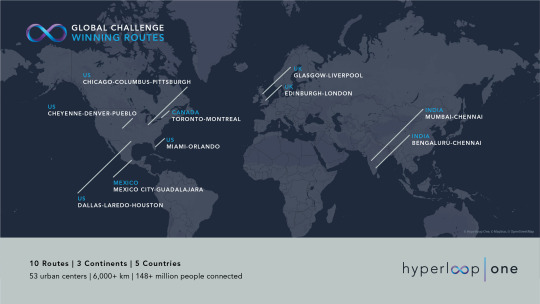
    On September 14, 2017, Hyperloop One announced the 10 winners of its Global Challenge. These are the world’s “most promising” Hyperloop routes; selected through a process that began in May 2016 and involved more than 2,600 registered teams.

    The winners:

    1. Canada | Toronto-Montreal
    2. India | Bengaluru-Chennai
    3. India | Mumbai-Chennai
    4. Mexico | Mexico City-Guadalajara
    5. UK | Edinburgh-London
    6. UK | Glasgow-Liverpool
    7. US | Chicago-Columbus-Pittsburgh
    8. US | Miami-Orlando
    9. US | Cheyenne-Denver-Pueblo
    10. US | Dallas-Laredo-Houston

    If you aren’t familiar with what Hyperloop One is trying to accomplish, here is a quick video explaining the basics. Their goal is to have the world’s first operating Hyperloop by 2021.

    If you happen to live in one of the above regions (about 148 million of us do), then you are probably already seeing the headlines in your feeds. For Canada, the promise is of connecting 25% of our country’s population with one single Hyperloop route.

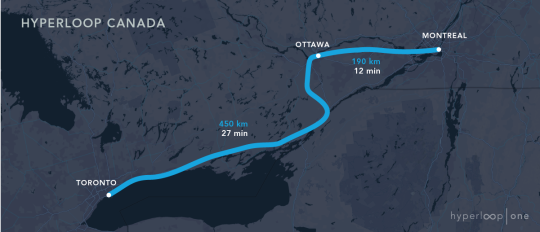
    It would mean Toronto-Montreal in just 39 minutes:
    image

    This is shorter than many morning commutes. So it’s not hard to see why this is a tantalizing proposition. It would mean a union of our two biggest cities and our capital. More accessible Montreal bagels. And maybe, just maybe, a strengthened sense of bilingualism in this country. 

    But there are also critics who believe that all of this Hyperloop hype is simply a distraction. Why not focus on proven technologies as opposed to some fanciful pipe dream that may never materialize? This is about stroking political egos as opposed to real progress.

    My views are pretty simple on this one.

    Will Hyperloop Canada happen? Maybe. Maybe not. I sure hope it does. But it may not. It’s easy to draw lines on a map. It’s much harder to actually execute on those lines. And of course, logistics aside, the technology is still being developed.

    But if all we ever focused our energy on were things that have already been “proven”, we likely wouldn’t create many new things. Things that today are proven, were once unproven. But they became proven because there were folks who didn’t let that minor detail deter them from trying. They went for it.

    So if a private company would like to go out and raise $160 million from private investors to try and figure out how to sustainably connect Canada’s two largest cities in 39 minutes, I am more than happy to cheerlead. Because I’m not the one trying. Who am I to naysay? 
  • The Life-Sized City

    I just discovered a new video series by TVO called, The Life-Sized City. It’s all about the “anatomy of the modern metropolis.” The first episode – which was released on Sep 13 – is on Medellin and is just under an hour long. I have a feeling that many of you will like this video series.

    Whenever I watch videos like this, it makes me think that I should be starting a city building-focused vlog. I am a big fan of this format. I follow a handful of vloggers. And I think it could be a lot of fun. But sometimes you just have to say no.

    For those of you who aren’t longtime readers, I would also like to point out that my good friend Alex Feldman wrote a guest post on this blog over 3 years ago following a trip to Medellin. It’s about what cities could learn from Medellin’s extraordinary turnaround. If you missed it, click here.

  • My prediction for Amazon HQ2

    “Now the trick is that we gotta look like we don’t need this shit and they give us the shit for free.“ –Mike Peters

    This is a line from one of my favorite movies, Swingers. Short video clip here. Mikey and Trent are in a Las Vegas casino trying to play it cool. They’re looking to make a scene at a table and Mikey throws out this gem of a line. He knows that people want what they can’t have and that confidence matters.

    I was reminded of this line today after Amazon announced its HQ2 Request for Proposal (full RFP document here) and every city, from Chicago and Toronto to Philadelphia and Dallas, started swooning over the prospect of housing Amazon’s second headquarters in North America. 

    But to be clear, I do not think this is a bad idea. I actually think Amazon HQ2 is an incredible city building opportunity that would generate countless positive externalities for the selected city. I’m thrilled that Mayor John Tory will be personally “leading the charge” with respect to Toronto’s response.

    Over $5 billion in construction and as many as 50,000 employees making on average over $100,000 per year. Amazon is looking for about 500,000 sf of space in phase 1 (2019) and up to 8,000,000 sf in total. Based on the RFP, they seem to be pegging their capital investment at somewhere around $600 per square foot.

    If I’m being as objective as possible, I honestly believe that Toronto is the city to beat in his competition. I think it will come down to access to talent. Human capital is the lifeblood of a company and Trump’s immigration policies simply put U.S. cities at a disadvantage in this regard.

    Of course, Toronto is also awesome. So that’s my prediction: Amazon HQ2, Toronto.

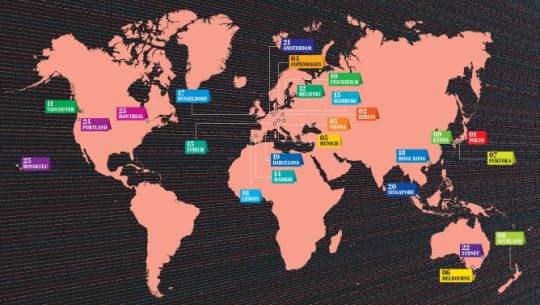
  • Monocle’s Top 25 Liveable Cities — 2016 Edition

    Monocle’s annual survey of the top 25 most liveable cities in the world was just released. It’s now in its 10th year. I found it in my inbox this morning and it was a good reminder that it was about time I renewed my subscription. I’ve been a regular reader of Monocle since 2007, but I let my membership lapse last year.

    Of course, any sort of list like this is going to be subjective. It all depends on the methodology you use. Still, their annual survey is an interesting way to see what each city is up to and where the tides are going. This year Monocle put extra weighting on each city’s nightlife. If you’re not a subscriber, here’s a short video you can watch. It will give you a rundown of all the cities. (I was happy to see Montréal creep onto the list. Incredible city.)

    This focus on the night is something that I’ve been writing about a lot both on this blog and elsewhere. It’s an idea that’s picking up momentum around the world as an economic development strategy. But for whatever reason, uptake seems to be slower here in North America.

    I like how architect Anna Dietzsch puts it in this video. She says that Rio may have the beaches, but Sao Paulo (where she’s based) has the night. That’s exactly how cities should be thinking about this opportunity. It used to be that cities thrived almost entirely because of location, waterways, transport, and other natural features (example: Buffalo). But increasingly, it’s becoming about things like nightlife.

    Vancouver may have the mountains, but Toronto has…

    Image: Monocle

  • How sexy is your city?

    I recently penned an article for Building Magazine called How Sexy Is Your City? The subtitle is: The next generation of talent will require cities to take a next generation approach to city building.

    I know that we’re all hitting our limit in terms of people talking about millennials, so I’d like to reassure you that – excluding the actual article tag – the word “millennial” only shows up twice in the piece. 

    I also don’t write long-form articles very often. I’ve had people suggest that I do that periodically on this blog, but I find the time commitment to be exponentially greater than for the short, glib pieces I usually write here. 😉

    So if you can bear two more instances of the word “millennial” and you’ve been looking for something longer, you are in luck. Also, if you’d like to subscribe to Building, you can do that here.

    Image: Doublespace Photography via Building

  • Is Toronto a world-class city?

    image

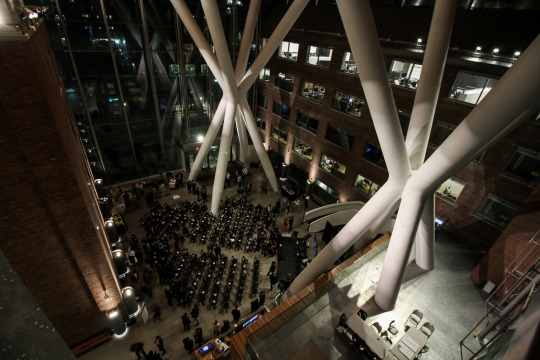
    Earlier this week I was on a panel discussion called Building Toronto Tomorrow. One of the questions was about whether or not Toronto is world-class city. It elicited a good discussion, so I thought I would talk about that today on the blog.

    Shamez Virani, President of CentreCourt Developments, responded by saying that he thinks Toronto is the greatest city in the world and that he wishes more people would just accept how incredible this city is. I agreed with him.

    I also responded by saying that I hate this question. I think it reeks of insecurity and I think it’s a bit of a red herring. It distracts from more direct and meaningful questions – questions such as our livability and our position as a global city.

    Because the reality is that Toronto is one of the most livable cities in the world and, in my view, we are the only true global city in Canada. We are an important node in the global economy for the flow of goods, people (we’re particularly good at this), capital, and now information. There’s a lot to be proud of.

    But that’s not to say that we’re perfect. Everyone knows we need better transit. And to name a few others (non-exhaustive list), I also think we need to:

    • Get a move on road pricing.
    • Loosen up our archaic alcohol laws and start using nightlife as a competitive advantage for attracting talent.
    • Acknowledge through our governance structures that cities are what drive today’s information economy.
    • Stop thinking about the Canadian/Toronto value proposition as being about cost savings. That is, buy this from us because our currency is weaker than yours. This is anti-innovation and there are much better ways to create sustainable value. (Innovation is still a weak spot.)
    • Focus on developing an information economy that leverages the unique talent and knowledge base of Toronto. For example, I think we’re in a great position for real estate + tech innovation.
    • Do everything we can to encourage big tech IPOs in this city. They are critical to developing the ecosystem.

    There’s a saying in Silicon Valley that you “make what you measure.” It means that whatever you decide to focus your attention on, is invariably what you end up making – regardless of whether or not you happen to be focusing on the right metric.

    In the context of Toronto, I think we’d be better served if we focused on and quantified our position in the global economy, as opposed to chasing some idea of “world-class.” The latter will grow as the former grows.

    I also think that this needs to be balanced against our livability. Sometimes there’s a tension. But there are cities – the best example is perhaps Tokyo – who have managed to pair a high quality of life with one of the strongest positions in the global economy.

    Is there anything else you think we should be doing? We can talk about it in the comments below.

    Image: Building T.O Toronto (BuzzBuzzHome Event)

  • Automobile vs. tram

    In grad school, I was fortunate enough to be a teaching assistant for a class called Urban Real Estate Economics, which was taught by Dr. Richard Voith. It was one of my favorite classes. So if you ever find yourself at the Wharton School, I would highly recommend it.

    Richard is also the President of a consulting firm in Philadelphia called Econsult Solutions. And I think a lot of what they focus on would be of interest to the audience of this blog. Their focus is on urban economics, real estate economics, transportation, public policy, and – you get the idea.

    Recently, he wrote a post called, Moving Cities: Berlin, where he outlines some of the transportation decisions that West and East Berlin made in the second half of the 20th century. 

    What I found most interesting was how the trams of East Berlin were stigmatized to represent communism and a centrally planned economy. On the other hand, West Berlin was all about the free market, and the symbol for that was none other than the automobile. That meant that the trams had to go. 

    Here is a quote that he shares from B.R. Shenoy, first published in August 15th, 1960:

    “The main thoroughfares of West Berlin are near jammed with prosperous looking automobile traffic, the German make of cars, big and small, being much in evidence. Buses and trams dominate the thoroughfares in East Berlin; other automobiles, generally old and small cars, are in much smaller numbers than in West Berlin. One notices cars parked in front of workers’ quarters in West Berlin… In contrast with what one sees in West Berlin, the buildings [in East Berlin] here are generally grey from neglect, the furnishings lack in brightness and quality, and the roads and pavements are shabby…”

    My favorite line: “…jammed with prosperous looking automobile traffic.”

    Of course, Berlin wasn’t the only city to eschew trams in the 20th century. Detroit and Los Angeles both did exactly the same thing. But in Berlin, this philosophy wasn’t applied equally across the urban fabric. And that’s what makes it a particularly interesting case study.

    I don’t know Berlin well enough to comment specifically, but Richard writes about how parts of East Berlin remained quite pedestrian friendly compared to West Berlin. That makes intuitive sense, given that it didn’t reorient itself towards the car in the same way that the West did. That being the case, I am curious to what extent those parts of the city may be benefiting today.

    In any event, you should also give Richard’s article a read. You can do that here.

  • How Premise is crowdsourcing economic data in developing countries

    I have to tell you all about a company that I just discovered called Premise. I think it’s incredible what they’re doing and a perfect example of mobile (smartphones) eating the world.

    The problem that Premise is solving is that of developing-world economic data being both not timely enough and not all that accurate/granular. This is important, because lots of big organizations – ranging from governments to private companies – are making funding and investment decisions based on this inadequate information.

    So here’s what Premise did:

    They put smartphones into the hands of the people who are on the ground in these places. They paid them meaningful amounts of money (relative to local wages). And they developed a technology platform that could index and analyze the millions of local observations being sent in. So far they have paid out over $3 million to their contributors located across 34 countries.

    As an example: Premise has developed food price indices. And the data comes directly from locals physically going to the market on a regular basis (which most would do anyways) and snapping photos of the food + prices. This allows Premise to provide basically realtime pricing data. (There are checks and balances to ensure data integrity.)

    Why does this matter? 

    Because it allows Premise, for instance, to figure out exactly what happens to food staple pricing when something like an Ebola epidemic hits:

    “Premise started tracking food prices in Monrovia on September 8, and throughout the month we observed upward pressure on prices (our Liberia indices and data are freely available at data.premise.com). The price of rice, Liberia’s primary food staple, increased 12% during September. Moreover, we saw significant price differences across the city. Prices in neighborhoods with the most exposure to Ebola were 8-12% higher on average than relatively unaffected neighborhoods. As the disease tore through the city, market sellers avoided the worst-hit areas and trade declined.”

    This is powerful information and just one example of what Premise is doing. Obviously this data is also of use to for-profit companies, which is how the company has managed to raise over $66 million in VC funding. But I think there will also be big benefits for these developing countries. As the saying goes, you make what you measure.

  • Not zoned for dancing

    Yesterday, when I was reading up on Toronto’s “TOcore” initiative, I came across a report from 2014 called Not Zoned For Dancing: A Comprehensive Review of Entertainment in Downtown Toronto

    It was prepared by five graduate planning students at the University of Toronto: Anna Wynveen, Brenton Nader, Carolyn Rowan, Chris Hilbrecht, and Kyle Miller. 

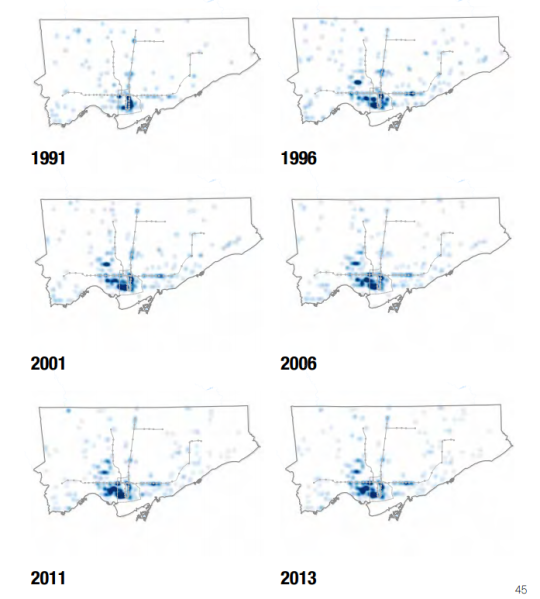
    The entire report is fascinating, but here’s one diagram that stood out to me:

    image

    It shows the migration of bars, clubs, and lounges westward, away from the downtown core, from 1991-2013.

    This migration doesn’t surprise me at all. I saw it happening and I understand the market forces at play here. There’s also the simple fact that nightlife is often viewed as a nuisance.

    But it’s worth calling this out. 

    Because I don’t think enough city builders appreciate the value of nightlife. It can and has served as a valuable catalyst for urban regeneration and I believe that it should form part of any city’s economic development strategy.

    A lot of cities are focused on things like bike lanes, public spaces, and on becoming the next Silicon Valley. And don’t get me wrong, those are all important things (though we could debate the Silicon Valley part). 

    But let’s not forget about nightlife.

  • Moving to the big city

    When I was 18 years old, I
    moved from the suburbs of Toronto to Waterloo, Ontario, which is about an hour
    west of the city.

    I largely did this for two reasons.

    Firstly, I had started
    visiting friends at both Wilfrid Laurier University and the University of
    Waterloo while I was in high school, and I thought that I wanted
    that kind of University town experience.

    Secondly,
    I started University as a Computer Science student and I figured that Waterloo
    was a pretty good place to study that. Research In Motion (later renamed to
    Blackberry) was an important company at the time and interesting things were happening.

    Though
    to be clear, I was a student at Laurier and not at the University of Waterloo – the better of the two schools for Computer Science – because I didn’t have
    the grades for the latter.

    But a
    funny thing ended up happening. I hated living in Waterloo. I felt so out of
    place. So much so that I spent every weekend back in Toronto visiting my
    friends who had instead decided to go to the University of Toronto.

    And I
    remember vividly how I felt during those weekends. I would stand in my friend’s
    apartments – most of which had dens and solariums that were hacked into
    bedrooms so that they could afford to live there – and I would look across the skyline and
    think to myself: why the hell do I not live here?

    So I
    transferred to the University of Toronto. And that solved that.

    The
    reason I bring up this story today is that I was reminded of it while reading a recent CityLab article by Richard Florida called, The
    Self-Confident City
    .

    The three
    main arguments in the article are:

    (1) Where
    we choose to live has a massive impact on our life outcomes.

    (2) Self-confident
    people – according to a recent study – seem to be drawn to big cities.

    (3)
    Self-confidence can also be a self-fulfilling prophecy
    for people in big cities.

    Now,
    I don’t know if it was really self-confidence and youthful hubris that told me I needed to live in a bigger city than Waterloo. (It was probably part of it.) All I know is that I
    wanted to live in a super dynamic place that felt bigger than me. I wanted to
    feel like I was a small fish in a big pond trying to make some sort of
    meaningful dent.

    That
    was true for me when I was 18. And it remains true for me today at 32.