Daily insights for city builders, delivered every morning at 6 AM ET. I’m Brandon Donnelly — a Toronto-based real estate developer and founder of Globizen. I’ve been writing here since 2013.

Tag: ecommerce

  • Notes from the retail apocalypse

    A friend of mine was in Scottsdale last month for an ICSC conference where Garrick H. Brown (VP of Retail Research for the Americas at Cushman & Wakefield) delivered this retail presentation

    My friend flipped it to me this week and below are a couple of slides that stood out as I scanned through it.

    image

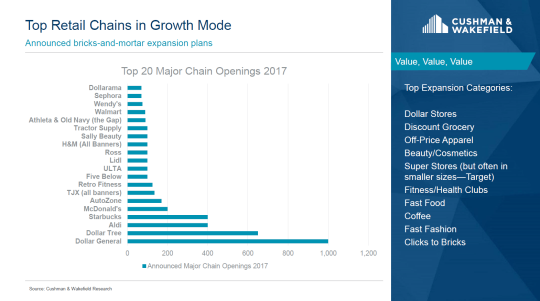
    Apparently over the last five years, a new dollar store has opened every four hours in the US. That’s how quickly this category is growing. A race to the bottom.

    image

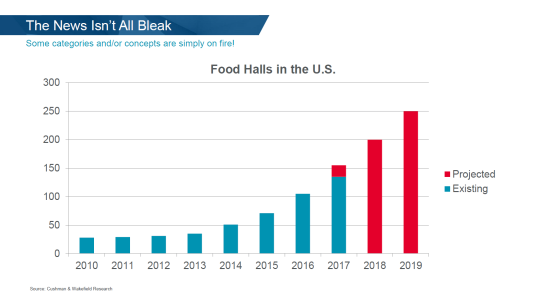
    Food halls are hot and not just in the US. Check out: “5 huge food halls opening soon in Toronto”.

    image

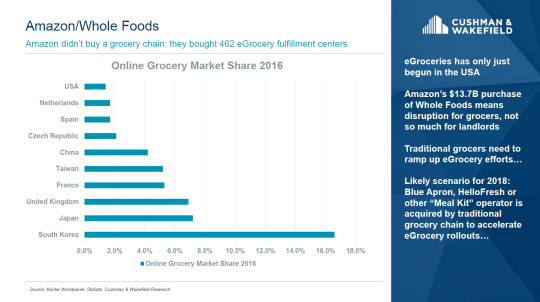
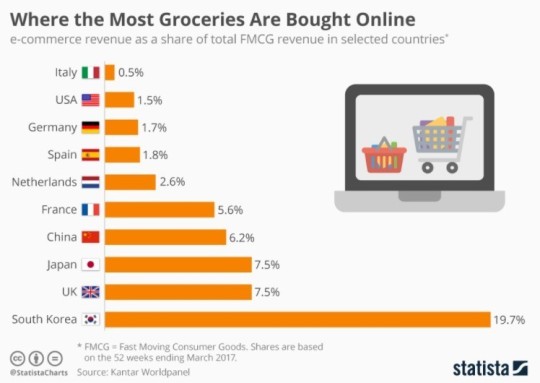
    This is similar to a chart I posted a few weeks ago that pegged online grocery shopping in South Korea at closer to 20%. I’m still fascinated by this market share number and want to better understand what’s driving it.

    image

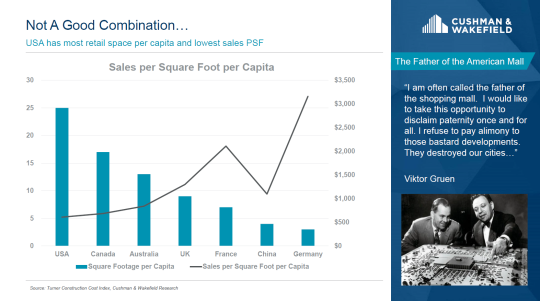
    This is an interesting chart that shows the relationship between retail square footage per capita and sales per square foot per capita. The US has lots of retail space per capita but low sales. Now look at Germany.

    image

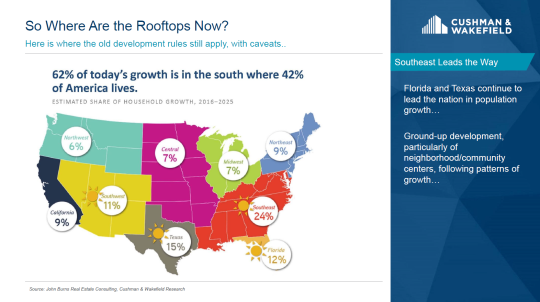
    Finally, this is a chart that shows where household growth is expected to happen from 2016 to 2025. It follows a very clear historical trend of Americans moving from cold places to warmer/hot places.

    image

    For the full presentation, click here.

  • South Korea buys 20% of its groceries online

    The World Economic Forum recently posted the below chart showing that 1/5 of all grocery purchases in South Korea are done online. The calculation is e-commerce revenue as a percentage of total fast moving consumer goods revenue in the country.

    image

    The explanation they give for this high percentage is that South Korea has some of the fastest and most ubiquitous internet access in the world. 

    But as soon as I read this I thought to myself: This can’t be the only reason. When was the last time you really wanted to order groceries online but your internet connection was too slow? 

    Also, if you look at all online shopping (not just FMCG), South Korea no longer shows up as such an outlier. So what’s happening with grocery?

    Without actually knowing the market, I would imagine that there are companies in South Korea who have simply figured out how to offer a great online grocery shopping experience.

    South Korea is also one of the denser countries in the world at about 513 people per km2. That would help with distribution. 

    But then again, the Netherlands is also quite dense (414 people per km2). Why are they only at 2.6%? (For comparison, the US is about 33 people per km2.)

    If any of you are familiar with the South Korea market I would love to hear from you in the comments. If they really are at 20%, I am surprised more people aren’t talking about this.

  • Online shopping and “last mile” real estate

    The Globe and Mail recently published an excellent article on “how e-commerce is driving a real estate revolution.” This is a topic that I’m very interested in: how online manifests itself offline.

    Not surprisingly, the article talks a lot about Amazon, including their 4th warehouse in the Greater Toronto Area, which is an 850,000 square foot facility in Brampton equipped with 350-pound robots (8050 Heritage Road).

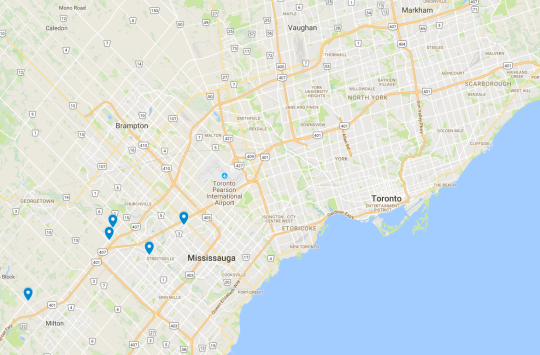
    The first thing I did after reading the article was figure out the location of all of Amazon’s fulfillment centers in the GTA. Amazon doesn’t seem to publish this. But according to TaxJar, they are here (I mapped out the addresses):

    There are two in Brampton at the precise location where Hwy 407 (toll route) and Hwy 401 meet. The other three are distributed along Hwy 401 in Milton and in Mississauga.

    Now let’s get back to that Globe and Mail article:

    – In 6 years, Amazon has leased over 2 million square feet of warehouse space in Canada.

    – Toronto is the third largest warehouse market in North America. It represents 43% of Canada’s total inventory.

    – Average net rents have increased 9.7% over the past year and vacancy rates have dropped to 2.7% (CBRE data). In Vancouver, those same numbers are 5.1% and 3%, respectively.

    – Online shopping is thought to account for about 6.5% of all retail sales in Canada. But in Toronto, 23% of all industrial space is already e-commerce-related (CBRE data, again).

    – CBRE believes that every $1 billion in new online sales per year requires an additional 1.25 million square feet of warehouse space. 

    – Based on online sales projections, Canada needs another 27.5 million square feet of industrial space over the next 5 years. We don’t have that much space in the pipeline.

    – Clear heights are increasing for stacking purposes. Amazon’s new Brampton facility is 45 feet tall / 4 floors. 10 years ago new warehouses were 26 feet tall.

    – Average sale price of warehouses in the GTA has gone from $119.35 psf to $142.19 psf over the last year.

    Perhaps the most interesting takeaway from the article is the discussion around “last mile” distribution hubs. These are fulfillment centers located closer to the city, which are used to offer shorter delivery times: 

    “…instead of having inventory stored for days or months, these fulfilment centres will turn over their inventory in one day, sometimes twice a day.”

    This is something that I addressed in my recent presentation about the “mall of the future” at B+H’s retail design charrette. Where do these physical distribution centers want to be as online sales continue to grow and delivery times continue to compress? Where’s the future growth?

    According to this article, it’s going to be in “last mile” fulfillment real estate – relatively smaller spaces that are located very close or directly in the city center.

    Photo by Samuel Zeller on Unsplash

  • E-commerce jobs are clustering in larger cities

    image

    The New York Times just ran an interesting piece on “how the growth of e-commerce is shifting retail jobs.”

    Here are some of the key takeaways (all US data).

    Online shopping accounts for about 8.4% of all retail sales.

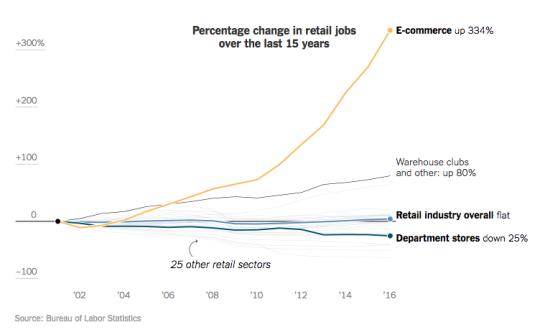
    But e-commerce related jobs are growing way faster than all other forms of retail employment. See above graph.

    That said, e-commerce jobs are still a small portion of overall retail employment. And the rise in e-commerce employment has not been enough to offset the losses in other areas, such as in departments stores.

    Over the last 15 years, e-commerce added 178,000 jobs and department stores lost 448,000 jobs. In this same time period, warehouse clubs added 841,000 jobs! I found it interesting to see department stores on the bottom and warehouse clubs on the top of the graph.

    image

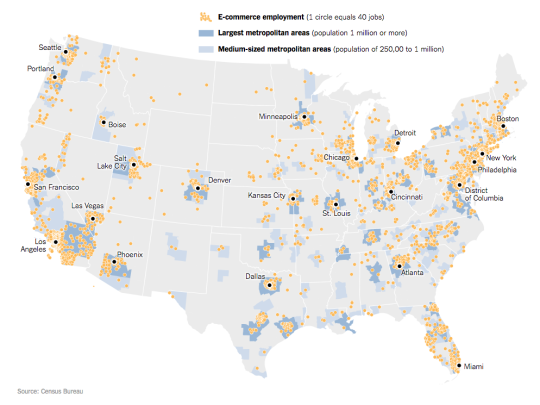
    Finally, e-commerce jobs appear to be concentrating in larger metros. See above map. Each mustard dot represents 40 e-commerce jobs. You’re selling more products with less human capital, and those people are clustering. This is a broader trend.

    According to the New York Times, counties and smaller cities (under 250,000 people) account for almost ¼ of overall retail employment. But when it comes to e-commerce firms the number drops to around 13%.

    Once again it would seem that technology and what we do online have an impact on our cities and towns. And that’s fascinating.

    All images from the New York Times

  • The grocery wars: Why Amazon bought Whole Foods

    The big news on Friday was that Amazon has agreed to buy grocery chain Whole Foods for $13.4 billion.

    Some people – such as Bruce Berkowitz, who manages the $2.3 billion Fairholme Fund and who is the second largest shareholder of Sears Holdings Corp. – believe that this says to the market that “there is a need for physical space in retailing.” Everything can’t be online.

    I obviously agree that there’s value in real estate / physical locations, but I don’t see this as Amazon capitulating in any way. This is not Amazon saying to itself: “Well, AmazonFresh hasn’t grown as quickly as we’d like, so let’s forget this ecommerce thing.” No, Amazon is determined to win.

    Indeed, the fact that shares of supermarket operators tumbled across the U.S., Canada, and Europe, probably signals that the market is expecting something other than the status quo following this acquisition. 

    All of this is a big deal because grocery is a big deal

    There’s a reason Wal-Mart ramped up grocery (and now derives over half of its revenue from it). There’s a reason why drug stores are proliferating across our cities (and expanding their grocery offerings). In Toronto it’s Shoppers Drug Mart and Rexall. In New York it’s Duane Reade.

    We buy groceries frequently and we overwhelmingly still buy them in person. So online grocery is the holy grail of ecommerce of right now. Everyone wants to nail it first.

    How does this acquisition help Amazon do that? Here are two thoughts.

    1) The real estate still matters. 

    Even in a world where most groceries are purchased online, you need still need physical distribution centers in close proximity to lots of customers.

    Whole Foods has more than 460 stores across the U.S., Canada, and Britain. Their formatting would obviously evolve, but the bones are there for Amazon to leverage.

    Startups such as Instacart have tried to circumvent this requirement by fulfilling only the delivery portion. And arguably their pitch to other grocers may now be stronger: “You need to offer this to compete with Amazon/Whole Foods.” (Instacart currently provides this service Whole Foods.) But you can bet Amazon will want to squeeze/control this part of the supply chain.

    2) The data.

    Many analysts are already assuming that Amazon will work to automate away cashiers, similar to what it’s trying to do with its Amazon Go concept store. If you combine this with other offerings such as 15 minute pickup (Amazon Fresh PIckup), you can easily imagine a world where us customers get weaned off of in-person shopping.

    For example, if my regular grocery store made better use of its data, it would probably come to the conclusion that I generally buy things like orange juice, milk, and avocados (I’m a Millennial) every X days. I’m sure if you look at my shopping habits, I’m pretty predictable. Whenever I go to a new store it always takes me 100% longer to shop because I don’t generally wander. I target my stuff.

    Now if I could get somehow prompted to re-order my regular items every X – 1 days, chances are I would gladly tap order. And now I’m shopping for groceries online. Get ready for the grocery wars.

  • Retail tipping point

    Venture capitalist Benedict Evans recently published a post on his blog called, Ten Year Futures. If you haven’t already noticed, I really enjoy this sort of curiosity and line of thinking. Here is an excerpt where he talks about retail being at a tipping point:

    “First, ecommerce, having grown more or less in a straight line for the past twenty years, is starting to reach the point that broad classes of retailer have real trouble. It’s useful to compare physical retail with newspapers, which face many of the same problems: a fixed cost base with falling revenues, the near-disappearance of a physical distribution advantage, and above all, unbundling and disaggregation. Everything bad that the internet did to media is probably going to happen to retailers. The tipping point might now be approaching, particularly in the US, where the situation is worsened by the fact that there is far more retail square footage per capita than in any other developed market. And when the store closes and you turn to shopping online (or are simply forced to, if enough physical retail goes away), you don’t buy all the same things, any more than you read all the same things when you took your media consumption online. When we went from a corner store to a department store, and then from a department store to big box retail, we didn’t all buy exactly the same things but in different places – we bought different things. If you go from buying soap powder in Wal-Mart based on brand and eye-level placement to telling Alexa ‘I need more soap’, some of your buying will look different.”

    I’ve said this many times before, but the way the above excerpt ends is yet another remind that one has to look deeper beyond the obvious change(s). Yes, ecommerce is growing and impacting physical retail. But what other changes might ensue because of this shift?

  • The importance of shareable experiences for retail

    image

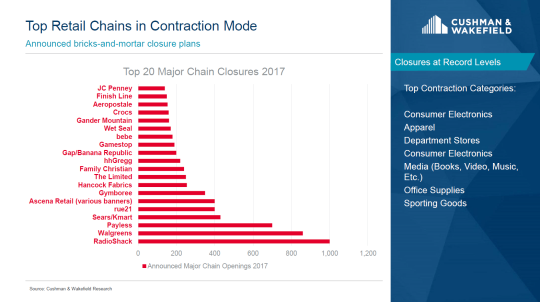
    There is no shortage of articles talking about the disruption currently taking place in the retail space. Just this past weekend the New York Times wrote: Is American Retail at a Historic Tipping Point? With nine U.S. retailers filing for bankruptcy protection in the first three months of 2017 alone, one could certainly make this argument.

    The obvious explanation is the shift to online shopping. Mobile spending now also makes up > 20% of total digital dollars spent. But you already knew that. Nothing new here. Perhaps less trite is one of the explanations that Derek Thompson offers up in this Atlantic article: Americans are spending less on material possessions and more on meals and experiences with friends.

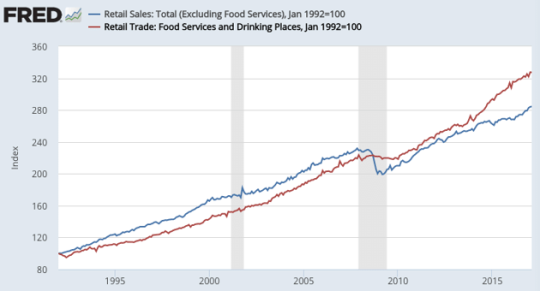
    Take a look at this FRED (Federal Reserve Economic Data) chart taken from the article:

    image

    According to Thompson, spending at “food services and drinking places” has grown twice as fast as all other retail spending since 2005. Americans now spend more money in bars and restaurants than they do in grocery stores. Last year was the first year that happened.

    But the possible reason behind all of this is arguably the most interesting: young people are looking for ways to create great social media content. And going out for gluten-free dinners with friends and traveling to Tulum “with bae” are clearly far better fodder for that than scouring the sale racks at J.C. Penney. 

    Social media is redirecting discretionary income. This is our new reality. Whether you’re a city builder or a retailer, you must now ask yourself: How shareable is the experience that I am trying to create? 

  • Amazon is just getting started

    image

    The Economist has an article up talking about what a behemoth Amazon has and will continue to become. Here are some interesting stats for you to think about:

    • More than half of every dollar spent online in America now goes to Amazon
    • Amazon’s share price has increased 173% since the beginning of 2015 (12x faster than the S&P 500)
    • With a market capitalization > $400 billion, it is the 5th most valuable company in the world
    • 92% of its value is supposedly being derived from profits expected after 2020 – they are playing the long game
    • Investors believe that revenue will go from $136 billion (2016) to half a trillion over the next decade

    If I can buy something online, instead of in person, I will do it. And that very often leads me to Amazon. In fact, I bought my new camera lens from them last week. Many others seem to be doing the same.

    When I go to a store now it’s because I need something immediately or because I’m looking for a new experience. I want novelty and I want to feel something special when I walk in. That, or I just need groceries.

  • Why brick-and-mortar stores should be scared of same hour delivery

    Venture capitalist Fred Wilson wrote a post on his blog today called, Same Day/Same Hour Delivery.

    The post is about why he believes that Walmart could get the “most disrupted by the Internet.” And it has to do with the rapid rise of same day and even same hour delivery from ecommerce companies. If you can order it online and receive it within an hour, why bother going to a brick-and-mortar store?

    His post reminded me of one I wrote towards the end of last year called, The threat to big box retailing. But since Fred is in the business of making bets on technology companies and he has accumulated a significant amount of wealth doing that, I thought you might like to also hear it from him.