
Daily insights for city builders, delivered every morning at 6 AM ET. I’m Brandon Donnelly — a Toronto-based real estate developer and founder of Globizen. I’ve been writing here since 2013.

Tag: dundas square

  • yongeTOmorrow

    Yonge Street divides Toronto between east and west. It’s an iconic street (though it has its ups and downs). Since 2018, the City has been studying ways to redesign and improve the stretch that cuts through the middle of downtown.

    It is a story that we have seen in many other cities around the world, perhaps most famously in NYC. Here is a street where pedestrians outnumber vehicles and yet we allocate more space to the latter (within a fixed ROW). This study hopes to fix that.

    They’ve narrowed things down to four Alternative Designs (downloadable, here). All of them prioritize pedestrians, but in different ways. As of right now the preferred option is Alternative #4. It looks like this:

    The section around Dundas Square (from Dundas Sq up to Edward Street) is fully pedestrianized with only emergency vehicles having access during the day. This segment has the highest pedestrian volumes. The other blocks allow for a combination of one-way and two-way vehicular traffic.

    Vehicular access is obviously still important for things like loading, but it’s pretty clear that the future of Yonge Street is pedestrian priority. We should probably be doing this right now. If you’d like to voice your own opinion, you can do that here until Friday, December 6, 2019.
  • Waste and efficiency

    Here are a couple of cut-up snippets from a recent post by Seth Godin titled: “Waste and the new luxury.”

    Luxury goods are built on a foundation of waste.

    The front lawn is a luxury good, a sign that you don’t need to graze your cows on every square inch, and that you’re willing to waste the lawn.

    There’s a new luxury that’s occurring, though, one that’s based on efficiency.

    A luxury that’s based on investing in renewables, in resources that might be seen as endless, in smart design, in the satisfaction of knowing that others are benefitting, not paying, for the experience or the object you’re buying.

    Waste vs. efficiency.

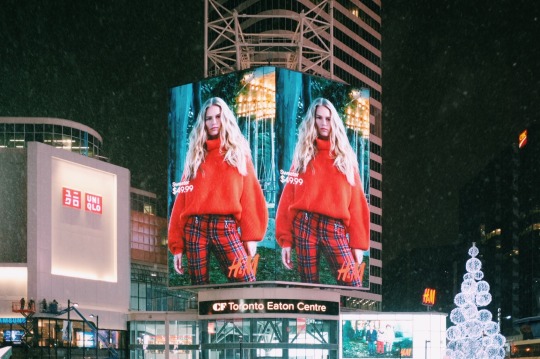
    (Above is a photo I took this week in Dundas Square.)

  • Can the creation of urban destinations transform or hinder a city’s development?

    I was recently asked by a Canadian architecture website called sixty7 Architecture Road to respond to the following: Can the creation of urban destinations transform or hinder a city’s development? It was for a regular Q+A series they do on their website. Here is my response (I was specifically asked about Dundas Square):

    The best line I’ve ever heard about public spaces and urban destinations was from Bruce Kuwabara of KPMB Architects. He said that the outside of buildings need to be thought of as the inside walls of the public realm. And I think that’s a really great way of framing this discussion. We often think of buildings inwardly and as self contained objects, but by virtue of their existence we’re creating and framing many other spaces.

    With that in mind, I absolutely believe that beautiful and well designed urban destinations–whether public or private–can transform a city and its development patterns. A perfect, but perhaps overused, example of this is the High Line in New York. Not only has it become a destination (“Have you been to the High Line yet?”), it has become an unbelievable city building catalyst. All of a sudden development is happening in, on and around the High Line, where as before developers would have tried to completely ignore it. And so today, the High Line, as an urban destination, is almost being continually reinvented by new development.

    To talk specifically about Toronto, I think that downtown needed a “public” space like Dundas Square. The design could have been less unidirectional (towards the Eaton Centre) and the building to the north is repulsive, but it provided a forum along Toronto’s main street in the heart of downtown. I also believe that good urban destinations give areas a sense of identity, which is why I’m somewhat bothered by the loss of the square at Yonge & Eglinton. Sure it was bad, but we could have made it better. It is the heart of midtown in my mind.

    So not only do urban destinations have the ability to transform, I would argue that they are essential to any great global city. Whether it’s the High Line in New York, the Spanish Steps in Rome, the old Love Park in Philadelphia, or Trafalgar Square in London, these spaces are integral to those city’s brands and identities. What do ours say about Toronto?

    For the full Q+A, click here.