Daily insights for city builders, delivered every morning at 6 AM ET. I’m Brandon Donnelly — a Toronto-based real estate developer and founder of Globizen. I’ve been writing here since 2013.

Tag: driving

  • What will driverless electric cars mean for cities?

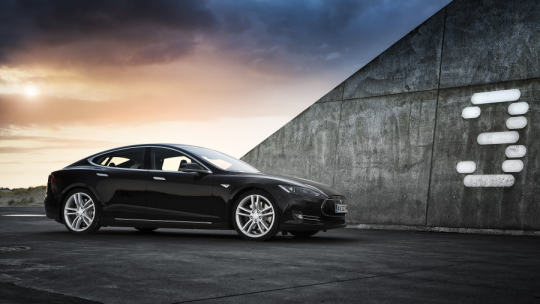
    Photograph T E S L A by Thomas Juel on 500px

    T E S L A by Thomas Juel on 500px

    Yesterday I posted a video about the career of Elon Musk. And it reminded me of something that’s been on my mind as I think about transportation, cities, and the future.

    Elon’s story for why he founded SolarCity, Tesla, and SpaceX is incredibly compelling. He chose problems and industries that he felt would move humanity forward. He felt that we needed sustainable forms of energy production (SolarCity), sustainable forms of transport (Tesla), and a way for humans to occupy other planets (SpaceX). That’s incredible ambition.

    Today though, I just want to focus on the transportation piece.

    Electric and driverless vehicles, I believe, are a step in the right direction. I honestly believe that at some point in the not too distant future we’re going to look back at that time when people used to drive their own cars and wonder how we ever allowed that to happen.

    But fundamentally, I think there still remains a question of how best to plan our cities. 

    There’s lots of talk today about peak car and the death of the automobile. Certainly within planning and urbanist circles, there’s an almost universal belief that planning (most of) our cities around the car, as opposed to people, was a huge mistake. Multimodal solutions with a public transit backbone are now the way forward.

    But will that always be the case as the notion of the “car” evolves?

    Intuitively, driverless vehicles feels like a massive opportunity to leverage data and better optimize our private transport assets. We know that the utilization rate for most private cars is incredibly low and so there’s lots of room to improve how we use and share private vehicles and how we move people around cities.

    But how big is that opportunity? Does a city filled with driverless electric vehicles and with networks like Uber mean that public transportation now becomes less important? And if so, how much less important?

    I can’t help but feel like private and public transport are on a collision course right now. I suppose that isn’t anything new. But this time around I wonder if private transport won’t figure out a way to achieve similar efficiencies to large scale public transport.
  • Marginal cost = 0

    Earlier this week I wrote a post called: The pull from services to products. And in it I made mention of the fact that part of what’s driving this pull towards products is that the marginal cost of servicing additional users or customers is almost nothing in a world of internet services and products.

    Well the reality is that this phenomenon is driving a hell of a lot more. It could – and probably will – fundamentally change almost all aspects of the economy.

    I know that sounds like a pretty audacious statement, but if you watch the following 10 minute talk by Albert Wenger (Union Square Ventures) you might start to feel the same way. He outlines 5 changes being driven by the fact that in the digital world, marginal cost = 0. The impacts go well beyond tech, capturing sectors such as transportation and industrial real estate.

    [youtube https://www.youtube.com/watch?v=sVEtTzlqsoE?rel=0]

    If you can’t see the video, click here.

  • Did we hit peak car?

    image

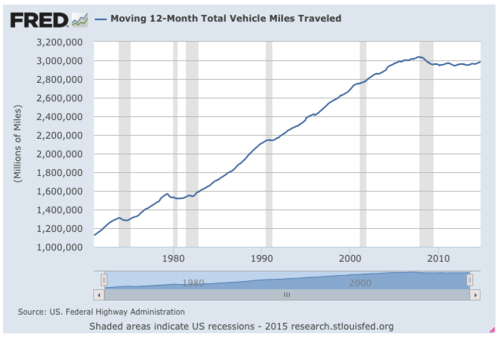
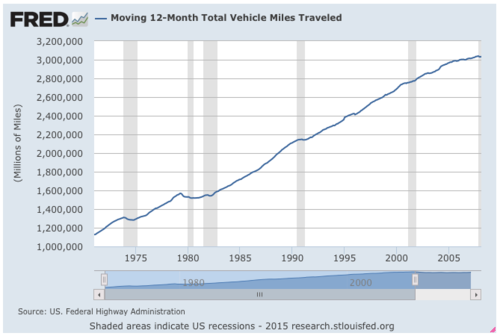
    The total number of vehicle miles traveled in the US used to largely do only one thing: go up. This is made it fairly easy for the Federal Highway Administration (FWHA) to forecast how much more Americans were going to drive in the coming years – they just extended the trend line.

    Below is what that looked like since the early 1970s (via FRED Economic Data). You’ll see that the total vehicle miles traveled went from somewhere around 1.1 trillion miles to around 3 trillion miles in and around the late 2000s. The shaded areas represent recessionary periods.

    image

    But then in 2007, something happened. Total vehicle miles traveled peaked, declined, and then flat lined at just under 3 trillion miles. Here’s what that looked like (the ending time period is October 2014):

    image

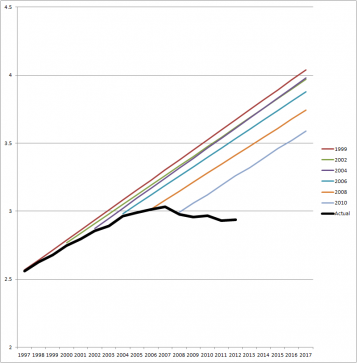
    However, since this was new for the FHWA, they continued to believe that this would ultimately correct itself and that total VMTs would eventually continue on their linear ascent. So here’s what their projections looked like (via State Smart Transportation Initiative):

    image

    Clearly things didn’t go as planned.

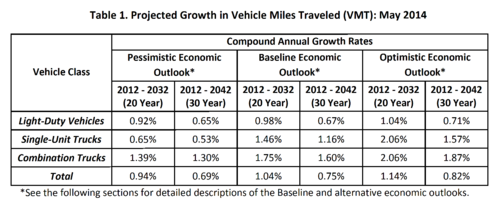
    But then in May of last year (2014), the FHWA finally changed its tune and released this forecast, which had the following projections:

    image

    It outlined 3 economic scenarios: a pessimistic one, a baseline one, and an optimistic one. In their baseline outlook, they believed that the annual growth rate for total vehicle miles traveled in the US would be 0.75% over a 30 year period running from 2012 to 2042.

    At the same time, they also stated that population growth would average about 0.7% per year through this same period. This means that the FHWA has more or less conceded that total vehicles traveled per person will likely remain flat, which is a significant change from previous forecasts.

    Now, given their track record, I don’t think any of us should put a lot of faith in the accuracy of these numbers. Per capita driving could flat line. But it might also go down, which is what it has been doing over the past few years.

    Either way, I do think it’s worth thinking about this shift. It’s a pretty big deal.

    Top Image: Flickr

  • Engaging with the sharing economy

    image

    Last week I wrote (yet another) post about Uber where I argued that leading cities will be the ones that engage with the sharing/rental economy (as opposed to try and outright ban it) and that Uber is going to continue to impact current beliefs around vehicle ownership.

    As to be expected, some people agreed with me and some people didn’t:

    //platform.twitter.com/widgets.js

    But I also discovered following that post that there are groups, and hopefully cities, who are working to adapt to the changing realities brought about by disruptive innovation.

    One of those groups is The National League of Cities – which I truthfully don’t know that much about. But they have created something called “The Sharing Economy Advisory Network.”

    “Cities across the country have been struggling to respond to the rapid emergence of the Sharing Economy,” said Clarence Anthony, National League of Cities executive director. He continued, “Cities are looking for ways to update and improve their current regulatory framework to ensure that regulations like safety and health protect residents, while at the same time supporting the growth of new businesses. It is imperative for cities to learn how this industry operates and discover ways to engage in order to support these new modes of doing business and to create jobs.”

    It sounds like the right kind of initiative and I wish them lots of success. I hope it’s effective and I hope that Toronto will look at how it too can properly manage these economic changes. This is going to take both the private and public sectors working together.

    Image: Sidecar

  • The Tesla Easter egg

    I was rushing to get to a real estate forum dinner last night and so instead of walking — which is normally what I would have done — I decided to grab an UberX. As some of you might be aware, I like UberX. It’s convenient to use. And the fares are cheaper than regular taxis. So why wouldn’t I use it?

    But last night I got an extra treat. A guy named Mike picked me up in his Tesla Model S:

    //platform.twitter.com/widgets.js

    According to Mike there are two of these “Easter eggs“ in the UberX Toronto fleet, which I was also told is now up to hundreds of cars. So it’s not everyday that you’ll get picked up in a Tesla.

    If you’ve never been in a Tesla, the first thing you’ll likely notice is the absolutely epic screen that sits in the dash. Most people’s laptops don’t have a screen this big. It’s gorgeous.

    But there are a bunch of small details that also standout. For example, the door handles sit flush with the door until they’re needed. Here’s a video of how they work:

    [youtube https://www.youtube.com/watch?v=UxavZ2QxuLY]

    But the real question that is probably on your mind is: Why is some guy with a Tesla driving around Toronto offering rides via UberX? That was certainly one of the first questions I asked him after I got in the car.

    And the answer is that he does it for fun.

    He actually owns a medical clinic in Markham, but comes downtown on the evenings and weekends to drive around and meet new people. In fact, he called it the “best networking tool on the planet.” Because as soon as he picks people up in his Tesla, they immediately take him seriously and want to have a conversation. That has translated into business relationships and even invites to parties. As in, he drives a group to a party and they ask him to come in — which he said he often does.

    If he really took it seriously and did it full-time, he figures he could make around $40,000 – 50,000 a year driving for UberX. And I believe that’s close to what a regular taxi driver would make. But again, that’s not why he’s doing it. Isn’t it interesting how things change?

  • A revolution in personal mobility

    In the spirit of Startup Weekend, I thought it would be interesting to go back in time and pretend to pitch one of the most disruptive innovations of the 19th century: the automobile.

    Typically pitches start by first outlining the problem. The idea is to make your audience aware of the pain point, so that they feel excited when you ultimately pitch your solution.

    In the case of cars, the incumbent technology would have been horses. So I can imagine somebody standing up and talking about how horses are slow and how they drop stinky poo all over our city streets. And that the time has come for a revolution in personal mobility! Enough of this crap! 🙂

    But while many of us probably can’t imagine a world without cars, try and put yourself in the shoes of somebody at the end of the 19th century who can’t imagine a world without horses. And then think about all the things we have subsequently done to make cars thrive:

    • We paved roads and created networks of freeways.
    • We invented rules of the road to ensure that people were operating these new devices properly.
    • We created a licensing system to ensure that anybody who was operating a car was doing so relatively safely and following the rules that had been created.
    • We created schools that taught people how to be better drivers.
    • We started insuring cars for when accidents inevitably happened.
    • We started having to accept fatal car accident and pedestrian deaths.
    • We built networks of gas stations. As of 2004, there were 168,000 retail locations selling gas in the United States.
    • We had to give over large land masses to parking. In fact, we reorganized entire cities so that the car could be better accommodated.
    • And we setup government transportation divisions to make sure the needs of the car were always being met.

    This is a long list of things we had to do to make cars possible and I’m sure there are many others that I have missed. Today, we all know how disruptive cars have been and we’re certainly questioning many of the things we have done. But we also accept this list as being largely normative.

    However, before they were the norm, they were insurmountable challenges. How will we teach everyone how to drive these new cars? How will we minimize accidents? How will we make it easy for people to refuel their cars? Where will people store them when they’re not using them?

    There were a lot of moving parts to figure out. 

    Which is why people like Paul Graham have argued that the best ideas almost have to live in your unconscious mind. Because your conscious mind would simply reject them as viable options as soon as you started thinking about all the required moving parts. I guess that’s why they say there’s a very fine line between crazy and brilliant.

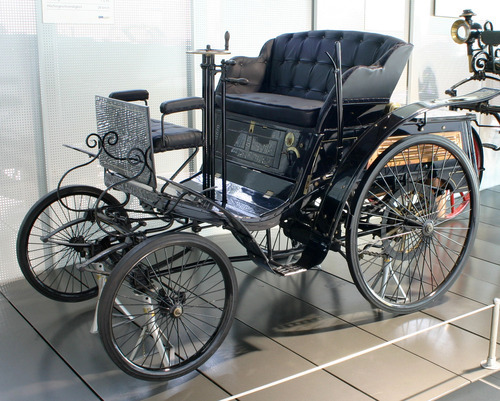
    Image: Benz Velo

  • Who are you planning for?

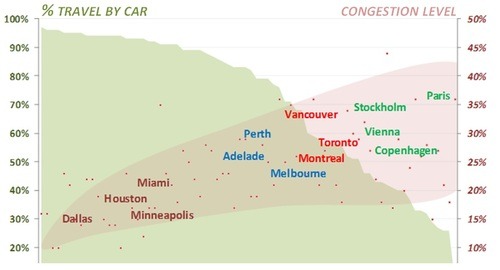
    I just came across the following chart via City Clock:

    It came from a study that looked at 74 cities in terms of two measures: the percentage of people that travel by car and the traffic congestion levels within those cities.

    The way to read the chart is to first look at the red dots. Each dot represents one of the cities studied. The position of the red dot corresponds to that city’s congestion levels. So for example, if we were to take Toronto, the congestion level is 27%.

    If you then take that same dot and draw a vertical line to the top of the green shaded area, you get the percentage of people who travel by car. In the case of Toronto, it is 56%.

    What’s interesting about this chart is that as congestion levels rise, it forces people out of their cars. In other words, the cities with the highest congestion levels also have the lowest auto share percentages.

    But the other way I interpret this chart is that the decision is almost binary: you’re either planning for cars or you’re planning for people. Based on this data, it’s hard to have both.

  • Avoiding driving

    If you’ve been reading Architect This City since last winter, you might know that every year I go on one big snowboard trip with a group of guys I went to grad school with at Penn. Last year we went to Jackson Hole and Vail, and this year the plan is to go to Banff and Revelstoke.

    We start planning it by the fall and so already we’ve been trying to sort out the details for this winter’s trip. But as we finalize the plans, one thing I’ve noticed is how I’ve automatically been trying to minimize the amount of driving that we’ll need to do. In fact, in a perfect world, we wouldn’t have to rent a car at all.

    Now, small mountain towns aren’t usually the best for public transit, but there are often ways to get around that. When we were in Jackson, we took the public bus to get to the mountain every day, as did most people who lived or stayed in town.

    This winter, the plan is to fly into Calgary and stay in Banff for the first leg of the trip. So I’ve been trying to figure out if there’s a train that can get us from Calgary to Banff and which hotels offer shuttle buses to the mountains. Because I’d rather not drive, and I know many of my friends feel the same way. It’s an added cost and it gets in the way of après ski.

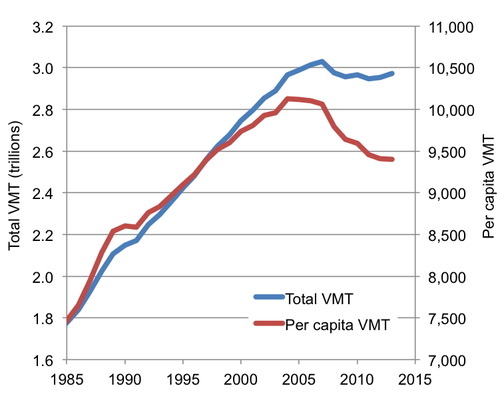
    What’s interesting about this, is that not only do I try and minimize the amount of driving I do here in Toronto, but I do it when I travel as well. And if you’ve been following the macro trends, you might know that many other people feel the same way. That’s why total Vehicle Miles Traveled in the US has been in falling since about the mid-2000s:

    image

    People are falling out of love with driving, and many believe that this shift is permanent. Here’s a recent report from the US PIRG Education Fund talking about just that:

    //platform.twitter.com/widgets.js

    I also think this shift is permanent – until maybe the nature of driving changes and cars start driving themselves. But at that point, it won’t be called driving anymore and there will probably be many other changes. So on this rainy Wednesday morning, my big bold prediction is that future generations will no longer drive.

    What do you think?

  • Multi-modal cities are the new reality

    CityLab published an article last week on multi-modal cities that caught my attention (because it used a picture of Toronto with about 3 or 4 streetcars stacked up along Queen Street). The premise of the article is that all of this car vs. transit debate is actually missing the bigger picture: our cities are multi-modal and we need to be planning for that.

    That’s not to say that the shift away from cars isn’t a good thing. It is. But it’s not as simple as saying that, instead of driving, people should now only take transit. In today’s cities people walk, bike, take streetcars, take buses, take subways, take taxis, take private shuttles, use Uber, and, yes, they still drive.

    From my own experience, this is absolutely how I get around Toronto today. I walk to the gym. I ride my bike whenever I’m going somewhere downtown. I take the subway to my office in midtown because it’s far and I would be too sweaty if I biked there. I use Uber and Hailo when I’m going out at night. And I drive when I need to go to the suburbs or leave the city.

    But the key takeaway here is that we now have a much tougher challenge on our hands. When we were only optimizing for cars – however detrimental to our cities that was – we only had one mode to plan for. Now we have several. Some of which are public and some of which are private.

    However we also have access to technologies that we didn’t have before. We are networked in ways that weren’t possible before and we’re at the dawn of many profound mobility changes, such as driverless cars. (Have you read about Tesla’s new Autopilot feature yet?)

    So as I’ve said before, I really believe that we need to look at this, not as a war on the car, but as a war on inefficiency. The problem we are trying to solve relates to mobility: What’s the best way to move lots of people around dense urban regions? Stop focusing so much on the technologies and focus more on the people.

    Image: Flickr

  • Taxis just got 40% cheaper in Toronto

    UberX officially launched in Toronto today. Which means that Toronto’s taxi and limousine industry is about to get a lot more grouchy. For those of you who may not be familiar, uberX is Uber’s low-cost car service. Just like the regular version, you hail a car using your mobile phone. But this option will cost you 40% less than a regular taxi!

    Here are sample rates from the Financial District to Yonge & Eglinton (midtown):

    And from the Financial District to Pearson International Airport:

    image

    This is pretty exciting. Because as much as I think it’s great to use Hailo or Uber to hail and then pay for a car, the big problem in my mind has always been that cabs in Toronto are just far too expensive. The meter starts at $4.25 and shoots up faster than you can take a selfie in the backseat.

    But obviously there’s an entrenched industry here that is not going to be happy about a startup eating into their fares. So I wouldn’t be surprised if we see a lot more backlash here in Toronto – as has been the case in many other cities. However I don’t think that’s a viable long term solution for the incumbents.

    Uber is thought to be worth $18.2 billion right now. It’s probably not going to go away.

    So instead of protesting and trying to ban it, we should be figuring out how to adjust to this changing reality. For the incumbents, this might mean lowering fares or figuring out a better way to differentiate themselves. A 40% discount is a pretty compelling value proposition. For me personally, I don’t know why I would ever pay more for a regular taxi, unless there was no other option.

    On a side note, it’s worth pointing out that an uberX trip from downtown to Pearson is estimated to cost around $33 – roughly the same as what some people think the Union Pearson Express train will cost. That’s further evidence that charging a lot and targeting business travelers may not be the best strategy.