Daily insights for city builders, delivered every morning at 6 AM ET. I’m Brandon Donnelly — a Toronto-based real estate developer and founder of Globizen. I’ve been writing here since 2013.

Tag: donald trump

  • Manhattan’s congestion charge is back, maybe

    I first wrote about Manhattan’s proposed congestion charge back in 2018. Naturally, some people supported it and some people opposed it. Four years later, it was reported that the charge was still being considered for the area of the island south of 60th Street, and that it could generate an additional $1 billion in revenue for the city’s transportation authority. But then in June of this year, right before the charge was set to come into effect on June 30, 2024, New York Governor Kathy Hochul said “nah, let’s pause this indefinitely.” And at that point, it felt mostly dead.

    Nope: A revised tolling plan has just been announced — the charge has been reduced from $15 to $9 — and Hochul is now trying to jam it through before Trump takes office in January. Trump opposes the charge and has branded it the “most regressive tax known to womankind”, so there’s a real deadline here. This could get interesting. Do you think it will actually happen, some 6 years later? (In reality, the timeline is far longer. Congestion pricing also looked promising during the Bloomberg era, but then similarly died. And I’m sure there were even earlier proposals.)

  • Does every real estate developer really do this?

    I am not a lawyer. Nothing I write on this blog should be construed as legal advice. In fact, it is highly questionable whether anything I write here should be construed as any sort of advice. Still, Trump’s fraud trial is an interesting one for us to discuss. The case, as I crudely understand it, accuses him of “inflating his net worth to dupe banks” and “issuing false financial statements every year between 2011 and 2021.” And possibly some other things, too.

    Now there are some people who are saying that there’s nothing actually wrong with the way Trump conducts his real estate practice. Kevin O’Leary, for instance, was just on CNN saying, “every real estate developer everywhere does this.” His position was that if you’re going to fault Trump, then you need to go after every developer out there. Here’s the video interview where he says this:

    Let’s break this down. Kevin is right in that people who own real estate ordinarily want it to be worth as much as possible. This is true for individual homeowners and it’s true for large real estate companies. And there are various reasons for this. One reason is that it maximizes your debt proceeds. For example, if you buy a building for $100 and the banks are willing to give you a loan based on a LTV (loan-to-value) of 70%, then you will get $70 in debt proceeds and you will need to put in $30 of your own cash equity.

    However, if you buy a building for $100 and it ends up being worth ~$143, then this same 70% LTV will result in $100 of debt proceeds. This means that you won’t need to put in any of your own cash and that, for all intents and purposes, you just got a building for “free.” By most metrics, this would be considered a good real estate deal. (Of course, you could also buy a building for $100 and have it be worth only $50. And this would be much less fun than getting free real estate.)

    One important question, though, is how does the building end up “being worth $143?” Well, one scenario could be that you just bought really well. It was an off-market transaction (i.e. it wasn’t formally listed), the seller was highly motivated, and so you negotiated a below-market purchase price. You then went out and hired a reputable third-party appraiser who did a bunch of rigorous research and issued you a report that said, “your building is worth $143.” And this would be perfectly fine.

    But one can also imagine ways in which someone could lie and do nefarious things to try and convince people that their building is worth $143, even if it clearly isn’t. Now, at the end of the day, I don’t know the facts of this case. So I can’t comment directly. But I did want to use this as an opportunity to add some nuance to Kevin’s claim that “every real estate developer everywhere does this.” Ultimately, that depends on what “this” is. Are we talking about doing customary things to maximize value creation? Or are we talking about fraud?

  • Biden revokes Trump’s executive order encouraging classical architecture

    This week it was announced that US president Joe Biden has revoked a number of Presidential Actions, one of which is Executive Order 13967 — Promoting Beautiful Federal Civic Architecture.

    Signed on December 18, 2020 by former president Trump, the order, which I wrote about last February, encouraged the use of “classical and traditional architecture” for all federal buildings.

    Part of the argument was that too many buildings are being made for only architects to appreciate. This includes, you know, modern architecture and styles like brutalism.

    Well that order has been revoked and that means that “beautiful” federal civic architecture is now free to be anything it wants. Look to the past, look to today, and/or look to the future.

    This is the way things should be.

  • The Trump family real estate empire

    He is tall, lean and blond, with dazzling white teeth, and he looks ever so much like Robert Redford. He rides around town in a chauffeured silver Cadillac with his initials, DJT, on the plates. He dates slinky fashion models, belongs to the most elegant clubs and, at only 30 years of age, estimates that he is worth “more than $200 million.” 

    Judy Klemesrud, New York Times, 1976

    Last week the New York Times published a special investigation looking at the Trump family’s real estate empire and the suspect tax schemes that they allegedly employed over the years to preserve, grow, and pass it down. 

    According to the Times, all of which has been rebuked by a lawyer for the president, Donald Trump received at least $413 million in today’s dollars from the family empire. 

    I just finished reading the investigation in its entirety. It’s a long one. But if you’re interested, you can do the same here. If you’d prefer the Coles Notes version (Cliff Notes for you Americans), have a scroll through the headlines in this article instead.

  • How the Time Warner Center came to be

    New York Magazine is running a weekly series right now that tells the stories behind key moments in the city’s cultural history. This week’s is about how the Time Warner Center came to be.

    Like most real estate projects, it took an enormous amount of time for it be realized. Multiple developers had attempted to buy the site, which previously housed the New York Coliseum.

    In 1987, the agency put out a call for proposals, its parameters calculated to yield the highest price and the biggest building. Among the 13 developers who responded was Donald Trump, who proposed the world’s tallest tower, 137 stories high.

    It’s a good example of just how difficult it can be to get a large project off the ground. The Time Warner Center opened in 2003. Thank you Paul for sending this along. Click here for the full story. 

  • How urban density dictates how we vote

    “It’s remarkable that even as the internet disperses information and enables us to form online communities across great distances, our politics are still highly correlated with physical environments. Who we are is largely defined by where we are. For architects and urban designers, this is an important reminder that space is and always has been political, from the days of the valley section to the postmodern stage of Trump.”

    The above excerpt is from a Places Journal article by Neeraj Bhatia called, Environment as Politics. The premise of the article is that residential population densities have long shaped political outcomes and that that was certainly the case in the 2016 U.S. presidential election.

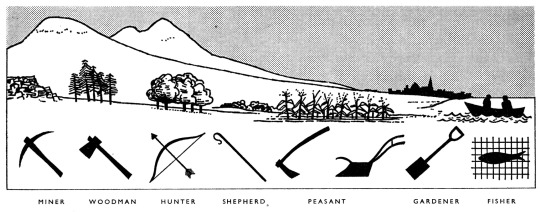
    But before we get into the work and drawings of Places Journal, let’s first talk about one of the inspirations mentioned in the article. In 1909, the pioneering town planner Patrick Geddes drew the following “Valley Section”:

    The point of this section drawing is to make clear the relationship between humans and their environment. In this case, it speaks to occupation. The physical geography of where you lived determined what you did: fish, hunt, mine, and so on.
    For those of us now living in cities, these “natural occupations” may not seem all that relevant. But that same human-environment relationship remains.
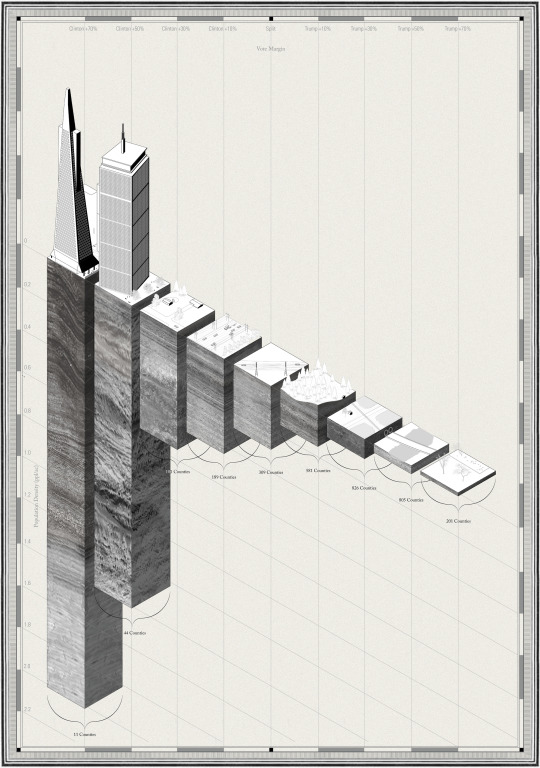
    In the 2016 election, 49 of the 50 highest density counties voted for Hillary Clinton. And 48 of the 50 lowest density counties voted for Donald Trump. It turns out that how close you live to your neighbor had/has a tremendous impact on your political views and the way you vote(d).

    Below is a chart from Places Journal that plots the 2016 election results for all U.S. counties:
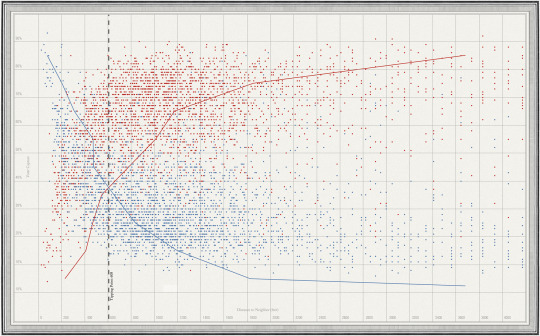
    On the y-axis is “vote capture” by Democrats and on the x-axis is “Distance to Neighbor (feet).” What you see here is a dramatic drop off in liberal voting as distance to neighbor increases. And the tipping point appears to about 608 feet.

    Part of the explanation for this is that living in close proximity to others change how we feel about others. It can reduce fear and prejudice. In other words, it makes us more open. And as Bhatia points out in his article, one could argue that this last U.S. election was in fact a “clash over the openness of society.”

    We often talk on this blog about how space impacts our lives. As Jan Gehl once said: we shape cities and then cities shape us. Today we are reminded that space is also highly political.

    In my case, the distance to my neighbors is likely about 8-10 inches. Sometimes I can hear somebody sneeze. But most of the time I don’t hear anything at all. It’s usually pretty quiet around here. Whether I acknowledge it or not, this distance is shaping me and how I see the world.

  • This is not right

    I have largely avoided commenting on politics and Trump on this blog, but at this stage it is almost impossible to do that.

    Donations are starting to pile up for the American Civil Liberties Union (ACLU) as the tech community, and many others, begin to respond to Friday’s executive orders. Lyft announced a $1 million contribution to the non-profit group.

    Today, venture capitalist Fred Wilson wrote: Make America Hate Again. And yesterday, his business partner Albert Wenger wrote: Misleading the World on Immigration.

    At 6 AM this morning, Richard Florida started a tweet storm where he argued that “Trump’s immigration insanity” will fundamentally threaten the core of America’s innovation hegemony. 

    (He also argued that Canada, and more specifically Toronto, serve to “gain substantially”, as there will no doubt be a doubling down on tolerance to attract the best talent from around the world.)

    The Canadian tech community penned an open letter to reinforce the message that, here in Canada, diversity is our strength. This echoes similar messages from Prime Minister Justin Trudeau and Mayor John Tory.

    Mass protests have broken out at US airports (links to photos) spanning San Francisco to New York. 

    And I am seeing folks from Toronto offer up their homes (publicly on Twitter) to anyone who might be stranded at Pearson International Airport as a result of the orders. Many have even tweeted out their phone numbers.

    Everywhere I look this weekend I am seeing these sorts of messages. So while I could remain quiet, that doesn’t feel right. And that’s because what is happening is not right.

  • Empire and ego

    This morning I stumbled upon an old New York Times article from August 7, 1983 called: The Empire and Ego of Donald Trump.

    Here’s an excerpt you might find interesting:

    The essence of entrepreneurial capitalism, real estate is a business with a tradition of high-rolling megalomania, of master builders striving to erect monuments to their visions. It is also typically dynastic, with businesses being transmitted from fathers to sons and grandsons, and carried on by siblings. In New York, the names of Tishman, Lefrak, Rudin, Fisher, Zeckendorf come to mind.

    And now there is Trump, a name that has in the last few years become an internationally recognized symbol of New York City as mecca for the world’s super rich.

    “Not many sons have been able to escape their fathers,” said Donald Trump, the president of the Trump Organization, by way of interpreting his accomplishments. Three of them, built since 1976, stand out amidst the crowded midtown landscape: the 68- story Trump Tower, with its six-story Atrium housing some of the world’s most elegant stores; the 1,400- room Grand Hyatt Hotel, and Trump Plaza, a $125 million cooperative apartment. And more is on the way.

    “At 37, no one has done more than I in the last seven years,” Mr. Trump asserted.

    As I read this, 3 things came to mind.

    1) One could argue that, as real estate development institutionalizes, the megalomanic and dynastic nature of the business is being somewhat muted.

    2) I hope we are well beyond the point where a “dynasty” has to be transmitted only through men. We are, right?

    3) Trump sounded the same at 37.

  • Introducing YOO Architecture

    Back in 2006 when I was fresh out of architecture school and looking for work, I knocked on the door of a design company based in London with my polished resume in hand. I was sleeping on a friend’s couch at the time and the company seemed like a perfect fit for me – so I went for it.

    There’s no happy ending to this story though – because I didn’t get past the front door that day – but there’s never any harm in trying. As my friend told me the morning I went: fortune favors the bold.

    The firm I visited that day is called YOO.

    They call themselves “a residential and hotel design company”, but their model is actually more unique than that. Founded in 1999 by John Hitchcox (a property developer) and Philippe Starck (a rockstar designer), the firm partners with local real estate developers around the world and creates value through design, branding, and marketing expertise – as well as through celebrity names like Philippe Starck and Jade Jagger.

    They did one project in Toronto with local developer Peter Freed called 75 Portland.

    What makes their model interesting is that, unlike the real estate developers they partner with, they’re not assuming the same level of risk (unless, of course, they co-invest). They get paid (well) for the design services and marketing expertise they provide, as well as the brand equity that they bring.

    This is similar to what Donald Trump does with some (most?) of his developments now. Want the Trump name on your building? Pay $X. Want Philippe Starck at your condo sales launch? Pay $Y.

    When I was in architecture school, I used to wonder why we didn’t talk about the importance of branding and marketing. I thought we should. Which is probably why I ended up in business school afterwards.

    I think there’s a lot of potential in overlaps and hybrid business models, which is why I was excited to learn today that YOO has just launched a new architectural practice called YOO Architecture.

    You can read more about it here.

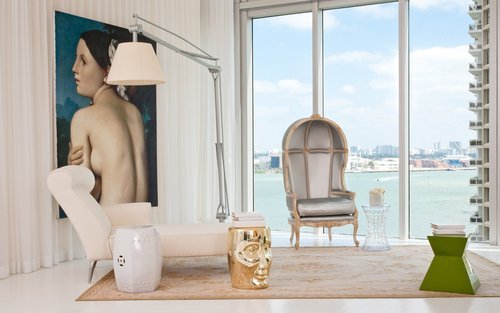
    Image: Icon Brickell, Miami via YOO