
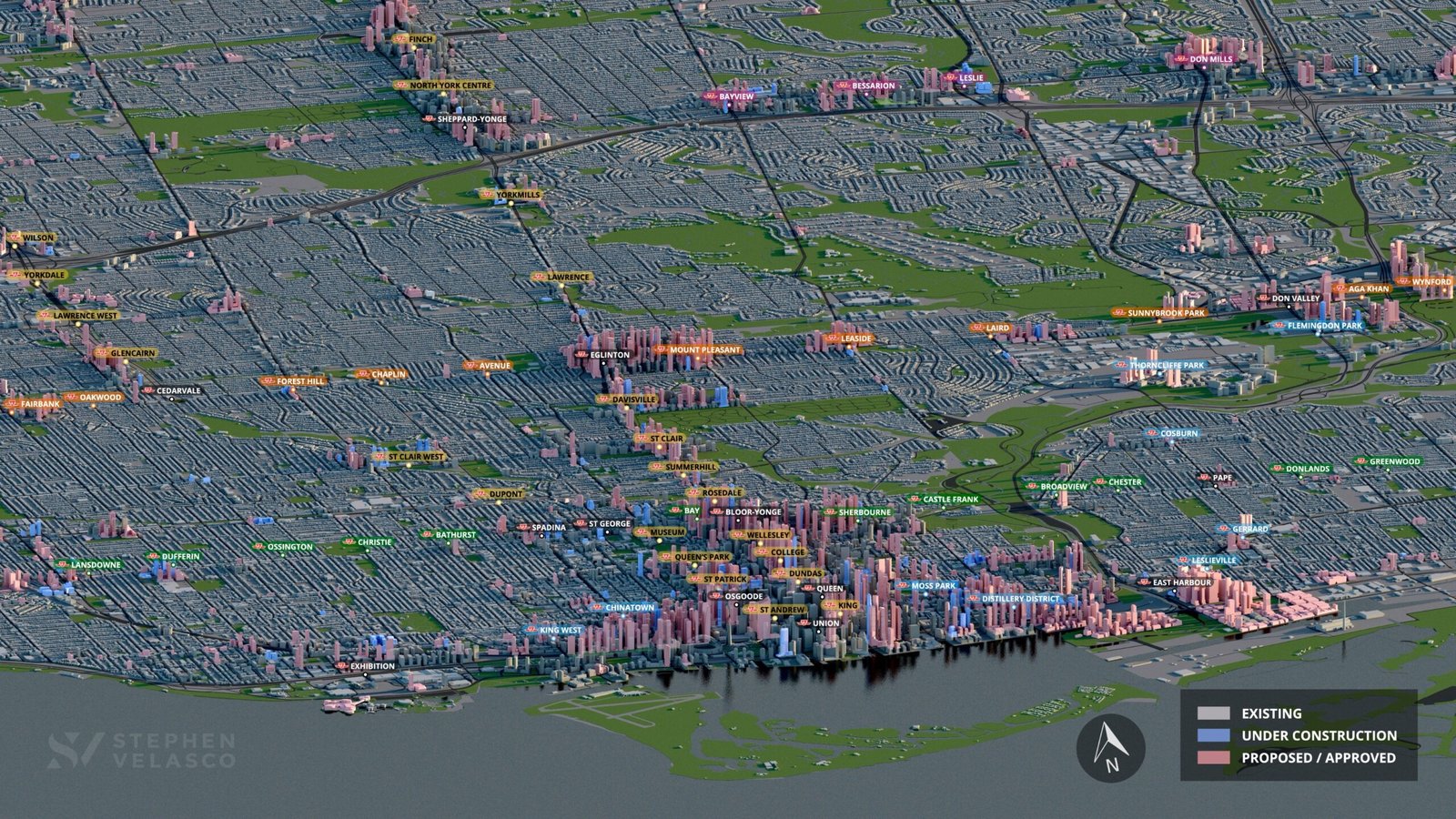
Stephen Velasco maintains a wonderful set of models for Toronto showing existing, under-construction, and proposed/approved developments. Here’s his website and here’s an aerial he recently shared showing a large section of the city overlaid with subway and LRT stations.
What is abundantly clear from this visualization is the “grand bargain” that has guided development in Toronto for over two decades: we won’t touch most of the low-rise residential land in the city, and instead we will create high-rise pockets next to transit.
This was the path of least political resistance, and while building on top of and next to transit is obviously sound, the extreme density cliff we encouraged created several urban economic and city-building distortions.
Land became artificially scarce, even though there’s lots of room within the boundaries of Toronto. And high density became our only option, eliminating many other housing typologies for Torontonians. But perhaps most importantly, it created an urban fabric of dense nodes that in many cases aren’t actually urban.
What this means is that most of the city remains unwalkable, without urban amenities, and clogged with car traffic. The way to better use our existing transit infrastructure, create more amenity-rich communities, and reduce Toronto’s dependency on the car is to flank these isolated tower clusters with more evenly distributed density.
Towers on top of stations are, of course, good, but there then needs to be a gradient of 4-12 storey buildings across the surrounding avenues, major streets, and interior residential streets.
The good news is that we’re moving in this direction. It’s just going to take time for us to firmly strike a new grand bargain. But in my view, this city-building approach is going to guide the next two decades of development in Toronto.
Aerial visualization by Stephen Velasco