Daily insights for city builders, delivered every morning at 6 AM ET. I’m Brandon Donnelly — a Toronto-based real estate developer and founder of Globizen. I’ve been writing here since 2013.

Tag: dirt

  • Understanding building areas is not as simple as it seems

    Understanding building areas is a fundamental component of real estate and development. But it can actually get surprisingly complicated. Definitions, naming conventions, and measurement techniques vary greatly around the world. 

    To some, “GLA” means gross leasable area. But to others, it means gross livable area. So it’s important to understand what exactly is being measured when someone tells you that that a building is X number of square feet. Are we talking gross building area, gross floor area, or rentable area? Does that number include the below-grade areas or just what is above-grade? To make matters even more complicated, there are nuances to consider depending on whether it’s a residential or commercial building. 

    By now, I am sure you’re starting to see how complicated something as seemingly simple as building areas can get. So let’s talk about some of the basics today. Again, definitions might vary depending on where in the world you area. They might even vary based on conventions you’ve adopted within your particular firm.

    Gross Building Area: Also referred to as Gross Construction Area by some, this is the total area of the building, measured to the outside walls without any deductions. As you’ll see later, some area definitions allow for certain deductions. Gross Building Area is important because it’s a big driver of your costs – specifically construction costs. This is how much building you’re building. But, and this is important, it does not drive your revenue. That comes later.

    Gross Floor Area: This is usually a specific locally-defined measurement convention. It often allows you to deduct certain areas from your gross building area, such as “major vertical penetrations” and below grade parking areas. This number doesn’t directly drive construction costs or revenue (saleable/rentable area), but it’s important because it’s what the city will use to determine important planning numbers such as the building’s density/floor space index and to calculate any applicable levies. It’s also a fairly public number and might be what the brokers are using to calculate, as one example, what certain land sold for on a per buildable square foot basis.

    Net Saleable/Rentable Area: This is a hugely important number because it directly drives revenue. It’s your top line. It’s the amount of space you can collect rent on or the amount of space that you can sell. And unless your revenue exceeds your costs (which you’ve calculated using the numbers above), you’re not going to be able to build. 

    Note: Commercial spaces (at least in this part of the world) often work a bit differently in that there is what is known as a gross-up factor. What that means is that tenants pay rent on portions of the common areas (such as corridors) that fall outside of what is known as their “usable area.” In this scenario, the rentable to usable area ratio (R/U) becomes important. Naturally tenants don’t like paying for a lot of space beyond their usable area.

    This is just a brief overview of building areas. A good architect will make sure that your building area calculations are meeting all local rules and conventions. But as a developer it’s important to know and understand what exactly is being measured and what the “loss factor” of your building is. In other words, how much space is being lost to areas that cannot be sold or rented? Typically, you want to minimize lost space, unless maybe you’re pushing some new concept.

    Anything to add to this building area summary? Do you use different terminology or conventions in your part of the world? Let us know in the comment section below. That would make for a fascinating discussion.
  • What’s in a neighborhood?

    image

    When I was working on my startup Dirt last year, one of the things we spent a bit of time figuring out was how to classify buildings according to neighborhood. Now, at first blush, this may seem like a fairly easy thing to do. You simply locate the building, figure out which neighborhood it’s in, and then tag it accordingly. But neighborhood boundaries and definitions aren’t as clear cut as you might think.

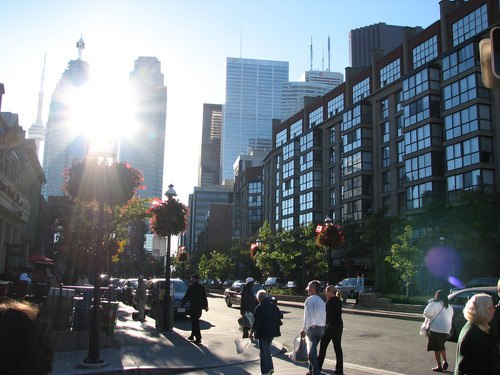
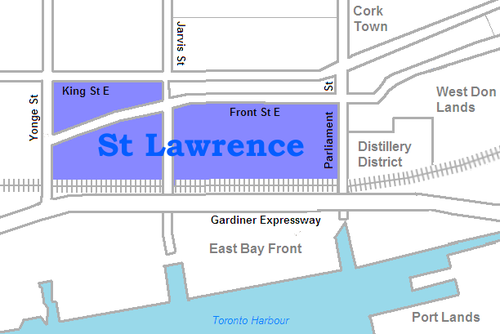
    For example, a lot of you probably know that I live in the St. Lawrence Market neighborhood of Toronto. And indeed, if you look at this Wikipedia definition, I live in that area. But if you look at what they call it, it’s just: “St. Lawrence.” They also specify that it used to be called “St. Lawrence Ward”, but that today most people actually call it “the St. Lawrence Market.” So here you have an example of an evolving and changing name.

    image

    But then there’s the question of boundaries. According to Wikipedia’s definition, the north boundary is Front Street. This means that the North Market Building would be technically outside of the area and so would the Market Square condos. But I suspect that almost everyone would consider these two buildings to be part of the neighborhood. So where exactly is the north boundary? Is it King Street? Or maybe by Front Street they mean that all buildings on the north side of the street are included.

    If you look at the city’s official neighborhood list (which is built from Statistics Canada Census Tracts) you’ll find a completely different boundary and name. According to this list, I live in the “Waterfront Communities–The Island” neighborhood. Obviously nobody, other than maybe somebody who deals with census data, would have any idea what this area is. But it’s how the city tracks its demographic data.

    What this begins to show you is that neighborhood definitions and boundaries aren’t as black and white as they might initially seem. And it’s partially because cities themselves are always in flux. New neighborhoods emerge and old ones reinvent themselves. And as that happens, people start introducing new names and new terminologies.

    image

    When I was about 19 years old, people in Toronto used to say they were going out “on Richmond and Adelaide.” Since then, gentrification has pushed many of the bars and clubs out of that area. So people instead go out “on King West” or “on Ossington.” And as people begin to use those terms and identify with an area, new brands are created. Ask anybody who lives downtown and I bet they’ll tell you that King West has its own unique personality and even a type of person who typically lives there. This is an on the ground type of awareness though, which doesn’t get captured in census tracts.

    The other reason neighborhood boundaries can be so fuzzy is because we – the real estate community – are constantly trying to manipulate them for our own benefit. I’m indifferent to the fact that this happens, but it is a reality. Think about how much the neighborhood of Yorkville has been stretched from its original roots north of Bloor Street. If a neighborhood has a good brand, agents and developers will naturally try and leverage it. Homeowners do it all the time too. Would you prefer to say that you live in Seaton Village or the Annex?

    Ultimately, we (my Dirt cofounder and I) decided that neighborhood definitions and boundaries needed to be fluid. They needed to dynamically adjust with the market and come from as many people as possible on the ground. Because at the end of the day if the official documents say one thing, but the majority of city residents believe another, then that official boundary and definition are probably out of date. The crowd wins here.

    We liked this approach because it was organic – just like cities.

    Images: Flickr, Wikipedia, Flickr

  • The why of ATC

    The journey of Architect This City has been an organic one. When I first started blogging regularly in September 2013, I had no plan in mind other than that I wanted to write about cities. I had just come off working full-time on my startup, Dirt, where I had gotten into the habit of writing and I enjoyed it immensely. So I wanted to continue.

    Cities seemed like the perfect umbrella to capture all of my passions: architecture, design, planning, real estate, and even technology. And so I rebranded brandondonnelly.com—which I had already been using as a microblog—and slapped the title “Cities” on it. (That personal microblog has since become brandondonnelly.me.)

    Then, after a few months of blogging, I was having drinks with a good friend of mine and telling her about my new daily discipline. She immediately asked me what it was called and, when I replied by saying that I didn’t really have a name for it, she insisted that I create one immediately. Since she’s one of the brightest people I know, I gave it some serious thought. A few days later, Architect This City was born.

    I liked the idea of having a distinct brand, because then it meant it could grow beyond just a personal blog. It could become a real community of people passionate and committed to building better cities. And that ultimately became the goal as I got deeper and deeper into writing.

    Since that time last year, I’ve had friends guest blog on ATC. It has gone on to become syndicated on Mobility Lab and Urban Times. And it has been featured by the Guardian in the UK has one of the big city blogs in the world. But even more exciting are the moments when somebody tells me, either face-to-face or through a quick message, that they’re really enjoying ATC and that they read it daily. That’s what keeps me going.

    Lately though, I’ve been thinking about what’s next. What’s the purpose of ATC? What’s the why? I thought about writing a manifesto of sorts, but that just seemed unnecessarily onerous. So I sat down, primarily on the subway, with Evernote, and I wrote a purpose statement for ATC:

    To promote the building of beautiful and environmentally sustainable cities that offer strong economic opportunities and a high quality of life.

    That’s really what I believe cities should do. They should be enjoyable and beautiful places to live life and they should empower people to get richer. At the same time, we need to be aware that as more and more of the world’s 7 billion people move into cities, the need for environmentally sustainable solutions is only going to increase.

    So those are the kinds of discussions I hope we can have on ATC. Regular scheduled programming will continue as usual, but hopefully now the why is clearer. If you have any feedback on the above statement, I would love to hear from you in the comment section below.

  • Disrupting everything

    Last year when I started working on Dirt—which was really my first startup—I had a number of people say things to me like: “Wow, that’s quite a change, going from real estate into tech.” But that’s not the way I saw and see it.

    I don’t think you can silo industries like that anymore. Technology is touching everything. Some would even go so far as to say that every company in the world is, or will be, a software and technology company.

    The way I looked at it was that I was starting a technology-enabled real estate company. I was hoping to leverage the internet to improve the way things are done in an existing industry. Of course, by improve I really mean disrupt—which is arguably the biggest buzzword in the tech community today:

    “Disruption is not so much a trend as an especially lucrative world philosophy favored by technophilic entrepreneurs. It’s the only path towards progress. If you’re not disrupting something you might as well go collect kindling and roast raccoon meat in the hills of Cupertino.”

    A good example of how disruptive innovation is reaching all sectors of the economy, including government, is the New Haven-based startup called SeeClickFix (which I discovered via This Big City). What it does is allow citizens to report non-emergencies (like potholes) to their local government. Governments can then respond and manage these tasks. (Sorry Rob Ford. Now you don’t need to return all those phone calls.)

    But moreover, I think it shows that technology is not only going to disrupt business and industry, it’s going to disrupt the way cities function and the way we live. I don’t know what that’s ultimately going to look like, but I can already feel it underway.

    Albert Wenger, of venture capital firm Union Square Ventures, recently argued—in a talk at DLD—that we are still in the midst of a transition from the Industrial Age to the Information Age. And I buy that. With every new disruption, we’re one step closer to completely making that transition. But we’re not quite there yet.

    The Industrial Age drove people out of cities. It made cities dirty and undesirable. But in the Information Age, cities are damn important and it’s where people want to be. Look at all the people rushing back to urban centers.

    So if technology has the power to disrupt business, industry, and cities, I suggest we stop just thinking about technology in isolation and remember the powerful words of Marshall McLuhan: “The medium is the message.” Don’t just focus on the obvious or you’ll miss a tidal wave of change happening beneath the surface.

  • Design your own beautiful maps

    If you love cities, then I’m willing to bet you probably also love maps.

    I just stumbled across a neat tool called Map Stack. It was created by San Francisco-based Stamen Design—probably one of the leaders in beautiful maps. The tool is one part Photoshop and one part Mapbox, and it allows you to quickly create an endless array of cool looking maps. Like these:

    image

    I spent 2 minutes and made a watercolor version of Toronto’s financial district:

    image

    This tool aside, I also really like Mapbox. When we were designing and building Dirt, we ended up using them for our map underlay because we wanted something beautiful and we didn’t love Google Maps for that reason. Though we missed Google Streetview, we were happy with the decision. Other apps using Mapbox include Foursquare and Pinterest.

  • Why I decided to start blogging

    New York VC Fred Wilson wrote a blog post yesterday called “Writing It Down.” In it he talks about why he blogs everyday. It’s worth reading. If you’re into tech, you should also read his linked post on Twitter.

    After reading it, I thought I should come clean about something: He’s one of the main reasons I decided to start blogging. I saw what he was doing and I felt inspired. The other reason is that I started blogging for Dirt and really enjoyed it. I’m trying to also do it daily, but so far I haven’t made any public promises on that front. I’d rather under promise and over deliver.

    I’ve been an avid reader of Fred’s blog for awhile now. What I find really powerful is that it has become a mechanism for him to get his thoughts out and into the world and to get feedback on them. Sometimes his posts can be a definitive how-to (such as his MBA Monday lessons) and in other cases it’s clear that he himself isn’t sure of the answer, but that he wants to put it out there for discussion. And I think that’s a great way to be. There’s wisdom in crowds.

    At the same time, when I decided to start blogging personally, I told myself that even if nobody reads my stuff that I’d still be getting value out of it. That’s because writing forces you to think about things to a greater extent than if you, well, just sat and thought about them. I like that.

    However, I do hope that my blog will end up getting read by others because I’m interested in happenstance. I’m interested in the chance that like-minded individuals will read one of my posts about cities and reach out to me, or introduce me to somebody I should meet. 

    When you put yourself out there, I think you also open yourself up to opportunities.

  • Get to know Riverside | Dirt.

    Whatever you do, don’t call it Leslieville. It’s RiversideSpanning 10 blocks along Queen Street East from the Don Valley Parkway to Degrassi Street, this part of town often gets rolled up into the hyped Leslieville neighbourhood. But they’re not one in the same. Formerly known as Queen Broadview Village, Riverside is a small neighbourhood within the larger South Riverdale precinct. But what it may lack in size, it certainly makes up for in terms of culture and history.

    Get to know Riverside | Dirt.

  • Crowdsourcing Condos

    Crowdsourcing Condos

  • Reintroducing Dirt

    New Dirt release. Check us out.

    Reintroducing Dirt

  • Dirt shirt