Daily insights for city builders, delivered every morning at 6 AM ET. I’m Brandon Donnelly — a Toronto-based real estate developer and founder of Globizen. I’ve been writing here since 2013.

Tag: dhaka

  • Yes, the most surveilled cities in the world are in China

    Toronto has a lot more CCTV cameras than I would have thought.

    According to this (2022?) data from Comparitech, there is estimated to be about 19,236 cameras installed around the Greater Toronto Area. With a population of around 6.31 million people, this translates into a per capita rate of 3.05 (CCTV cameras per 1,000 people). What this means is that there is almost surely footage of me enjoying a late-night shawarma sandwich after the bar somewhere on the streets of Toronto.

    In some ways, this is a high number of cameras. Tokyo, which is usually considered to be the largest metro area in the world with nearly 40 million people, only has 1.06 cameras per 1,000 people. Dhaka is 0.71. Sao Paulo is 1.04. Osaka is 1.57. And Montreal is 1.03. Though to be totally fair here, Rio de Janeiro is up at 3.34 (and it may be the most dangerous city mentioned in this post). Paris is 4.04. New York is 6.87. Los Angeles is 8.77. And London is 13.35.

    But where things get really exciting is in authoritarian places. Moscow is estimated to have 16.85 CCTV cameras per 1,000 people. And in China as a whole, there is estimated to be roughly 540 million cameras scattered around its cities, which works out to an average of 372.8 cameras for every 1,000 people. For a city like Shanghai, this crudely equals something like 10.6 million cameras.

    It turns out that surveillance is pretty important for things other than shawarma-eating videos:

    Vyborov wasn’t arrested that day, but the police informed him that he was under surveillance through Sfera, one of Moscow’s face recognition systems, for participating in unsanctioned rallies. Considered one of the most efficient surveillance systems, Sfera led to the detention of 141 people last year. “Facial recognition, and video cameras in general in a totalitarian state, are an absolute evil,” Vyborov says.

    Here’s the other thing. Safety is usually touted as the reason to have lots of cameras. But Comparitech’s data suggests that there’s an almost non-existent correlation between lots of cameras and lower crime. I mean, just look at Tokyo. It is basically the model megacity, and its per capita camera rate is only 1.06. The real utility, it would seem, is using cameras and face recognition software to restrict personal freedoms.

  • Largest cities in the world from 100 to 2015 CE

    I just discovered this set of maps (via Brian Potter) looking at the largest cities in the world from 100 CE all the way through to today (well 2015 CE). Here are what the two bookends of this map series look like:

    It is an interesting reminder of just how centralized the world was around the Mediterranean and parts of Asia, and also how nothing is guaranteed. As recent as 1900, cities like Manchester and Philadelphia were among the top 10 largest cities. Today they aren’t even close.

    For the full map collection, click here.

    UPDATE: The data behind these maps has been called into question. Look out for a follow-up post.

  • The anatomy of density

    Urban environments can be dense in many different ways. This is a topic that we have discussed on several occasions here on the blog. But this working paper by Solly Angel, Patrick Lamson-Hall, and Zeltia Gonzales Blanco — called The Anatomy of Density — is a more scientific way of looking at it. They have come up with six measurable factors that, when combined, define urban density.

    What this means is that cities achieve urban density through different kinds of built form. Hong Kong, for example, gets its density from height, even though only about 4% of its land area is occupied by residential buildings. Dhaka, on the other hand, does it through low building heights and high residential coverage. Homes occupy about 20% of the city’s area. Another dimension is crowding.

    But here’s something that may surprise you. Most cities are actually becoming less densely populated. And, despite our best efforts to encourage more sustainable forms of development, sprawl has continued to outpace densification in the vast majority of the urban agglomerations that were studied as part of this working paper. The wealthier we become, the more space we want to consume.

    Here’s a graph from The Economist that speaks to this trend:

    To download a copy of the working paper, click here.

    Image: The Economist

  • Urban population densities, compared

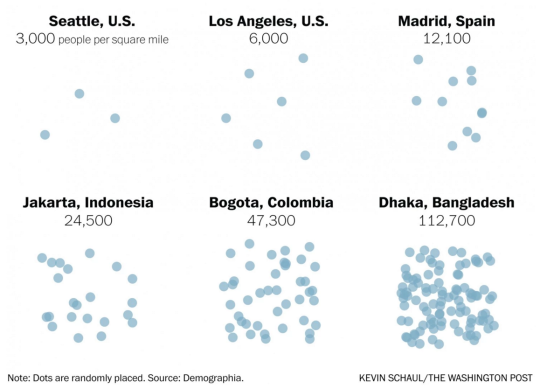
    Earlier this month The Washington Post published an article called, There’s no such thing as a city that has run out of room.

    And what it was really about was that when we say there’s no more room (I guess people are saying this), we are really saying that we just don’t want to allow anyone else to become our neighbor. Because the reality is that urban population densities vary widely around the world. So how can you really call a place full?

    I’m not sure I feel this pain point as much as the author, but I always find population densities to be a fascinating topic. And accompanying the article was a tool – using data from Demographia – that allowed you to compare the population densities of various cities.

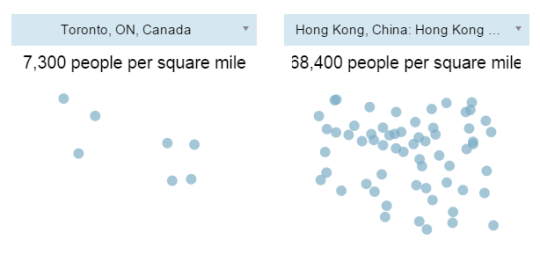
    Here are are two scenarios I ran:

    It’s important to keep in mind that these numbers are averages for the entire economically contiguous region. So it tells you nothing about the potential spikiness of certain areas. That’s why the population density of New York (which includes portions of New Jersey and Connecticut) probably seems low to you.

    Still, it’s fascinating to see how extreme some cities – including some first world cities like Hong Kong – can be. Clearly many cities have a lot of room to become a lot more dense. And I think that would be a good thing.

  • Thoughts on megacities in the developing world

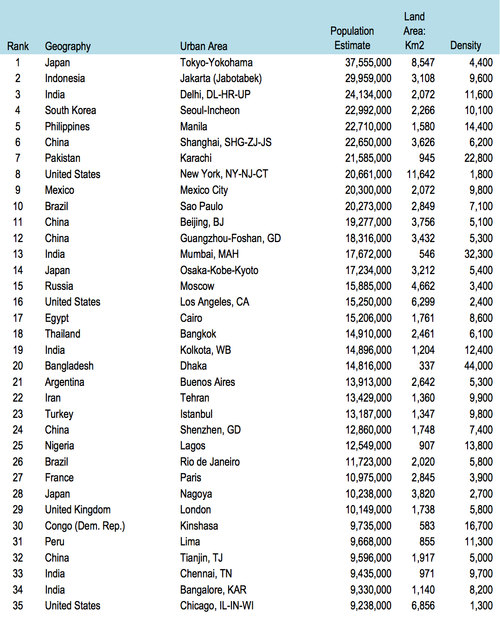
    Without a question, we are living in an urban era. More people now live in cities than anywhere else on the planet and I’ve repeatedly argued that cities are our most important economic engine. As a result of these demographic and economic shifts, we’re seeing megacities at a scale the world has never seen before. Below is a list of the top 35 largest urban areas in the world.

    image

    The top urban area is Tokyo-Yokohama, with a population of roughly 37.5 million people. That’s almost the same as the state of California and is more than the entire population of Canada, which sits at just over 35 million people. London, which, during the 2nd half of the 19th century, would have been the largest urban area in the world is now the 29th largest.

    But at the same time, London arguably remains the most important global city–a title that can only really be rivalled by New York. Which raises an important distinction. One that Aaron Renn clearly identifies in this recent article for New Geography: Just because a city is a megacity, doesn’t mean it is or will ever be a global city. In fact, Renn argues that many of the world’s largest megacities will never “turn the corner” and become leaders of the global economy.

    For that to happen, he believes that the city needs to belong to a country on the rise:

    Moscow was the capital of the Soviet Empire. New York and Los Angeles came of age when America was the rising, and ultimately dominant, economic colossus. It’s the same for Paris and London, two borderline megacities, which rose as imperial capitals. 

    But how much of this is driven by the country and how much of it can be driven by the city itself, upwards? Could it be the city that ultimately empowers the country to rise? I ask these questions because Renn frames his argument as if “national hyper growth” is the only prerequisite that will allow the struggling and underdeveloped megacities to pull themselves up and into the developed world.

    But the problem is that there’s no clear path to prosperous maturity for these megacities.  They are so huge, and their problems so immense that they are difficult to even conceptualize, much less do something about.  The amount of needed infrastructure provision alone – water, sanitation, drainage, transport, telecom, electricity, parks, schools, etc. – is staggering. And that doesn’t even touch arguably more difficult problems like corruption and good governance. Absent national hyper growth – a la Japan or Korea – of a level that creates a plausible claim to being the world’s rising economic power, or the proceeds of empire, it seems unlikely any of these cities will ever succeed. By contrast, smaller cities have a much more addressable problem space.

    Now, I don’t disagree that the problems in these cities seem almost insurmountable. I’ve been to places like Dhaka, Bangladesh. I’ve witnessed first hand the challenges facing megacities in the developing world. 

    But to assume that these cities are lost causes without the nation itself lifting it up, seems almost self defeating and overly pessimistic. It also strikes me as a bit of a chicken and egg scenario. Because if cities are our economic engine, then “national hyper growth” seems difficult without also getting our cities right.

    What comes first?

    Yes, there are and will be reforms that need to happen at the federal level but, at the same time, I think there’s a lot that can and should happen from the ground up. Perhaps that’s part of the reason Singapore has been so successful. As a city-state, its reforms were both top down and bottom up. 

    I want to believe that with the right reforms, policies, and leadership, any country can create a framework in which its cities are able to thrive. And that it’s not just the result of imperial rule or some other circumstance. From good and transparent governance to developed financial markets, there are many things that cities need to truly prosper. But when you get it right, the results can be remarkable. 

    Chart: Demographia

  • Urbanization in the developing world

    A few days ago I asked a reader of this blog if there was anything, in particular, that she’d like to see more of on here. She responded by saying that she’d love to learn more about how other cities—outside of Toronto—are managing urbanization, as well as how we shape cities and cities shape us.

    It’s an interesting and important question because, frankly, the challenges are greater outside of Toronto. One of the stats that often gets cited here in the media is how the Greater Toronto Area gets approximately 100,000 new immigrants every year. This doesn’t include domestic migration though, so I would assume that our total number is even greater.

    But if we stick with 100,000 for now, it means the GTA receives about 11.4 new immigrants every hour (100,000 people / 8,765 hours in a year). Lagos, Nigeria, on the other hand, receives between 50-60 new people every hour. In fact, it’s predicted to be 7th fastest growing city in the world between now and 2020. 

    If you take a look at the complete list of the world’s fastest growing cities (all estimates, of course), you’ll likely notice that the vast majority of the cities are in the developing world. And that’s really the challenge. The world is rapidly urbanizing and becoming the most urban it’s ever been, but the changes are the greatest outside of developed nations. This poses entirely unique challenges.

    Of the kinds of cities I’m talking about, I’m most familiar with Dhaka, Bangladesh. In my last year at Penn, I was part of a studio led by KieranTimberlake Architects that focused on water and housing issues in that city. It was a partnership with the University of Dhaka. We spent roughly 2 weeks there and it was an eye opening experience.

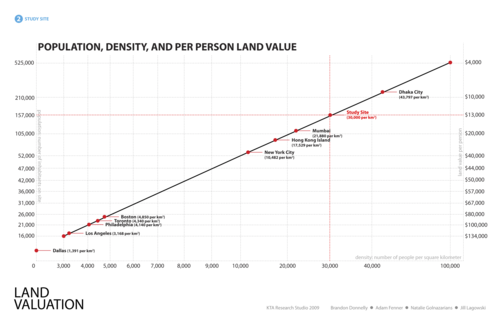
    Here’s a telling slide from our final presentation:

    image

    What we were trying to do with this chart was compare population and per person land value for our development site according to various city types. In other words, we were essentially asking: If we were to build out our proposed site in the same way, as say, Dallas, Los Angeles, Hong Kong, or what is typical for Dhaka, how many people could we fit and what would be the resulting per person land value?

    I don’t remember where we got the land value figures from, but we were trying to be cognizant of the fact that every city requires a unique solution. Using the same per person land values in Dhaka as in Dallas would be unimaginable because Dhaka has over 40,000 people per square kilometre (top right on the diagonal line above) and Dallas has under 1,400 per square kilometre (bottom left on the diagonal line above).

    The challenges of urbanization in the developing world are profound, particularly in places like Dhaka where most of the city is subject to severe annual floods. By some estimates, 18% of the city’s land area gets flooded every year—talk about adding another layer of city building complexity.

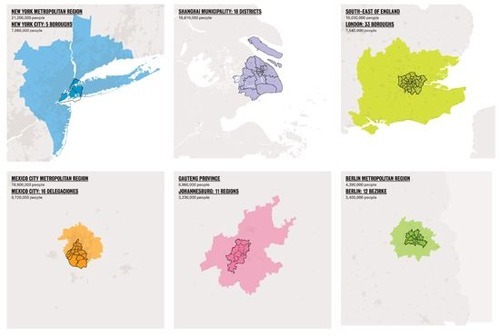
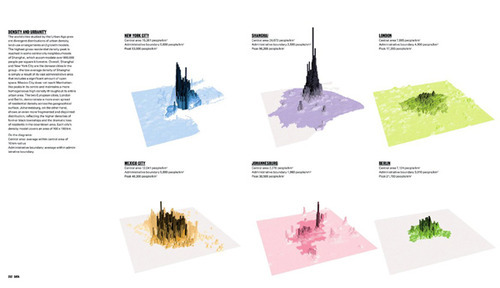
    We didn’t solve all of the problems in that studio and we’re not going to do it here, but I do think it’s important to fully understand the problem. One of my favorite books on cities is called “The Endless City.” It examines New York, Shanghai, London, Mexico City, Johannesburg and Berlin, and has a ton of great data and diagrams.

    Here are a two that outline densities and land use patterns for the above 6 cities (same order starting on the top left):

    image

    image

    If you’re interested in cities, it’s definitely worth having it on your coffee table. And fitting to @PhatNancy’s tweet, ”The Endless City doesn’t just show how cities are changing but also how they are changing us.