
Daily insights for city builders, delivered every morning at 6 AM ET. I’m Brandon Donnelly — a Toronto-based real estate developer and founder of Globizen. I’ve been writing here since 2013.

Tag: development proposal

  • Finally, more density next to transit!

    Sometimes on this blog, I like to write about things that I wish would happen. For example, back in 2014 I wrote this post calling Toronto’s Bloor-Danforth subway corridor a “land use crime scene.” And in it, I called the intersection of Bloor & Dundas West one of the best connected mobility hubs in the region. Then earlier this year, I quoted a post by Reece Martin where he referred to this same node as “the second-best transit node in the country” after Union Station.

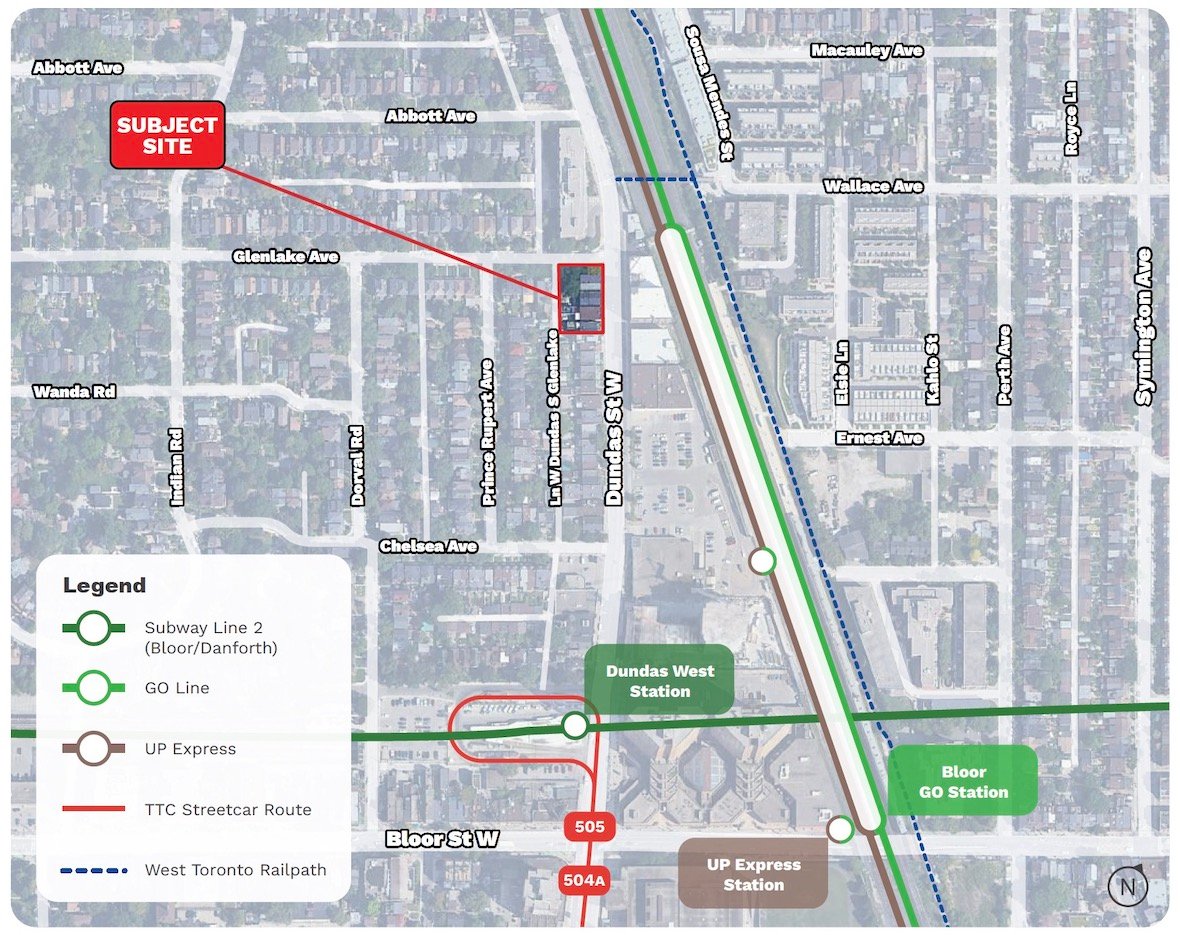
    I’m fairly confident that these posts did absolutely nothing. But today, I am happy to report that my friend and former colleague, Adrian Tarapacky (now VP of Development at Fairway Development Group), has submitted a rezoning application for a new tall building at 2475 Dundas Street West. The site is just north of Bloor Street West, at the intersection of Glenlake Avenue, and it’s exactly the kind of development I was wishing for when I wrote the above posts.

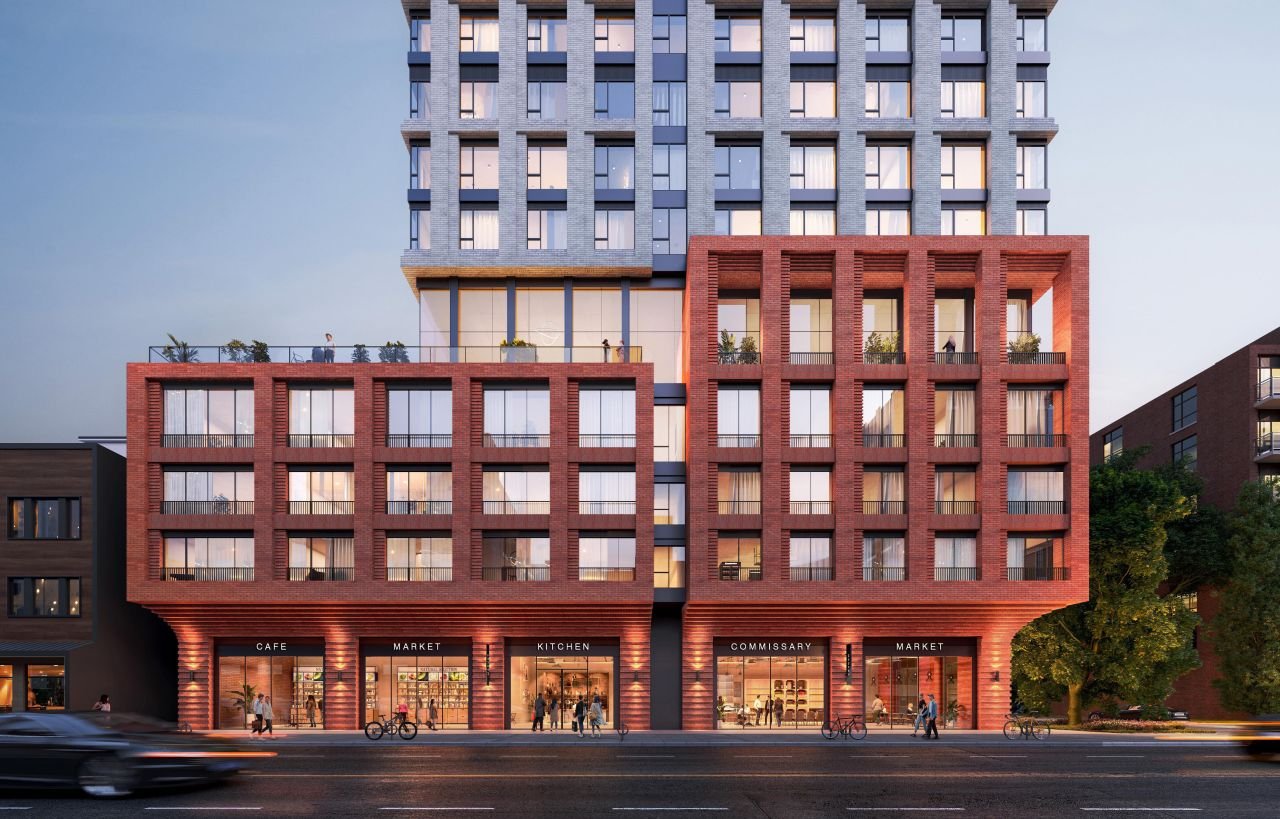
    Here’s a rendering of the proposed podium:
    And here’s the context:
    Any developer will tell you that it’s not easy assembling this many parcels, which is likely one of the reasons why the street/area remains this underdeveloped. So great work, Adrian. I look forward to you bringing more vibrancy to my neighborhood and the second-best transit node in the country. I also know that you have impeccable taste in lunch sandwiches, so I look forward to seeing what happens with the ground floor retail spaces.

    If you’d like to learn more about the development proposal, here’s an article from UrbanToronto.

  • Project Profile: 1925 Victoria Park Road, Toronto

    A recent development proposal at 1925 Victoria Park Road (Toronto) by Well Grounded Real Estate (developer) and Partisans (architect) is noteworthy for a number of reasons:

    • The 12-storey, 168-suite residential mid-rise building is proposed to be built out of mass-timber.
    • It is targeting Toronto Green Standard Tier 4, which is a voluntary, difficult-to-achieve, and expensive sustainability target. It is the equivalent of net-zero and I believe the only projects to date that have achieved this level in the city are public projects.
    • The circulation spaces are exterior single-loaded corridors that face an internal courtyard. This approach is very common in some cities, but almost non-existent in Toronto. Usually because someone will cite our winters as being a problem and because double-loaded corridors are typically the most efficient (rentable area / gross construction area). But the benefits are that you don’t need to heat/cool these corridor spaces and you open up the possibility of suites with windows on both ends.
    • The design doesn’t generally follow the typical “pyramid-shaped confection” that has come to define Toronto mid-rise buildings, though it does seem to generally conform to the 45 degree angular planes that we love to obsess over. Instead, it is starting to resemble a typical European courtyard building. Good. For some more commentary on this, check out John Lorinc’s recent piece in the Globe and the Mail.

    This is unquestionably an ambitious project. And ambition is what cities need. So I am pleased to write about it today on the blog. If you’d like to learn more, check out their project website.

    Image: Partisans

  • [Video] Saudi Arabia’s new 170-km-long vertical city

    I am usually known for my optimism for the future. But I am having a difficult time deciphering whether the new 170-km-long vertical city that Saudia Arabia just revealed (see above video) is a legitimate development proposal, a new metaverse project, or a dystopian spoof about how we’re all going to live in beehives once autonomous everything and artificial intelligence takes over.

    The Line, as it is cleverly called, is intended to form the basis for a new and allegedly livable city called Neom. This is a city that is intended to lead Saudi Arabia into some sort of glorious post-oil future. And the plan is for it to eventually house some 9 million people; all within a 170-km-long mirrored strip that is 200m wide, 500m tall, and accessible end-to-end in 20 minutes via high-speed rail.

    I would love to see the development pro forma for this one (if it even exists), but I certainly don’t need it to determine that this thing is never going to be built — certainly not in its current incarnation.

  • Creating change

    I was reading about a proposed development earlier today (it doesn’t really matter which one for this story) and I immediately thought to myself, “wow, this is a beautiful development. I like what they’ve done here.” The project happens to be by one of my favorite architects in the city. Sadly though, we have yet to work with them on any of our projects.

    I then decided to read the comment section of the article. There were dozens and dozens of comments and virtually all of them were negative and against the development. What is, of course, clear is that we all have different beliefs. We all see things differently. And that’s part of the reason why creating any sort of change is usually so difficult.

    But if you think about it, so much of our world resolves around change. If we want to address climate change, we are going to need to make changes. If we want to improve housing affordability, we are going to need to make changes. If we want to build more inclusive and economically prosperous cities, we are going to need to make changes.

    The challenge with all of this change is that we have inertia working against us. Case in point: I’m sure that most of us have been in a meeting at one point or another when a decision was made purely based on what was done the last time around. We did X. So let’s do X again. Why change? Probably a safe bet.

    Seth Godin once said that, “if you do anything that matters, it means you’re trying to change something.” He was talking about the world of marketing. But I believe that there’s a universal truth to this. Change unlocks potential.

  • For the love of compactness

    I’m in Provincetown, Cape Cod right now. One of the things that is great about this town is the scale of it. It’s compact and many of the streets feel like laneways or alleys (I’m obsessed, I know). It’s all about pedestrians here. Even the main drag, Commercial Street, is effectively a pedestrian street – though it’s not technically closed to cars most of the time.

    There’s something liberating about being able to get where you need to go by walking or biking or skateboarding. And all of those things are done here. I enjoy the inherent efficiency that compactness brings. That’s why I was excited to learn this morning about the following proposal at 24 Mercer Street in Toronto (via Urban Toronto):

    image

    It’s a 12 unit, 17 storey building on a 195 square metre lot. The proposed FSI is 16.8. And it will have zero parking. I would be incredibly curious to know what the construction costs will be and how the overall project pencils out. But regardless, it’s exciting to see someone trying to make use of such a tight site. I would love to see more of this in Toronto and I am certain we will.

    What do you think about projects like this? Some of you may call this “poor planning,” but I see the efficient use of resources.

  • Positivity at a public meeting

    I’ve been reading the blog 5 Kids 1 Condo for, I think, about a year now. It’s written by Adrian Crook who is a single dad of 5 kids, living in a 2 bedroom condo in downtown Vancouver. And his blog is about just that.

    A few days ago he posted a video of himself speaking at a public meeting in support of a new purpose-built rental building at 18th and Commercial Drive in Vancouver. The proposal includes 110 secured market rental units; 37% of which will be 2 or 3 bedroom apartments. (More information on the project, here.)

    It’s rare to see people come out in support of a project at a public meeting. Usually people only show up when they’re grouchy and upset. So today I’d like to share his speech (click here if you can’t see the video below).

    [youtube https://www.youtube.com/watch?v=q-ENWu__HdM?rel=0&w=560&h=315]

    I’m curious to know what was shouted right at the beginning after he said that he was in favor of the proposal. I listened a few times but couldn’t figure it out. 

    In any event, Adrian’s speech touches on a number of important points that transcend this specific development proposal and that are relevant to many of the topics that we discuss here on this blog.

  • Mirvish+Gehry and the story of 4 heritage buildings

    I am a real estate developer and I believe in progress. But I also fundamentally believe in balancing progress and preservation. I’ve said this before.

    This morning, Alex Bozikovic of the Globe and Mail, published a piece on the epic Mirvish + Gehry proposal for Toronto’s Entertainment District. It’s called, “Frank Gehry and David Mirvish’s tall order in Toronto.

    Now, I’ve said before that I like this project. I don’t mind the height and I don’t buy the argument that there aren’t enough public spaces in the area. There’s David Pecaut Square directly to the south that could use a few more warm bodies in it.

    But as I also said before, I think the key concern here is one of heritage. There are 4 heritage designated buildings on the site dating back to as early as 1901. Here’s where they sit:

    image

    The Anderson Building (1915) is particularly unique. Here’s a larger photo (via blogTO):

    image

    So while I’m excited by the prospect of a real Gehry project in Toronto, I think we need to figure out a way to find a balance. Preserve the facades, build on top, or relocate them. Do something besides wipe the slate clean.

    As Bozikovic rightly points out in his article, “Toronto has a sophisticated culture of working with heritage buildings.” There are lots of great examples of how we managed to move forward as a city, without erasing our past.

    And in many ways, I see this ability to work with and build upon heritage buildings as an emerging Toronto vernacular. I mean, what could be more appropriate for the most diverse city on the planet than an architectural style—of our own—that blends and layers history with disparate design ideologies.

    I sense an opportunity.

    We could have Gehry’s white sinuous curves drape over the heritage buildings. Make them become a literal unveiling of Toronto’s past and a metaphor for the sophisticated way in which we build upon legacy.

    It’s too easy to just demolish everything. We’re better than that.