

Daily insights for city builders, delivered every morning at 6 AM ET. I’m Brandon Donnelly — a Toronto-based real estate developer and founder of Globizen. I’ve been writing here since 2013.

Tag: detlef mertins

  • Mies

    image

    If you’re into architecture, specifically epic modernism, then I would encourage you to pick up this new monograph on Mies van der Rohe–simply called Mies. It was written by the late Detlef Mertins, who was the Chair of the Department of Architecture at the University of Pennsylvania from 2002 to 2007, but is originally from Toronto.

    Detlef was one of the most brilliant, but also nicest, people I’ve ever met and unquestionably the leading scholar on all things Mies. He passed away in the midst of working on this publication, but it was completed by his partner Keller Easterling–another powerful architecture mind–and a few other contributors.

    For those of you unfamiliar with the work of Mies, here’s a brief description from the book publisher:

    Ludwig Mies van der Rohe is one of the twentieth century’s most influential architects. His most well-known projects include the Barcelona Pavilion in Spain (1929); the Seagram Building in New York (1954-56); the Farnsworth House (1945-50), 860 and 880 Lakeshore Drive (1945-51) and the IIT Campus (1939-58), all in and around Chicago, and the New National Gallery in Berlin (1962-68). These are only a few of Mies’s pavilions, houses, skyscrapers and campuses, which all epitomized a radically new structural and spatial clarity. 

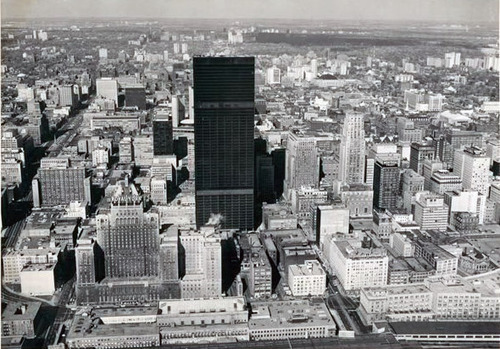
    For readers in Toronto, Mies’s biggest contribution is the Toronto Dominion Centre, which is a beautiful example of the International Style. The complex was designated under the Ontario Heritage Act in 2003. But in addition to it being great architecture, its construction in the late 60s really coincided with Toronto’s rise as a modern metropolis. Here’s a photo of the first tower from blogTO.
    image

    The TD Centre introduced not only a new architectural language into Toronto’s urban fabric, it also introduced a new and bolder way of how we thought of ourselves as a city. Remember this was a moment in time where Toronto was just about to overtake Montreal as the most populous city in Canada.

    We were reimagining our city with Mies.

  • Why was Lafayette Park so successful?

    One of the places I had to visit during my trip to Detroit last weekend was Lafayette Park. Designed by famed German-American architect Mies van der Rohe, it’s the largest collection of his buildings and one of the most successful examples of urban renewal in America.

    Still today it remains one of the most economically and racially diverse neighbourhoods in the city and a bastion of stability within Detroit’s eroding urban fabric. But from a planning standpoint, it shares many of the same characteristics as other tower-in-a-park renewal plans. 

    It was built at a lower density than the neighbourhood it replaced (the unfortunately named Black Bottom slum) and it was far more insular in terms of its relationship to the greater city. From cul-de-sacs to expansive green space areas, it’s an island in the middle of Detroit.

    This recipe has created many spectacular urban failures all across the world. So why not in Detroit? One would think that Detroit of all places would suffer the same fate.

    I have 3 hypotheses.

    First, the fact that it’s a Mies community matters.  I’m sure it attracted and continues to attract residents simply because of who designed it. The entire neighbourhood is on the National Register of Historic Places.

    Second, the community doesn’t have the same monoculture that many other master planned communities had. From the beginning, the intent was to develop a self sustaining mixed-income neighbourhood with shops, restaurants, schools and so on.

    Third, I think the fact that the neighbourhood was more insular actually helped it. As the rest of the city’s fabric crumbled, Lafayette Park remained this kind of curated semi-urban space in the core of the city.

    These are just some of my initial thoughts.

    There has, of course, been a lot of rigorous academic thought on this topic by the likes of Charles Waldheim, the late Detlef Mertins, and others.