Daily insights for city builders, delivered every morning at 6 AM ET. I’m Brandon Donnelly — a Toronto-based real estate developer and founder of Globizen. I’ve been writing here since 2013.

Tag: designer

  • Don’t get me started

    I cover a lot of different topics on this blog. It’s hard to write daily for a decade and not meander every now and then. But generally speaking, I do try and keep this forum focused on things that are related to city building — real estate, housing, design, transportation, etc. And I do try and share some of the things that I have learned (and the mistakes that I have made) since I started working in real estate development back in 2007.

    But we all have limits, and different perspectives are vital for solving problems. So I’d really like to introduce more Q&A features on this blog, similar to this recent one that I did with structural engineer, James Cranford. If this sounds interesting to any of you, please reach out. I’m open to anyone who touches the built environment: architects, artists, planners (private or municipal), lenders, furniture designers, bollard manufactures … you name it!

    Image: Jason Adam Katzenstein

  • The Art of Design

    I don’t actually have Netflix, but they have a new original documentary series out called, Abstract: The Art of Design. It’s a look at “eight of the most creative thinkers” working in art and design. It premiered at the Sundance Film Festival this year.

    Here are those 8 people:

    1. Es Devlin (stage designer)
    2. Ilse Crawford (interior designer)
    3. Ralph Gilles (Chrysler head of global design)
    4. Bjarke Ingels (architect)
    5. Platon (photographer)
    6. Christoph Niemann (New Yorker cover illustrator)
    7. Paula Scher (graphic designer)
    8. Tinker Hatfield (Nike sneaker designer)

    The trailer feels unnecessarily dramatic for a documentary, but I’d still like to watch it. The reviews also seem to suggest that it’s pretty good. Below is the trailer. If you can’t see it below, click here.

    [youtube https://www.youtube.com/watch?v=DYaq2sWTWAA?rel=0&w=560&h=315]

    If you’ve already seen it, what did you think?

  • Forest

    I just backed the following project on Kickstarter:

    https://www.kickstarter.com/projects/991195979/n-o-r-t-h-simple-timeless-and-refined-watches/widget/card.html?v=2

    It is a new watch line from two Montreal designers. The brand is called Forest Time Co. There’s so much creative talent in that city.

    I was immediately drawn to the focus on minimalism and on high quality materials. That’s a philosophy I can get behind. I plan to go for the black band with copper case.

    I know nothing about watch movements, but it’s a “Japanese Miyota.” I assume that’s pretty basic.

    I love finding interesting projects on Kickstarter. There’s something about backing a team and their new creation. We should all aspire to make and create more.

    At the time of writing this post, they’re about $1,000 shy of their funding goal of $24,000. I hope they reach it by this Sunday. I’m sure they will.

  • Design, technology, and culture

    Every now and then I’ll come across a website, a product, or something that immediately resonates with me. Usually that means I’ll immediately subscribe to it, buy it, follow it, or do whatever the action is supposed to be. It doesn’t happen all that often – though I think it should be a goal of companies and organizations to delight – but that’s exactly what happened to me this morning when I stumbled upon Subtraction.com.

    Subtraction is a blog about design, technology and culture (all things I love) and it’s written by Khoi Vinh. Khoi is Principal Designer at Adobe. Prior to this, he was Design Director of The New York Times and co-founder of the design studio Behavior, LLC. Fast Company also named him one of the 50 most influential designers in America. But enough of all that. His blog is great.

    Whenever I write about blogging, I tend to get questions about other blogs I might recommend. So today I’m recommending Subtraction.com. I’ve also added it to my working reading list, which I don’t think many of you are aware of because you probably just read this blog in your inbox. But it exists and I’m happy to add to it if you have interesting suggestions. (Please leave a comment below.)

    P.S. Because of Subtraction, I now have the movie High-Rise on my watch list. Have any of you seen it? Because I don’t have cable or Netflix, I tend to be painfully out of the loop on these sorts of things. It’s based on a book by J.G. Ballard and it’s the story of a 1970s suburban London apartment building that starts to socially degrade. How could I not want to watch that?

  • [Video] Interview with designer Marcel Wanders

    I just got home from Christmas dinner and I am so full that I can barely keep my eyes open. So rather than attempt to write something insightful, I am going to share a 2 minute interview with designer Marcel Wanders.

    [youtube https://www.youtube.com/watch?v=w78Bjfscii0?rel=0&w=560&h=315]

    It’s a short piece, but he covers some interesting topics such as his office culture and the value of Amsterdam for their creative process (specifically the city’s openness and tolerance).

    Regular scheduled programming will resume tomorrow. 

    And sometime before the end of the year I’m going to do a summary of 2015 on ATC and make some predictions for 2016. I haven’t really done the prediction part before, but I think it would be a good practice to start.

    Until tomorrow 😴

  • 16 mobile theses and how tech might change the built environment

    Caucasian woman standing near passing subway in train station by Gable Denims on 500px.com

    https://500px.com/embed.js

    One of the things that I try and do here on this blog is examine the intersection of design, real estate, and technology. I didn’t explicitly set out to do that, but more and more I find myself thinking that way when I’m writing and when I’m giving talks.

    Part of that is because of my passions, but part of it is because there is a big and important overlap. One example of that is autonomous, self-driving cars. The tech community is enamoured with driverless cars, but everyone involved in the built environment should also be thinking about their impacts. Because it’ll be significant.

    Benedict Evans – who is a venture capitalist with Andreessen Horowitz in the Valley – recently published a post called, 16 mobile theses. It’s a look at 16 topics, trends, and shifts that are happening in the tech space. (There’s also a related podcast discussion.)

    If you’re involved in internet products, you absolutely need to give it a read. But I also think it’s interesting to read it through the lens of a designer or real estate person. Productivity is changing. Notions around the living room are changing. And yes, autonomous vehicles are going to have a profound impact on the urban landscape of our cities – just as cars did initially.

    Below are 3 excerpts from Benedict’s post that I really enjoyed.

    The first is about mobile and just how massive it is:

    “The mobile ecosystem, now, is heading towards perhaps 10x the scale of the PC industry, and mobile is not just a new thing or a big thing, but that new generation, whose scale makes it the new centre of gravity of the tech industry. Almost everything else will orbit around it.”

    The second is about how “networked” is quickly becoming a given:

    “Our grandparents could have told you how many electric motors they owned – there was one in the car, one in the fridge and so on, and they owned maybe a dozen. In the same way, we know roughly how many devices we own with a network connection, and, again, our children won’t. Many of those uses cases will seem silly to us, just as our grandparents would laugh at the idea of a button to lower a car window, but the sheer range and cheapness of sensors and components, mostly coming out of the smartphone supply chain, will make them ubiquitous and invisible – we’ll forget about them just as we’ve forgotten about electric motors.”

    And the third is about those self-driving cars:

    “The move to electric and the move (if and when) to autonomous, self-driving cars fundamentally change what a car is, but also what the whole automotive system might look like. Electricity changes the mechanical complexity of cars and hence changes who might build them and what they might look like. Autonomy and on-demand services change who buys them, meaning the buying criteria will be different. But they could also change the urban landscape just as much as cars themselves did – what do mass-market retail or restaurants look like if no-one needs to park?”

    Can you think of other ways in which tech will impact cities and the spaces we occupy?

  • City building every way you can

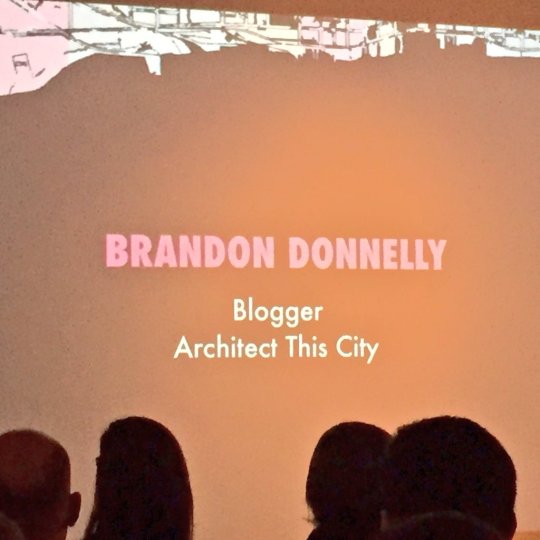
    Tonight I attended and gave a short talk at a city building themed PechaKucha night here in Toronto. If you aren’t familiar with the PechaKucha 20×20 presentation format, click here.

    The first PechaKucha night was held in Tokyo, but it has since expanded to over 800 cities around the world. Each city has a local organizer who acts as a steward and here in Toronto it is Amy Bath. She did a fantastic job this evening.

    Tonight’s event was all about non-traditional forms of city building. It was not so much about how architects and developers are shaping the built environment – thought there was some of that. It was more about how interdisciplinary artists, graphic designers, bloggers, and others, are having an impact on cities. So in my case, I was speaking as a blogger, rather than as a real estate developer, which was a bit unique for me.

    What excited me about tonight is the amount of talent and passion that we have in this city, and how so much of it is being harnessed to make cities better.

    Jay Wall of Studio Jaywall is doing incredible work at the intersection of graphic design and city building. My friend Mackenzie Keast of Distl and NXT City Prize is organizing public space competitions and then working with the city to get them built. And my friend Justin Broadbent, who is an interdisciplinary artist, is just killing it and putting Toronto on the map. I don’t know how else to say it.

    And this is just naming a few of the people in attendance.

    I have so much respect for people who love the city they call home and actively try to make it a better place. That’s a lot harder to do than just complain about why your city isn’t (insert other allegedly better city here). But it’s also a lot more productive.