
Daily insights for city builders, delivered every morning at 6 AM ET. I’m Brandon Donnelly — a Toronto-based real estate developer and founder of Globizen. I’ve been writing here since 2013.

Tag: department store

  • From mail-order catalogues and e-commerce to brick-and-mortar retailing

    It was recently announced that Amazon plans to start opening large brick-and-mortar retail stores that are akin to department stores. They won’t be quite as big. Supposedly they will be around 30,000 square feet. But this is still a meaningful commitment to physical retailing. The first stores of this type are expected to be in California and Ohio.

    On the one hand, this move probably appears counterintuitive. I mean, Amazon is a machine built around e-commerce (though it does already have other physical stores). But on the other hand, you could argue that they are simply following a retailing playbook that was developed over a century ago by companies like Montgomery Ward and Sears.

    Both of these companies disrupted traditional retailing in the late 19th century through mail-order catalogues. Why pay for physical space when you can just mail people catalogues? (Your margin is my opportunity, right?)

    But as we know, eventually these mail-order catalogue businesses turned into brick-and-mortar stores, and they then thrived this way for many years. If you consider e-commerce to just be the 21st century equivalent of the mail-order catalogue, then perhaps this next move by Amazon was always destined to happen.
  • Pleasure and product discovery

    Benedict Evan’s most recent blog post, called “Amazon as experiment,” draws some interesting parallels between what Amazon is doing today (and experimenting with) and the beginning of mass retail, namely the invention of the department store. He also talks about some of the shortcomings of Amazon’s model, which isn’t at all focused on (or good at) things such as “pleasure” and product discovery. Here are a couple of excerpts:

    On the other hand, it’s interesting that Amazon seems to be doing as much experimentation as possible around the logistics model—from stores to drones to warehouse robots of every kind—but much less around the buying experience, other than small-scale tests of the Four-Star stores. After all, historically, department stores were about pleasure as much as they were about convenience or price. They changed what it meant to “go shopping” and helped turn retail into a leisure activity.

    This has always been the gap in the Amazon model. It’s ever more efficient at finding what you already know you want and shipping it to you, but bad at suggesting things you don’t already know about, and terrible whenever a product needs something specific—just try finding children’s shoes by size.

    This is probably inherent in the model. For Amazon to scale indefinitely to unlimited kinds of products, it needs to have more or less the same commodity logistics model for all of them. That’s the line it’s never been willing to cross. Amazon doesn’t do “unscalable.” And yet, while we now know there is nothing that people won’t happily buy online, not everything will fit that commodity model. So maybe that’s the real test of Amazon’s pride: can it work out how to let us shop, rather than just buy?

  • Riding an escalator for the first time

    image

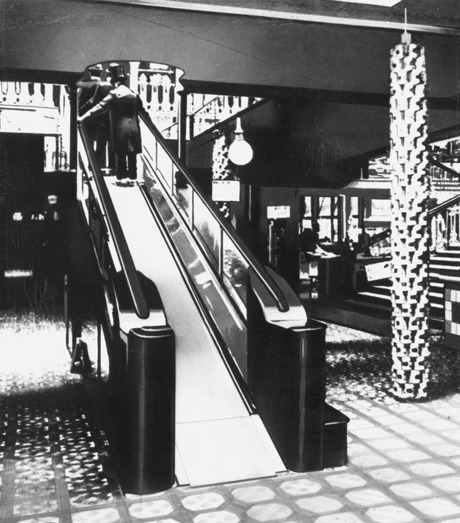
    On Wednesday, November 16th, 1898, Harrods department store in London opened up the first escalator – or moving staircase as it was called – in England. The first escalator-like machine in the world had actually been patented many decades before in the US, but this was the first real application in England and likely one of the first in the world.

    At the end of the 1800s, this was a big deal. Victorian England had never seen or experienced anything like this before and people were genuinely concerned about its use. More specifically, people worried what such a rapid change in elevation would do to the body. It was believed that it could discombobulate your inner workings. People were unnerved.

    Which is why when it was first introduced at Harrods, people were offered brandy and other substances at the top of the escalator in order “to revive them after their ordeal.” Riding an escalator was no small feat for these people.

    Now to us today, this sounds ludicrous. Most of us probably ride a few escalators a day. They’re ubiquitous. But I tell this story because I think it clearly underlines how disruptive the new and unknown can feel, and how difficult it can be for us to accept sometimes.

    If you go back throughout history, you could easily replace escalators for many other new technologies: the printing press, the automobile, the internet, and so on. And in some cases we were wrong to worry, and in other cases we were right to worry.

    Cars, for example, have had a pretty dramatic impact on our lives and the way we build our cities. And since the very beginning, they had no shortage of critics. But does that mean we should have never invented the car? I don’t think so.

    As I said earlier this week week, the goal in my mind is to find the right balance between preservation and progress. Just as we shouldn’t be so quick to erase our architectural history, we shouldn’t be so quick to erase our way of life.

    But at the same time, it’s important to remain open minded to what’s coming. I’m optimistic about the future. Change can be a great thing, even if it may feel as uncomfortable as riding an escalator for the first time. Maybe you just need a bit of brandy to calm your nerves.

    Image: Pinterest