Daily insights for city builders, delivered every morning at 6 AM ET. I’m Brandon Donnelly — a Toronto-based real estate developer and founder of Globizen. I’ve been writing here since 2013.

Tag: delivery

  • Construction is messy

    The typical way to build buildings is through a design-bid-build approach. The way this works is that you first design stuff and create drawings. You then ask people to price the stuff that you have drawn. And then you proceed to build what is on the drawings and what has been priced.

    There are a number of possible risks with this approach. For one, the design/drawing phase is sometimes/often done in isolation without a lot of feedback from the contractor and/or subcontractors. So you might be designing and drawing things that aren’t all that feasible or constructible. Pre-construction involvement helps address this.

    Another risk is that you’re buying what is on the drawings. So if the drawings suck or aren’t properly coordinated, then you are likely opening yourself up to a barrage of change orders and lots of additional costs.

    In theory, it all sounds fine. Here are my drawings and specifications. Give me a price. And then let’s build. But as many or most of you will know, it’s generally never that simple or easy. Though it will, of course, depend on the type and complexity of the project.

    Another consideration is the kind of contract you enter with your constructor. Is it a cost-plus contract, where the constructor simply charges a percentage on top of whatever the costs end up being, or is it some kind of lump sum or guaranteed maximum price (GMP) contract?

    While I was in architecture school I decided to take a class on construction delivery methods. The instructor was, in my mind, your quintessential construction person. He was built like a brick shithouse and he never minced words. He also had a voice that sounded like a subwoofer.

    I wouldn’t say I’m an expert, but I do remember him hammering home two points. One, GMP actually stands for guaranteed minimum price. This is forever imprinted in my mind. You’re never going to pay less and you’re almost certainly not going to pay the “maximum” number. You will end up getting change ordered and paying more.

    Two, lump sum and at-risk contracts create a very different relationship between owner/developer and constructor. In his words, it is adversarial.

    Because if I’m a constructor and I’ve promised a specific number, I’m likely going to do a few things. I am going to inflate the numbers to make sure my profit margin is protected throughout the project. And if my profit margin gets squeezed, which it likely will, I’m going to look for other ways to make money.

    Personally, I side towards cost-plus and construction management arrangements. I don’t want an adversarial relationship. I want a partnership where there’s as much alignment as possible around a common set of project goals. Let’s ride or die together.

    Similarly, when it comes to the actual procurement and delivery methods, I find that we are often using more integrated approaches as opposed to cut and dry design-bid-build approaches. You want the competitive pricing that comes with bidding, but you also want collaboration. It’s about striking that right balance.

    The construction process is a messy one. These are just some of my thoughts this morning. If any of you have any insights, I would, of course, welcome them in the comment section below.

  • Delivery > mobility

    I was picking up food the other night on Bloor Street (via Uber Eats) and the lineup of delivery drivers outside of the restaurant was at least ten people deep when we arrived. While we were waiting, another handful of drivers pulled over to quickly pickup their deliveries. This is what is happening in our cities right now, especially here in Toronto while we live through another stay-at-home order. And the numbers certainly reflect it.

    Last month in March, Uber’s delivery business (which is separate from the company’s mobility business) recorded a 150% year-over-year increase in annualized gross bookings. The company’s run-rate as of March is now $52 billion. To put this number into perspective, the company’s mobility business also had its best ever month in March with an annualized gross bookings run-rate of $30 billion.

    Delivery > mobility right now. Makes sense.

    To further put this into perspective, total restaurant spending across the entirety of the United States was $670 billion in 2019 (figure from Benedict Evans). So Uber Eats has quickly become a meaningful part of how we eat. I obviously believe that people are dying to get out and eat at restaurants again, but these figures are still interesting nonetheless.

    It’s also interesting to think about the above trendline from a broader logistics perspective. Alongside the rise in Uber Eats, we are seeing a wave of capital move toward “rapid delivery apps.” These are platforms that allow meals, groceries, and other stuff to be delivered, in some cases, almost right away, which aligns with where I think consumers are moving. Rather than making lists and doing weekly shops, it’s now about just-in-time delivery.

    It’s arguably a lazier way of going about things, but water will always find the path of least resistance.

    Many, or perhaps most, of these platforms have adopted an asset light approach. Instacart, which partners with existing grocers, would fall into this category. Their model revolves around gig workers going into existing stores, picking orders directly from the shelves, and then delivering those orders. And it is what Blair Welch was getting at in his recent RENX interview when he reasoned that grocery shopping is still being done, almost exclusively, at local stores.

    This approach is enough for Instacart to be valued at nearly $40 billion, according to the Financial Times. So something seems to be working.

  • Amazon’s delivery network is now the 4th largest in the US

    This is an interesting article about Amazon’s delivery network, which is now the 4th largest in the United States. Here are the numbers (most of which are as of 2019):

    • Since 2014, Amazon has spent $39 billion building out its delivery network. When you add in warehouses and airplanes, this number increases to about $60 billion. As of 2019, Amazon leased 97% of its fulfillment and data center spaces.
    • Amazon is becoming increasingly vertically integrated. Last year, Amazon delivered about 58% of the 4.5 billion parcels that it shipped to US consumers. This represents about 22% of all online retail deliveries.
    • Outside of the US, Amazon still handles close to 50% of its own order deliveries. By 2025, Bank of America Global Research is predicting that Amazon could grow to handle somewhere between 38% and 49% of all online order deliveries in the US.
    • Amazon is the 4th largest in terms of US package deliveries (2019), behind FedEx, UPS, and USPS (in that order).
    • Amazon’s fulfillment network roughly entails: receiving centers -> fulfillment centers -> sortation centers -> last-mile delivery stations. It’s a hub and spoke system with the physical real estate naturally getting smaller as you get closer to the end destination. For a lot more information on their network, click here.
  • Everything delivered on demand

    Last week I had something delivered from Amazon almost every single day. They weren’t necessarily big things though. One day it was a new corn broom for the patio. Another day it was a small set of hooks that I wanted to hang some lights. And the list goes on. 

    This is what Amazon wants us to do. Order every little thing, instantly, as soon as you think about it. And it’s magically convenient.

    Developers and architects are of course thinking about the implications of this shifting shopping habit on new residential developments. Usually it comes in the form of a large “Amazon room” and/or a parcel locker system. 

    I recently measured the package room in my building (geeky, I know). It’s about 10′ x 6′ and it sometimes isn’t enough for the volume of daily packages generated by ~360 units. 

    The other thing that happened last week is that my concierge said to me: “Brandon, we have become a full fledge post office with the amount of packages that come through here every day.” Every evening there’s a lineup of people waiting to collect their packages. 

    That immediately signaled to me that simply providing a larger room probably isn’t enough. This trend is only going to continue. How could we better design and optimize for this shift?

    I am sure that there many companies working on this problem. Hopefully they will surface in the comments and in my inbox following this post.

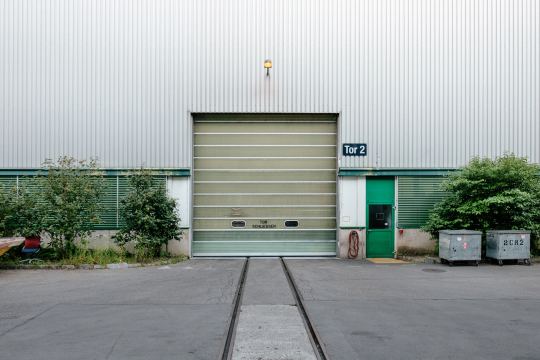
    Photo by Maarten van den Heuvel on Unsplash

  • Is it only a matter of time before Amazon enters the delivery business?

    Yesterday I ordered something from Amazon Prime. The guaranteed delivery time was today before 9pm, but within an hour of ordering the delivery estimate was updated and it ended up arriving on the same day about 5 hours after my order. I thought this was pretty amazing, particularly because the package was a bit time sensitive.

    Delivering to individual residences is more expensive than delivering to more centralized businesses and stores. And with the rise of online shopping, UPS now delivers as many as 31 million packages every day. Because of this, every little detail counts. 

    Last year the company started installing Bluetooth receivers on the inside of its delivery trucks. If a driver incorrectly loads a package that isn’t on their route, it pushes out a loud beep. (This is one of the many tech and data-driven projects that UPS is working on to ensure it stays competitive.)

    Previously there was no final check. If there was a rogue package on the truck, it meant the driver would have to stray from their route, coordinate a handoff, or delay the package for another day. These mishaps can really add up when you’re delivering 31 million packages in a single day.

    With Amazon squeezing delivery times and with the rumors that it’s going to start its own delivery business (to compete directly with UPS and FedEx), one has to wonder about the impact that these volumes will have on our cities. Perhaps autonomous vehicles will really become the new roaming retail outlet – ready to deliver as soon as we click buy.

  • Online shopping and “last mile” real estate

    The Globe and Mail recently published an excellent article on “how e-commerce is driving a real estate revolution.” This is a topic that I’m very interested in: how online manifests itself offline.

    Not surprisingly, the article talks a lot about Amazon, including their 4th warehouse in the Greater Toronto Area, which is an 850,000 square foot facility in Brampton equipped with 350-pound robots (8050 Heritage Road).

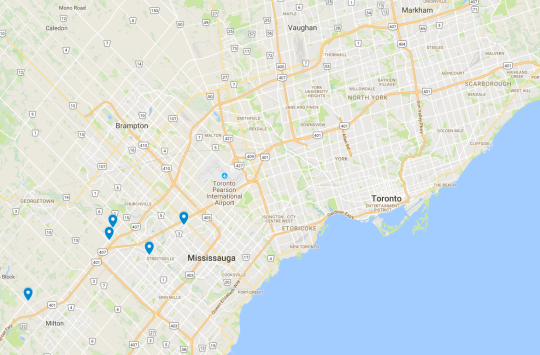
    The first thing I did after reading the article was figure out the location of all of Amazon’s fulfillment centers in the GTA. Amazon doesn’t seem to publish this. But according to TaxJar, they are here (I mapped out the addresses):

    There are two in Brampton at the precise location where Hwy 407 (toll route) and Hwy 401 meet. The other three are distributed along Hwy 401 in Milton and in Mississauga.

    Now let’s get back to that Globe and Mail article:

    – In 6 years, Amazon has leased over 2 million square feet of warehouse space in Canada.

    – Toronto is the third largest warehouse market in North America. It represents 43% of Canada’s total inventory.

    – Average net rents have increased 9.7% over the past year and vacancy rates have dropped to 2.7% (CBRE data). In Vancouver, those same numbers are 5.1% and 3%, respectively.

    – Online shopping is thought to account for about 6.5% of all retail sales in Canada. But in Toronto, 23% of all industrial space is already e-commerce-related (CBRE data, again).

    – CBRE believes that every $1 billion in new online sales per year requires an additional 1.25 million square feet of warehouse space. 

    – Based on online sales projections, Canada needs another 27.5 million square feet of industrial space over the next 5 years. We don’t have that much space in the pipeline.

    – Clear heights are increasing for stacking purposes. Amazon’s new Brampton facility is 45 feet tall / 4 floors. 10 years ago new warehouses were 26 feet tall.

    – Average sale price of warehouses in the GTA has gone from $119.35 psf to $142.19 psf over the last year.

    Perhaps the most interesting takeaway from the article is the discussion around “last mile” distribution hubs. These are fulfillment centers located closer to the city, which are used to offer shorter delivery times: 

    “…instead of having inventory stored for days or months, these fulfilment centres will turn over their inventory in one day, sometimes twice a day.”

    This is something that I addressed in my recent presentation about the “mall of the future” at B+H’s retail design charrette. Where do these physical distribution centers want to be as online sales continue to grow and delivery times continue to compress? Where’s the future growth?

    According to this article, it’s going to be in “last mile” fulfillment real estate – relatively smaller spaces that are located very close or directly in the city center.

    Photo by Samuel Zeller on Unsplash