Daily insights for city builders, delivered every morning at 6 AM ET. I’m Brandon Donnelly — a Toronto-based real estate developer and founder of Globizen. I’ve been writing here since 2013.

Tag: decentralization

  • A few thoughts on working from home/anywhere

    https://twitter.com/donnelly_b/status/1350479215574056960?s=20

    One of the big questions for this year is about whether or not work from home (WFH) and work from anywhere (WFA) policies are going to stick following this pandemic. It’s something that I mentioned in my 2021 predictions at the beginning of this year because it is something that would obviously have a massive ripple effect. So today I thought that it would be interesting to look back on data and articles that were published prior to 2020, before everyone really started prognosticating about the rise of fully distributed workforces.

    What is clear, at least from census data, is that working from home was on the rise before COVID-19, but that it still only represented a relatively small percentage of the overall workforce. The numbers are significantly higher if you consider people who maybe occasionally worked from home, but for those who were 100% remote, it was estimated to be only about 5.2% of the US workforce in 2017 (~8 million people), about 5% in 2016, and about 3.3% in 2000. But the question still remains: Now that many/most people have had a taste of the increased flexibility, to what extent will it stick?

    There’s a ton of research out there about the impacts of working remotely — covering everything from productivity to morale. But one takeaway that makes intuitive sense to me is that WFH/WFA flexibility is perhaps best when two things are present: 1) the employees already know how to do their job really well and 2) the work that these employees are doing is fairly independent.

    The corollary to this is that remote work is probably not the best environment for newer and younger employees who would benefit from being around other more experienced people, and for situations where collaboration among coworkers and outside humans is essential for the job. When I think of the job of a real estate developer, I would place it high on the collaboration scale. Building a building involves a full orchestra of people that all need to be playing in sync. Personally, I find that easier to do when you’re sitting across a table.

    My belief continues to be that we are are greatly exaggerating the extent to which work is going to disperse in the short-term. I recognize the trend line that existed prior to this pandemic and I recognize that some jobs are perhaps well suited to decentralization. But I think we will continue to see real limits on how much of this sticks as we move past this moment in time and into 2022.


  • Hmm…architecture and basic income

    Albert Wenger recently published a post on his blog about architecture and basic income. Albert is a venture capitalist and is currently working on a book called World After Capital, which I have mentioned before on this blog. He is also an advocate of basic income as a solution to the growing inequality that the modern economy seems to be producing.

    In this latest post he wades into the world of architecture with two assertions that I would like to respond to today. The first is that with basic income the current trend of everyone piling up in large cities will end. We will decentralize in search of cheaper land on the outskirts of cities. And the second is that affordable housing could perhaps be produced with a more open source approach to architectural drawings and new construction.

    In terms of his first point, I’m not entirely clear why someone earning a basic income would suddenly decentralize. In the comments there is some discussion about how retirees, on a fixed income, often move outward in search of more affordable housing. I understand that phenomenon, but I am not convinced in this scenario. 

    There has been lots of talk about the demise of cities because of new technologies and other factors. But agglomeration economies have proved, again and again, to be a powerful centralizing force. Let’s also not forget about the environmental impacts of large scale decentralization, which would only be partially mitigated by the widespread adoption of electric vehicles. 

    Secondly, you can build a house without an architect. The issue isn’t that good bathroom details are hard to come by. Some of the bigger issues are likely the availability of land (decentralization, I guess, is supposed to solve this); construction costs (it’s a highly inefficient process that generates copious amounts of waste); and the immense regulatory burdens imposed on new construction (process, time, and costs).

    All of this stemmed from a visit that Albert did with a group of architecture students who are researching the relationship between architecture and basic income. I would be very curious to see what they produce.

    What are your thoughts?

    Photo by Mathyas Kurmann on Unsplash

  • Will autonomous vehicles make location irrelevant?

    I am not convinced that autonomous vehicles will make “location” irrelevant. 

    But I do agree with the following line from this recent Bloomberg article called, A Driverless Future Threatens the Laws of Real Estate.

    “The link between property and transport has been perhaps the most durable in human history.”

    So this remark by David Silver could very well be correct:

    “Real estate might be the industry that is most transformed by autonomous vehicles.”

    Technological advances in mobility have historically brought about decentralization because each advance – from streetcars to the automobile – made it reasonable to travel further distances.

    Of course, autonomous vehicles are also expected to free up our time and focus while in transit – although trains do that for us today albeit with that pesky last mile problem.

    But just like the internet in the late 90′s didn’t make location irrelevant (the opposite appears to have happened), I am similarly unconvinced when it comes to autonomous vehicles. What we consider a desirable location may simply shift.

    So this is not to say that the won’t see profound change in our cities. We will. Which is why we’re all trying to get ahead of it.

  • Motivation and coordination

    Albert Wenger of Union Square Ventures recently gave a talk at the 2017 Blockstack Summit about “Decentralization and the Knowledge Age.”

    He starts by talking about motivation and coordination.

    The state, he argues, is good at coordination, but not so good at motivation. The market, on the other hand, is good at motivation, but not so good at coordination. Money and self-interest are powerful incentives.

    He then talks about how networks have improved the market, the firm, and the state. When the cost of sharing information drops, everything gets better.

    But there are downsides to networks. For one, they form monopolies. Consider Facebook in social. Google in search. Amazon in ecommerce.

    They also create environments ripe for censorship and “algorithmic abuse.” Everything you see in your feeds is optimized to make you respond and/or feel a certain way. The line between delivering you relevant content and deliberate manipulation is perhaps a fine one.

    So what’s the solution? Decentralized blockchain networks are one exciting possibility. But they also have their own limits and drawbacks. Albert touches on those in his talk.

    The video is about 24 minutes. If you can’t see it below, click here.

    [youtube https://www.youtube.com/watch?v=LgQT874KHuw?rel=0&w=560&h=315]

  • Downstream effects of electric and autonomous vehicles

    I speculate a lot on this blog about what electric and autonomous vehicles will mean for the future of our cities. The reason it’s speculation is because it’s phenomenally difficult to know with any sort of certainty what the downstream effects of these technologies will be.

    I’ve seen some people claim that a car is still a car. That is, all of the same rules will apply even if they’re powered completely by renewals and we manage to make drivers obsolete (5-10 years?). But I fundamentally disagree with this line of thinking. There will be both positive and negative consequences. They are just yet to be seen.

    Benedict Evans recently wrote a post where he started to think about where some of these changes might happen. And so I thought it might be valuable to throw a few of these into the discussion mix. Here are some of his ideas:

    • About half of car maintenance spending in the US goes to things directly related to the internal combustion engine. Electric takes that away.
    • There are about 150,000 gas stations in the US. They go, along with their associated convenience stores, which is where the margins are made. Interestingly enough, more than half of all US tobacco sales happen at gas stations. Where does that go?
    • It is estimated that electric vehicles will increase overall electricity demand by 10-20%. But this could disappear with the battery storage and off-peak power.
    • Globally, about 1 million people die every year from car accidents. In the US, something like 90% of all accidents are thought to be caused by human error and about 1/3 of fatal accidents involve alcohol. Autonomy has the potential to take most of this away. Personally, I think we’ll look back and think about how dangerous driving used to be and wonder how/why we all did it.
    • A complete rethink of parking. This obviously gets talked about a lot. ~14% of LA’s land is thought to be used for parking. My guess is that parking ratios/requirements go way down (we’re already in the 0 to 0.3 per residential unit territory here in Toronto) and parking garages transform into yards for AVs.
    • Autonomous vehicles once again rewrite the retail real estate landscape. Benedict believes they will create more billionaires in real estate and retail than in tech or manufacturing. I like how he describes big box retailing as an arbitrage of land costs, transportation costs, and people’s willingness to drive and park. This point is likely about AVs + e-commerce. See yesterday’s post about Amazon.
    • Finally, his last point is that autonomous vehicles could become a kind of mobile Panopticon. The Panopticon was an institutional building typology conceived of by Jeremy Bentham in the late 18th century. It was based on the idea that inmates could all be monitored by a single watchman, without any of the inmates knowing if they were, in fact, being watched. It was a way of trying to impose strict obedience in prisons, and so on. Since virtually all autonomous vehicles require some sort of computer vision, Benedict argues that they could become the 21st century watchmen. Move over CCTV.

    The other big question is about decentralization. New transportation technologies have consistently promoted greater suburbanization – think streetcar suburbs to car suburbs. The fact that you’ll be able to use your time more productively in an autonomous vehicle is continually floated as an argument for this trend to continue. But I haven’t made up my mind about this one.

    Do you have any other thoughts on the downstream effects of electric and autonomous vehicles?

  • Your own 24/7 chauffeur

    image

    If you had a free 24/7 chauffeur to drive you anywhere you wanted, do you think that would impact where you lived, worked, and played? 

    Put differently, if you were relieved from actually having to contend with traffic yourself and if you never had to worry about parking and/or drinking and driving, would you be more inclined to live further out of the city to get bigger and cheaper housing?

    This is the question I tried to ask in a Twitter poll this morning:

    //platform.twitter.com/widgets.js

    Personally, I think that this scenario would impact my behaviour, only slightly. I would certainly take advantage of the free chauffeur, but I would not be more inclined to live 1 or maybe even 2 hours of the city.

    Sure, I would be able to get more real estate, but I wouldn’t want to sit in a car every morning – even if I wasn’t the one driving. Maybe I’d be more inclined to have a cottage out of the city, but I can’t imagine a big commute. In my view, minimizing commute times is one of the most effective ways to up your quality of life.

    I’m thinking about all of this because of this TechCrunch article, arguing that technologies such as driverless vehicles and VR (for telecommuting) will soon cause rapid decentralization. This reminds me of what was said during the dot com era. Real estate was out of favor and it was all about tech. 

    Though I am sure that there are technological impacts that you or I cannot foresee right now, I think it’s important to remember that people live in cities for many different reasons. It’s not only for access to a labor market, it’s also for access to a dating market, as well as other things that involve people coming together. I believe that we are inherently social beings. And technology is not going to make that disappear overnight.

    I would be curious to see how you all feel about this topic. Please leave a comment below so we can discuss.

  • Towards decentralized city building

    One of the
    most profound shifts taking place today – because of new technologies – is
    that of decentralization. I’ve written about this before, but I keep coming
    back to it because I find it so fascinating.

    It’s
    happening to varying degrees, but as a general trend, I believe it is leading
    to better data (less information asymmetries), more efficient markets, and the
    removal of many middle people. In the past, some intermediaries were necessary in
    order to act as proxies for portions of the market. But I believe that is
    changing.

    So what’s
    an example of this? Bitcoin. Bitcoin is an example of decentralization because
    no one entity controls it. It operates through a decentralized public ledger.
    And because of this, it has the potential to be highly disruptive to the way we
    think about currencies today.

    Put another
    way, I see decentralization as a way to leverage the wisdom of crowds. I am
    convinced that large groups of people can be incredibly intelligent when they’re
    allowed to contribute in the right ways. And I think this could solve many
    different problems, from the infighting we see within cities to broader market phenomena.

    As another example,
    there’s something new in the venture capital space called DAO – which stands
    for Decentralized
    Autonomous Organization
    . Essentially it’s a decentralized VC platform based
    off of a Bitcoin derivative currency.

    But perhaps
    the most noteworthy and relevant feature is that it allows its large pool of
    investors to anonymously vote on which investments to pursue. This is in
    contrast to a more centralized approach where an investment committee would
    meet behind closed doors in a big boardroom and make a decision. This would be the
    more typical approach.

    If you’re
    not in the tech space, the above may not seem all that exciting to you. But I
    see many parallels between venture capital and real estate development, which is
    one of the reasons I follow the space. So I can’t help but wonder what this
    trend could ultimately mean for real estate, design, and other city building industries.

    I can
    certainly imagine a world where the forces that shape our cities are more
    collective and decentralized in nature. It’s already starting to happen through crowdsourcing, social media, ridesharing, and other online platforms.

  • The Business Blockchain Series

    I just backed this project on Kickstarter.

    https://www.kickstarter.com/projects/wmougayar/the-business-blockchain-books/widget/card.html?v=2

    I haven’t backed a lot of projects on Kickstarter, but I definitely enjoy the process of discovering a project that I’m interested in and then providing a small, seemingly insignificant, sum of money to help make it a reality.

    In this case, it’s a collection of two books by William Mougayar about Bitcoin, blockchains, cryptocurrency, and decentralization.

    These are all topics that I’ve touched on before on this blog, albeit with much less rigor than what I’m sure William will be applying to his books. I wrote this post about 2 years ago, when I first started wrapping my head around Bitcoin. And more recently, I wrote posts about how the blockchain could transform home buying and how Honduras is building a decentralized land registry system using the blockchain technology.

    So while at first glance it may seem like these books having nothing at all to do with city building and real estate, I am betting that they will over the long term, which is why I am doing my homework today.

    Here’s a snippet from William’s Kickstarter page:

    “The fundamental characteristics of blockchains are puzzling to consumers, corporations, governments, policy makers and regulators, because their implementation challenges centrally orchestrated trust, and enables a new kind of trust: one that is distributed, decentralized, from peer to peer, and not centrally managed by any single entity. Take any service, and add “without previous center-based authority”, and replace by “peer to peer, trust-based network”, and you will start to imagine the possibilities.”

    If all of this isn’t enough to pique your interest, then you should also know that William is from Toronto. Great things come out of this city 🙂

  • Where the jobs are being created in cities

    According to a new report released by City Observatory, US cities have officially reversed a 50-year trend towards decentralization.

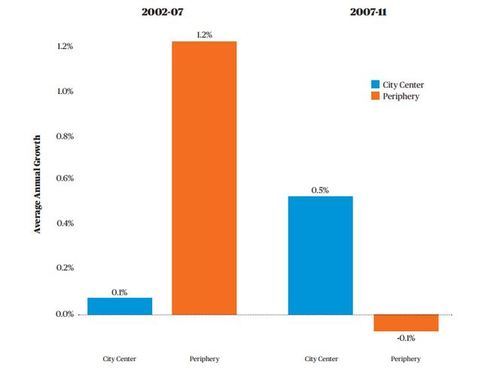
    We know that urban living has been seeing a renaissance over the last decade or so, but as recently as 2002 – 2007 (pre-Great Recession), the suburbs and peripheral areas were still seeing significantly higher job growth: 1.2% per year in the periphery versus 0.1% in the city center. The “city center” is defined as a 3 mile radius around the center of the city in this study.

    However since 2007 things have flipped:

    image

    Chart Source: City Observatory

    Why is this happening? Here’s a snippet from City Observatory:

    The strength of city centers appears to be driven by a combination of the growing attractiveness of urban living, and the relatively stronger performance of urban-centered industries (business and professional services, software) relative to decentralized industries (construction, manufacturing) in this economic cycle. While it remains to be seen whether these same patterns continue to hold as the recovery progresses, (the latest LEHD data on city center job growth are for calendar year 2011), there are structural forces that suggest the trend of center-led growth will continue.

    In some ways, it just makes intuitive sense. People started returning to cities and so the jobs followed (although there were also structural changes to the economy). 

    The big question, however, is whether this trend will continue? My bet is on yes. What do you think?

  • Does the world need a Global Parliament for Mayors?

    Earlier this month a team consisting of Benjamin Barber (who is author of If Mayors Ruled the World: Dysfunctional Nations, Rising Cities), Richard Florida (who is Director of the Martin Prosperity Institute here at the University of Toronto), and Don Tapscott (who is a leading authority on innovation) released a research report advocating for a global network of cities that they’re calling a “Global Parliament for Mayors.”

    Here’s a snippet from the press release:

    “Nation-states work together through multi-lateral agreements and global institutions in an effort to solve global problems. But states have limitations, and their cooperative efforts in our new era of interdependence and globalization are increasingly insufficient and even ineffective and outmoded,” say the three prominent researchers. A Global Parliament of Mayors represents a new type of governance network – one with enormous potential.

    “Our proposed parliament would operate as a global urban network with a vibrant online community that collaborates on key issues 365 days a year,” they say. “Multi-stakeholder governance has come of age and is now fully independent from control by any government, or governmental organizations like the UN.”

    And if you dive into their report, you’ll find the following 5 reasons for why they believe a Global Parliament for Mayors (GPM) makes sense:

    1. Global migration to cities. Most people live in cities, so it makes sense to concentrate problem-solving capabilities there.
    2. Urban predisposition for problem-solving. Cities are entrepreneurial, close to the people and richly connected to a wide variety of stakeholders. They have a history of cooperation and pragmatic problem-solving. 
    3. A need for experimentation with new governance models. Traditional models of state-based global governance have struggled to advance effective solutions to many global problems, so there is an urgent need to experiment with new models. The GPM is the most promising. 
    4. Digital networks. Online collaboration technology makes it possible to operate a largely virtual parliament that would not only be more cost-effective, but more transparent, inclusive and productive.
    5. Digital citizens. There is a large, educated and motivated population of digital citizens that could be tapped to improve urban governance.

    In principle, I agree with the direction. And I feel that way because of the two major shifts outlined above: More people are living in cities (a trend that all urbanists talk about ad nauseam) and digital networks are having a disruptive effect on the way we run companies and live our lives.

    I’ve talked before about how the internet is causing a decentralization of value creation (see Airbnb, YouTube, and so on) and so I think it only makes sense that our governance structures will inevitably go through a similar transformation.

    The governance models that we are living with today were put in place during a time when the world was a different place. At one point, nation-states were the de facto way to effectively organize ourselves on a global stage – probably because there wasn’t any other reasonable alternative.

    But today, we are connected and interdependent in entirely new ways. And so the opportunity in front of us is to create a governance structure that leverages the progress and innovation that’s happening in cities, everywhere.

    If cities are our most important economic unit, then mayors are arguably some of our most important leaders. So it behooves us to figure out how to give them the frameworks and forums to best do their job.