Daily insights for city builders, delivered every morning at 6 AM ET. I’m Brandon Donnelly — a Toronto-based real estate developer and founder of Globizen. I’ve been writing here since 2013.

Tag: debate

  • The childless city debate

    There’s an interesting debate happening online right now. A recent article by Derek Thompson (of the Atlantic) made the claim that today’s urban renaissance is great for young college graduates, but not so good for kids.

    Here’s a quick synopsis:

    Cities have effectively traded away their children, swapping capital for kids. College graduates descend into cities, inhale fast-casual meals, emit the fumes of overwork, get washed, and bounce to smaller cities or the suburbs by the time their kids are old enough to spell.

    Raising a family in the city [New York City] is just too hard. And the same could be said of pretty much every other dense and expensive urban area in the country.

    Michael Lewyn (of the Touro Law Center) responded to this argument with a post titled “the myth of the childless city.” While it is true that the US fertility rate is at an all-time low, the numbers — at least some of them — suggest that cities aren’t all that childless:

    Furthermore, not all urban cores are doing poorly in retaining children. Washington, D.C. had just under 32,000 children under 5 in 2010, and has over 45,000 today. In Philadelphia, the number of children under 5 increased from just over 101,000 in 2010 to 104,152 in 2018. Even in San Francisco (which, according to The Atlantic article, “has the lowest share of children of any of the largest 100 cities in the U.S.”), the number of under-5 children increased from 35,203 in 2010 to 39,722 in 2018.

    What I would be curious to see is a more granular look at where children are being raised within specific cities, and how that may, or may not, be changing over time. City boundaries can be broad.

  • Is this just how the game is played?

    As I am sure you have all heard, there’s a lot of debate in New York right now (city and state) about whether they should reject Amazon’s decision to open up a new headquarters in Queens.

    Urbanist Richard Florida has been arguing that one of the richest companies in the world shouldn’t be receiving taxpayer subsidies and that Amazon should do the right thing here. They should open up in New York but without any inducements.

    As a counter argument, Kenneth Jackson, professor of history at Columbia University, recently opined that this is actually business as usual. American cities have a long history of competing for companies because the benefits outweigh the costs over the longer term.

    Here is an excerpt from his op-ed in the New York Times:

    They are right about one thing. It is absurd that any city would agree to such a deal. But this is how the game is played. Paying companies to relocate has been the American way since 1936, when Mississippi established the nation’s first state-sponsored economic development plan. Under that plan, since followed by many other jurisdictions, cities and states agreed to pay companies to relocate by promising them new factories and low or nonexistent taxes. With those inducements, numerous businesses relocated in the decades after World War II, usually from the union-dominated Northeast and Midwest to the business-friendly South.

    Perhaps this would make a good debate topic for Kialo.

    Update: Amazon just cancelled its plans for a corporate HQ in NYC.

  • A platform for collaborative reasoning

    Perhaps for obvious reasons, I am interested in how important issues get debated. I have written before about how I think the community engagement process for new developments is largely broken. I think it naturally incents certain kinds of feedback.

    Recently, I’ve been playing around with an online platform called Kialo. They call themselves “an easy to use, yet powerful tool to engage in thoughtful discussion, understand different points of view, and help with collaborative decision-making.”

    The site works by trying to create a structured hierarchy of pros and cons around debatable questions. You participate by making claims (supported by links). Duplicate claims are neatly grouped together. And unthoughtful suggestions are moderated out.

    The UI looks like this (top level question shown):

    But you can then drill down into specific claim groupings (note the org chart looking graphic at the top):

    I’m not yet convinced that it creates the “collaborative reasoning system” that they are after (maybe because I haven’t used it enough). But I do really appreciate the structure and civility that they are trying to introduce to topics that are often vehemently debated.

    Are any of you regular users of Kialo?

  • The Scarborough Subway Extension is a mistake

    Last weekend over dinner, a friend of mine asked me what I thought about the Scarborough Subway Extension debate going on in Toronto right now. Costs are coming in higher than initially projected and the usual back and forth is taking place. Transit blogger Steve Munro has a good post on this called Spinning a Tale in Scarborough.

    I haven’t written much about the Scarborough Subway, but I do have a strong opinion. I believe it’s a mistake. I am not saying that we shouldn’t be building higher order transit in Scarborough – we absolutely should – but it does not need to be an expensive subway line. There are more sensible solutions.

    Here are a few things to consider:

    Light rail transit (LRT) does not equal streetcar. As an avid user of the King streetcar, I’ll be the first to admit that something needs to be done to address the city’s busiest streetcar routes. They are broken. But this is not what was being previously contemplated for Scarborough. True LRT – which Toronto does not yet have – is far more effective at moving people.

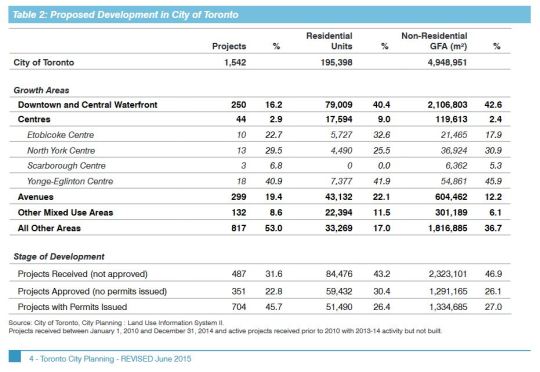
    Scarborough Centre is seeing almost no new residential and commercial development. In fact, the “Centres” in general are not seeing much development. The largest share is happening downtown, along the central waterfront, and along the “Avenues.” We shouldn’t ignore this when making our investment decisions. Transit and built form go hand in hand. 

    I also do not buy the argument that we are building this subway in anticipation of demand 50 or 100 years from now. We are not in a position to be proactive about our infrastructure. We are desperately playing catch up and there are already lots of high growth and high density areas in the city which today are completely underserved by higher order transit. 

    Finally, a new subway line with low ridership will mean higher operating cost subsidies to keep it afloat. And at the rate that Scarborough Centre is growing today, this would likely continue for many years into the future. Not only is this debate about spending money today, it is about spending money well in the future, month after month.

    So let’s be clear: the Scarborough Subway Extension debate is about politics. It is not about transportation planning.

  • Revisiting the Gardiner East debate

    Last week I argued that the eastern portion of the Gardiner Expressway (Jarvis Street over to the Don Valley Expressway) should be torn down and replaced by an enlarged Lake Shore Boulevard.

    To quickly summarize, here’s why I support removing the Gardiner East:

    • Now is the time to do it (before we develop the surrounding area and it becomes both more expensive and more difficult to do it).
    • It would go a long way to stitching our disconnected downtown back to the lake and realizing our ambitions for the revitalization of the waterfront.
    • Unlocking the full potential of our waterfront is hugely important.
    • In my opinion, the only way to build a big, well functioning city, is on the backbone of public transportation. And this—the tearing down of the Gardiner East—could represent that paradigm shift.
    • It is a portion of the Expressway that has relatively low traffic volumes.
    • It’s the cheapest option on the table.

    Somewhat surprisingly though, a lot of people disagreed with me. They told me that adding anything to our already long commutes would be simply unconscionable and that they would not support it, no matter how much it improved our waterfront.

    So in the spirit of avoiding confirmation bias (that is, only seeking out things that reinforce an already established belief), I thought I would share the following article: “Like It or Not, Most Urban Freeways Are Here to Stay.” It’s from Atlantic Cities and there are 3 key take-aways that I’d like to point out.

    First, I thought it was interesting that the interstate system in the United States was, from the onset, always conceived of as a solution to urban congestion. I always thought it was about connecting the country, but that, apparently, was a secondary goal.

    Second, cities all across North America are engaging in the same debate about what to do with their aging highways. Detroit is debating. New Orleans is debating. And so is Syracuse. Toronto is not alone. But we could be alone in taking the lead on this issue.

    Third, the author basically acknowledges that, while not ideal, we’re stuck for the time being with all these freeways and that the better solution is going to be a really tough slog:

    “This is not an easy assignment, seeing as how cars are purchases we make with our hearts, more than our heads. Logic won’t convince Americans to change their ways. What will? Maybe, over time, prohibitive fuel prices and withering tolls, and, most importantly, investment in useful and convenient public transit. Only when the carrot is irresistible, and the stick stings too sharply to bear, will the shift begin, and it will take years to play out.”

    And while I would agree that it’s not going to be easy, that’s par for the course with anything truly worthwhile. If it were easy, everyone would be doing it. But they’re not. And that’s why there are leaders and there are followers.

    People in Toronto like to talk about how our City sometimes lacks vision. Well, here’s our chance. I’m not worrying about what the commute is going to be like tomorrow, because I know there’s an even better solution for that problem. I’m worried about something even bigger. I’m worried about the kind of city we’re all going to leave behind to our children.