
Daily insights for city builders, delivered every morning at 6 AM ET. I’m Brandon Donnelly — a Toronto-based real estate developer and founder of Globizen. I’ve been writing here since 2013.

Tag: david mirvish

  • Westbank unveils #BloorAndBathurst before filing development application

    image

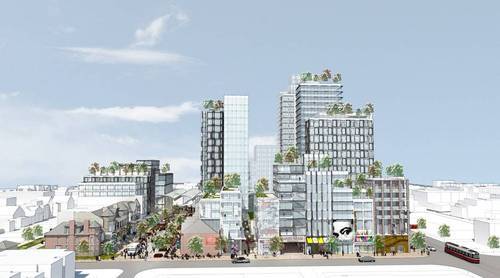
    Last night Westbank went public with their first design for the southwest corner of Bloor and Bathurst in Toronto (the Honest Ed’s site).

    There’s no name for the project yet and they haven’t even submitted a development application to the city, but I can tell you that there was a lot of excitement in the room last night. Over 500 people showed up at the Park Hyatt. And I think it only partially had to do with the fact that they were offering up free grilled cheese sandwiches.

    If you’d like to get a feel for last night’s open house, check out #BloorAndBathurst on Twitter. And if you’d like to learn more about the project, check out Alex Bozikovic’s piece in the Globe and Mail. It’s pretty exciting stuff. I’m not going to repeat all of the project details here because Alex has already eloquently done that. All of the developer’s information boards can also be found online, here.

    What I instead want to talk about is Westbank’s community engagement process. In Toronto, it’s quite rare to see this level of public consultation pre-application. And that’s because the city only requires it once a development application has been formally made.

    But I’m of the opinion that the status quo isn’t actually the optimal strategy for city building. In fact, I’ve argued before that public consultation is broken.

    And the reason I think that is because the typical process doesn’t allow for a critical mass of community feedback, both early on and throughout the process (think lean startup methodologies). In-person public meetings are too much friction for a lot people and getting feedback only once an application has been submitted means that a lot of work has already been done, which is the opposite of lean.

    In the case of #BloorAndBathurst, last night was part of an engagement process that began last year.

    Now, part of the reason that many developers don’t adopt this model is because of fear. There’s a belief that many communities just don’t like change, period. But is that really the public opinion? Or do we simply not have enough data and enough feedback loops built into the city building process?

    Time will tell how this approach works out for Westbank, but I have a pretty good feeling that they’ll do just fine.

    Image (Sketchup model + watercolor): Westbank via Globe and Mail
  • Mirvish + Gehry gets nod from City Council

    image

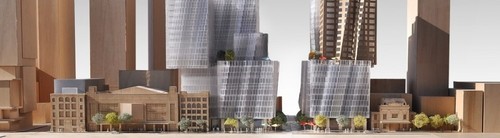
    Last week Toronto City Council voted to support planning staff’s recommendation to approve the landmark Mirvish + Gehry development on King Street West in the Theatre District. 

    The revised design now includes 2 towers (as opposed to 3) at 82 and 92 storeys tall. As a result of this change, 3 of the 5 existing buildings on the site will now be retained. I think this represents a good balance between (historic) preservation and progress.

    If you’re interested in a bit more of the backstory, Toronto Life published an article today called David Mirvish on the Edge. It talks about his father (Ed Mirvish), his upbringing, and how he got into the real estate development business.

    I thought you all might enjoy it.

    Image: Projectcore

  • Mirvish+Gehry and the story of 4 heritage buildings

    I am a real estate developer and I believe in progress. But I also fundamentally believe in balancing progress and preservation. I’ve said this before.

    This morning, Alex Bozikovic of the Globe and Mail, published a piece on the epic Mirvish + Gehry proposal for Toronto’s Entertainment District. It’s called, “Frank Gehry and David Mirvish’s tall order in Toronto.

    Now, I’ve said before that I like this project. I don’t mind the height and I don’t buy the argument that there aren’t enough public spaces in the area. There’s David Pecaut Square directly to the south that could use a few more warm bodies in it.

    But as I also said before, I think the key concern here is one of heritage. There are 4 heritage designated buildings on the site dating back to as early as 1901. Here’s where they sit:

    image

    The Anderson Building (1915) is particularly unique. Here’s a larger photo (via blogTO):

    image

    So while I’m excited by the prospect of a real Gehry project in Toronto, I think we need to figure out a way to find a balance. Preserve the facades, build on top, or relocate them. Do something besides wipe the slate clean.

    As Bozikovic rightly points out in his article, “Toronto has a sophisticated culture of working with heritage buildings.” There are lots of great examples of how we managed to move forward as a city, without erasing our past.

    And in many ways, I see this ability to work with and build upon heritage buildings as an emerging Toronto vernacular. I mean, what could be more appropriate for the most diverse city on the planet than an architectural style—of our own—that blends and layers history with disparate design ideologies.

    I sense an opportunity.

    We could have Gehry’s white sinuous curves drape over the heritage buildings. Make them become a literal unveiling of Toronto’s past and a metaphor for the sophisticated way in which we build upon legacy.

    It’s too easy to just demolish everything. We’re better than that.

  • Mirvish + Gehry

    I was reading Novae Res Urbis this morning and they had a piece on the 3 tower Mirvish + Gehry proposal in Toronto’s Entertainment District. It was talking about David Mirvish’s “sales pitch” to the Empire Club of Canada this week, an attempt to help overcome the criticism around the design, height and overall density of the project. The article ended by saying that the developer will be appealing to the OMB this January.

    I know that I’m probably biased in this matter, but I fail to understand the concern around height and density – particularly since the site is 2 blocks from a subway station. Why are we – citizens and policy makers – so obsessed with building height? Good architecture and urban design involves a lot more than the number of floors. Can we not have more sophisticated conversations about built form rather than fixating ourselves on building height?

    Secondly, whenever a building gets proposed in Toronto that attempts to, literally, step outside of the box it gets pegged as controversial. Take, for example, the Royal Ontario Museum by Daniel Libeskind. When people used to ask me what I thought of the crystal addition, I used to say that I was a fan simply because it was pissing off so many people. Love it or hate it, it’s architecture. The same can’t be said for a lot of the other stuff going up in this city. Why doesn’t mediocrity invoke the same response? It should.

    So my issue is that we seem to be far more comfortable accepting banality than we are with accepting bold new changes like the Mirvish + Gehry proposal. And frankly, if we could actually pull off three 80+ storey towers, it would be down right impressive in this market. How many cities in the world have a real estate market robust enough to support this scale of development?

    But this is not a post of unconditional support. I do have concerns.

    I’m concerned that 4 heritage designated properties will need to be destroyed in order for this project to move forward. This makes me wonder: What’s the point of a designation if the building can still be demolished? I’m actually surprised that this topic hasn’t been getting its fair share of attention. Again, we’ve been more interested in talking about building height.

    Further west along King Street, I have similar concerns with a development proposal that would demolish “restaurant row.” This a spectacularly successful – albeit touristy – restaurant strip and I would hate to see it go. It’s difficult to create this kind of fine grain retail experience from scratch. 

    Now don’t get me wrong, I believe in development. I am a developer, after all. But I don’t believe we should be so quick to erase our history.